


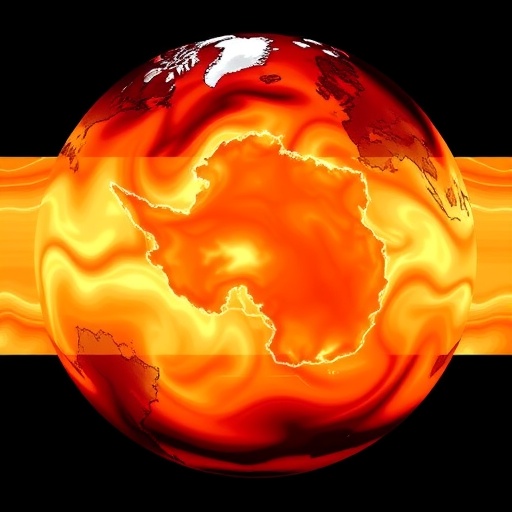
In a groundbreaking study that promises to reshape our understanding of Antarctic climate dynamics, researchers have uncovered compelling evidence for the poleward migration of the warm Circumpolar Deep Water (CDW) towards the Antarctic continent. This phenomenon, meticulously documented through decades of oceanographic data and advanced climate modeling, reveals profound implications for global sea levels, ice sheet stability, and the health of polar ecosystems. The study highlights a pressing concern within the scientific community: how shifts in ocean heat distributions are accelerating the melting of one of Earth’s most vital and vulnerable regions.
The Circumpolar Deep Water plays a critical role in the Antarctic’s marine environment. Originating from the deep ocean, this warm, salty water mass underlies the colder surface waters, and its interactions with the continental shelf are pivotal in regulating ice melt and ocean circulation. The research sheds new light on how subtle changes in temperature and salinity patterns are facilitating a poleward shift of this water mass, closer to the Antarctic coastline than ever recorded in recent history. Such a migration enhances ocean-driven melting of ice shelves from below, a process previously underestimated in current climate models.
Using a combination of satellite observations, autonomous underwater vehicles, and ship-based measurements, the research team was able to compile a detailed picture of how the CDW’s distribution has evolved over the past three decades. What emerges is a clear trend: the warm and saline waters are infiltrating closer to the Antarctic continental shelf break, entering regions that were once dominated exclusively by colder, fresher surface waters. This migration is not isolated to a particular sector; rather, it is a circumpolar phenomenon impacting multiple sectors of the Southern Ocean.
The study’s climate models, refined with high-resolution data inputs, reveal that the poleward shift of the CDW is driven by a combination of enhanced westerly winds and alterations in the Antarctic Circumpolar Current dynamics. These drivers are pushing the warm water masses towards the continent, creating more frequent intrusions beneath ice shelves. The dynamics of the Southern Ocean are complex, and the paper emphasizes how changes in atmospheric circulation patterns related to global warming are the primary contributors to this shift.
One of the most alarming consequences outlined in the research is the accelerated melting of the Antarctic ice shelves, especially along the Amundsen Sea sector and the western Antarctic Peninsula. The intrusion of this warmer water beneath floating ice shelves destabilizes them, which in turn leads to an increase in ice discharge into the ocean. This process contributes to global sea level rise but also jeopardizes the stability of the massive West Antarctic Ice Sheet, which holds enough ice to dramatically alter coastlines worldwide if destabilized.
The warming of the CDW also impacts the biogeochemical cycles in the Southern Ocean. By bringing warmer, nutrient-rich waters towards the continental margins, the poleward migration influences primary productivity and the overall marine ecosystem. The study discusses potential downstream effects on krill populations, a key species in Antarctic food webs, potentially leading to cascading impacts on fish, penguins, seals, and whales.
Beyond the physical and ecological implications, the research highlights critical feedback loops that could exacerbate climate change effects. The melting ice alters ocean salinity and stratification, which can, in turn, influence the formation and circulation of other water masses. These changes hold the potential to disrupt global thermohaline circulation, with repercussions felt far beyond the polar regions, affecting weather patterns and climates in distant parts of the world.
Importantly, the study underscores the limitations of current climate models that have yet to fully incorporate the nuances of CDW dynamics and their interactions with Antarctic ice shelves. The authors call for enhanced observational networks, including autonomous sensing technologies and expanded ship-based campaigns, to better capture these processes with finer spatial and temporal resolution.
The implications of this research extend to policymakers and coastal communities worldwide. As the Antarctic ice shelves continue to melt more rapidly than previously anticipated, projections of sea level rise must be revisited with this new understanding of ocean heat transport. Coastal cities, low-lying nations, and island states face increasing risks that necessitate urgent adaptation and mitigation efforts grounded in robust scientific forecasting.
While the paper emphasizes the inevitability of some ongoing warming, it also points to possible mitigations. Reducing global greenhouse gas emissions could help slow the acceleration of westerly winds and stabilize key elements of the Southern Ocean circulation. However, the persistence of warming in the deep ocean layers means that some changes are likely locked in for decades, reinforcing the urgency of monitoring and modeling efforts.
This research epitomizes the intricate connections between oceanography, climatology, and cryospheric science. By unraveling the complex mechanisms behind the poleward migration of Circumpolar Deep Water, scientists have not only advanced fundamental knowledge but also provided a critical warning about the trajectory of Antarctic Ice Sheet stability and its global consequences.
The multidisciplinary approach taken by Lanham and colleagues integrates physical oceanography with climate science and ecology, offering a comprehensive narrative of how subtle changes in ocean dynamics can have outsized impacts on global systems. The study stands as a clarion call to the scientific community to deepen our understanding of Southern Ocean processes and their far-reaching effects.
As we continue to grapple with climate change, these findings highlight the necessity of international cooperation in monitoring and responding to Antarctic changes. The remote and harsh environment of the Southern Ocean makes research challenging but no less vital for predicting the future of our planet’s climate and sea level.
In summary, the poleward migration of warm Circumpolar Deep Water toward Antarctica represents a potent mechanism driving ice shelf melt, ecosystem shifts, and potential global sea level rise. This study provides new evidence that demands integrated strategies combining improved observations, refined models, and proactive climate action to mitigate the looming risks posed by these emerging oceanographic trends.
The insights gained here fundamentally challenge prior assumptions about the stability of Antarctic coastal waters and underscore the Southern Ocean’s role as a sentinel of climate change impacts. The trajectory of CDW migration offers a stark reminder that changes beneath the ocean surface can trigger cascading effects felt across the globe, reinforcing the urgency of understanding and safeguarding Earth’s polar frontiers.
Cite Scienmag News
Violet Maxwell. (April 28, 2026). Warm Circumpolar Deep Water Migrates Toward Antarctica. Scienmag. https://scienmag.com/warm-circumpolar-deep-water-migrates-toward-antarctica/
Violet Maxwell. "Warm Circumpolar Deep Water Migrates Toward Antarctica." Scienmag, 28 April 2026, https://scienmag.com/warm-circumpolar-deep-water-migrates-toward-antarctica/. Accessed 4 September 2026.
Violet Maxwell. "Warm Circumpolar Deep Water Migrates Toward Antarctica." Scienmag. April 28, 2026. https://scienmag.com/warm-circumpolar-deep-water-migrates-toward-antarctica/


