


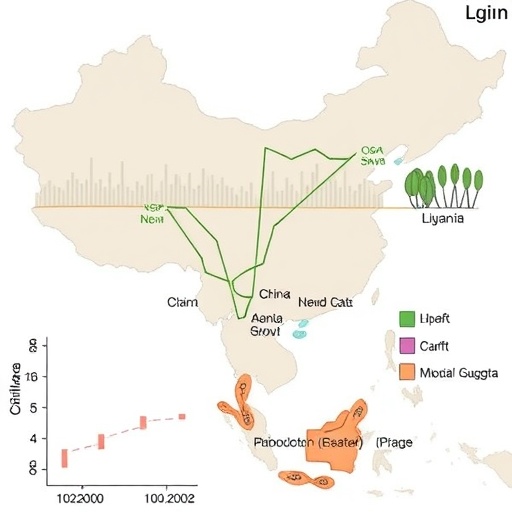
In a groundbreaking study conducted by researchers at the South China Botanical Garden, Chinese Academy of Sciences, the intricate evolutionary history and population genetics of Burmannia nepalensis—a fully mycoheterotrophic herb endemic to subtropical China—have been elucidated through advanced genomic and phylogeographic methods. This species, residing exclusively in the evergreen broad-leaved forests of subtropical regions, relies entirely on fungal symbionts for its carbon supply, rendering its survival and genetic continuity highly sensitive to ecological disturbances. By leveraging plastome sequencing alongside nuclear microsatellite analyses across 20 distinct populations, the research provides unprecedented insight into how geographic isolation and Quaternary climatic fluctuations have sculpted the genetic landscape of this enigmatic plant.
The study’s comprehensive exploration of plastid genomes revealed strikingly low genetic diversity within populations contrasting with pronounced genetic differentiation among them. Such a pattern underscores the species’ limited gene flow, a consequence of restrictive dispersal abilities compounded by topographical barriers such as the mountainous terrain of subtropical China. The researchers attribute this strong population structure largely to historical geographic isolation—a factor that has maintained distinct genetic identities among populations over extensive evolutionary timescales. These findings highlight the delicate balance mycoheterotrophs maintain with their environment and symbiotic fungi, emphasizing that even subtle disruptions can have profound genetic repercussions.
Spatial distribution modeling employed in this work sheds new light on the biogeographic history of Burmannia nepalensis during the Last Glacial Maximum (LGM). Contrary to typical models of postglacial southward retreat and subsequent northward expansion, the data suggest that the species persisted in situ within multiple glacial refugia. Notably, stable, climatically suitable habitats existed in the Nanling Mountains, Wuyi Mountains, and southwestern karst regions throughout the LGM. This in situ persistence indicates that these mountain ranges acted as critical reservoirs for biodiversity during periods of climatic adversity, ensuring the species’ survival and genetic stability.
Statistical analyses further unraveled the genetic architecture shaping Burmannia populations. Approximately 43% of nuclear genetic variation and a remarkable 72.11% of plastid genetic variation were found to be partitioned among populations. Such high inter-population differentiation suggests strong barriers to gene flow, likely exacerbated by the fragmented nature of suitable habitats. Mantel tests and Multiple Matrix Regression with Randomization (MMRR) analyses substantiated significant isolation-by-distance and isolation-by-instability effects, implying that both geographic separation and climatic instability have been instrumental in structuring genetic diversity, whereas contemporary environmental heterogeneity plays a minimal role in driving genetic divergence.
Demographic reconstructions provided further critical insights into the population history. The data depict an initial population expansion following the LGM, consistent with increased habitat availability and improved climatic conditions. However, this expansion was followed by a pronounced population decline approximately 3,000 years ago. The study correlates this bottleneck with escalating anthropogenic pressures, including forest loss and habitat fragmentation, rather than recent climate change. This finding importantly frames human activity as a pivotal agent of genetic erosion and population vulnerability in mycoheterotrophic plants.
By integrating plastome data with nuclear microsatellite markers, the research underscores the vulnerability of mycoheterotrophic herbs dependent on intact forest ecosystems and stable fungal associations. Burmannia nepalensis exemplifies the precarious evolutionary niche occupied by mycoheterotrophs, whose survival hinges on undisturbed habitats that support both plant and fungal constituents. Consequently, conserving the multiple identified mountain refugia becomes an imperative to safeguard the species’ genetic integrity and evolutionary resilience in the face of ongoing environmental change.
The findings presented amplify the narrative that subtropical evergreen broad-leaved forests function as biodiversity hotspots harboring unique lineages shaped by climatic history and geographic complexity. Specifically, the discovery of persistent northern refugia contradicts conventional southward migration paradigms, augmenting our understanding of plant responses to Quaternary glacial oscillations in Asia. These refugia not only provided sanctuary during glaciations but also serve to maintain high levels of genetic differentiation that may be essential for future adaptive potential.
This integrative approach combining phylogeography, genetic structure analyses, and demographic modeling serves as a vital template for studying other mycoheterotrophic species experiencing similar ecological constraints. It calls for a paradigm shift in conservation strategies towards preserving landscape connectivity and minimizing habitat degradation to curb genetic bottlenecks. Moreover, it accentuates the need to incorporate fungal symbiont dynamics when evaluating the evolutionary trajectories and conservation needs of mycoheterotrophs.
The research was underpinned by generous funding from the National Natural Science Foundation of China, the Guangdong Provincial Special Fund for Natural Resource Affairs on Ecology and Forestry Construction, and the Guangxi Key Laboratory of Plant Conservation and Restoration Ecology in Karst Terrain. The comprehensive analyses utilized state-of-the-art plastome sequencing technologies and microsatellite markers, coupled with sophisticated statistical models to unravel the historical and contemporary forces shaping the genetic landscape of Burmannia nepalensis.
Published in the esteemed journal Biological Diversity, this study not only offers profound insights into the ecology and evolution of a rare mycoheterotrophic herb but also highlights the broader implications for subtropical forest biodiversity conservation amid escalating anthropogenic impacts. It serves as a clarion call for integrating molecular phylogeographic evidence with ecological and climatic data to formulate holistic conservation frameworks that protect cryptic and specialized biological entities.
In conclusion, the research team led by Dr. Miaomiao Shi and Professors Tieyao Tu and Dianxiang Zhang reveals that the phylogeographic patterns of Burmannia nepalensis are primarily shaped by a combination of historical climatic oscillations, geographic isolation, and recent human-mediated disturbances. The revelations from this study highlight not only the complexity of evolutionary processes in subtropical forests but also the urgency of conserving ecological refugia and continuous forest habitats that sustain these vulnerable plant-fungal interactions.
News Publication Date: April 28, 2026
Web References: https://onlinelibrary.wiley.com/doi/10.1002/bod2.70021
References: Shi, Miaomiao, Tong Zeng, Zhongtao Zhao, et al. 2026. “Historical Climatic Fluctuations and Geographic Isolation Shaped the Phylogeographic Patterns of a Mycoheterotrophic Species in Subtropical China,” Biological Diversity: 3(1), 33–46.
Cite Scienmag News
Juliet Wilcox. (April 28, 2026). How Historical Climate and Geography Influenced the Phylogeography of a Rare Mycoheterotrophic Herb in Subtropical China. Scienmag. https://scienmag.com/how-historical-climate-and-geography-influenced-the-phylogeography-of-a-rare-mycoheterotrophic-herb-in-subtropical-china/
Juliet Wilcox. "How Historical Climate and Geography Influenced the Phylogeography of a Rare Mycoheterotrophic Herb in Subtropical China." Scienmag, 28 April 2026, https://scienmag.com/how-historical-climate-and-geography-influenced-the-phylogeography-of-a-rare-mycoheterotrophic-herb-in-subtropical-china/. Accessed 6 September 2026.
Juliet Wilcox. "How Historical Climate and Geography Influenced the Phylogeography of a Rare Mycoheterotrophic Herb in Subtropical China." Scienmag. April 28, 2026. https://scienmag.com/how-historical-climate-and-geography-influenced-the-phylogeography-of-a-rare-mycoheterotrophic-herb-in-subtropical-china/


