


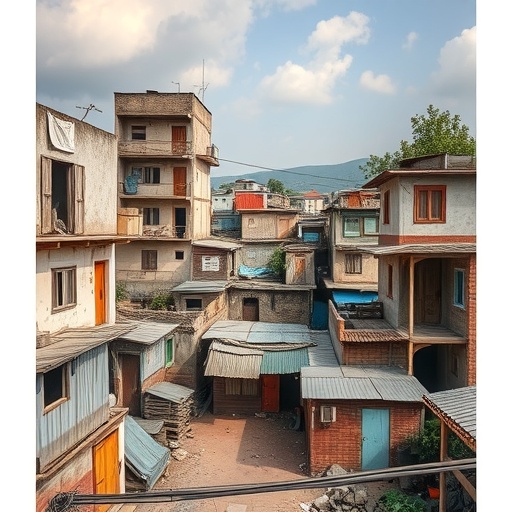
Amid escalating climate crises and burgeoning urban populations, the phenomenon of losses and damages in informal settlements has emerged as a critical concern with far-reaching implications. Recent scholarly research delves deeply into the nuanced dynamics of vulnerability shaping these losses and damages, shedding light on the intricate social, political, and economic processes that underlie this emerging urban challenge. By reconceptualizing vulnerability as a core lens, this scholarship pushes beyond conventional hazard-centric views, revealing how historical and contemporary power structures perpetuate cyclical harm in the world’s most precarious urban communities.
At the heart of this new understanding is an adapted Pressure and Release (PAR) model, which redefines vulnerability not as a static condition but as a progression shaped by intertwined root causes, dynamic pressures, and unsafe conditions. This model elucidates how losses and damages in informal settlements like Kalibaru in Indonesia, Kibera in Nairobi, Kenya, and Jardim Pantanal in São Paulo, Brazil, are symptomatic of deeper systemic inequities. These vulnerabilities have historical roots—colonial land dispossession remains embedded in urban governance practices, continually reinforced by neoliberal policies that privilege certain populations while marginalizing others.
An exploration of dynamic pressures reveals the multifaceted ways in which social and political exclusion manifest in contemporary informal settlements. Underdevelopment coupled with privatization of basic services and tenuous land tenure collectively produce unsafe living environments. These conditions perpetuate poverty, generate informal labor economies, and result in inadequate housing and infrastructure. For example, the illegal status of Nairobi’s Kibera explicitly shapes governance responses, effectively branding parts of the settlement as risk-prone and justifying neglect. In São Paulo, fragmented governmental responsibility leads to infrastructure voids, while in Jakarta, colonial-era urban infrastructures create uneven access to fundamental services.
The complex interplay between vulnerability and the occurrence of losses and damages is further highlighted by the study’s detailed examination of how climate-related hazards amplify pre-existing inequalities. Unsafe conditions, such as structurally deficient housing, financial instability, and poor health infrastructure, collide with flood events, droughts, and other climate-exacerbated hazards to produce cascading, often cumulative impacts. Notably, the financial strain from recurrent damages forces residents into erosive coping strategies—diverting limited resources to immediate recovery needs while depleting their capacity to handle future shocks, thereby entering a downward spiral of worsening vulnerability and declining well-being.
A pivotal addition to this vortex of risk is the role of climate change as a dynamic pressure, intensifying the frequency and severity of hazards. Droughts and erratic rainfall in Kibera, for instance, have worsened reliance on costly informal water vendors. Meanwhile, extreme rainfall in Jardim Pantanal exacerbates chronic flooding, with infrastructural inadequacies providing little defense. These observations underscore the necessity of climate-focused analyses within urban disaster risk paradigms, while emphasizing that the mechanisms producing vulnerability predate and transcend climate change, entrenched instead within longstanding urban inequities.
Crucially, this body of research challenges simplistic attributions commonly made within international frameworks, such as the UN Framework Convention on Climate Change (UNFCCC), which tend to prioritize hazardous events over the social processes that generate vulnerability. It lays bare a fundamental contradiction: governments, often the architects of vulnerabilities through neglect or exclusionary policies, simultaneously act as arbiters and reparative agents in global Loss and Damage negotiations. Such dual roles complicate accountability and the formulation of effective, just interventions that truly address the roots of losses and damages.
Assessing the causes behind losses and damages proves an intricate endeavor. In some cases, like water access in Kibera, high costs arise from informal privatization rather than environmental scarcity alone. This complicates efforts to ascribe losses solely to climate hazards, as economic inequalities, infrastructure deficits, and governance voids co-produce the insecurity experienced by residents. Consequently, climate-centric narratives risk obscuring these systemic contributors, depoliticizing challenges, and inadvertently endorsing solutions that overlook deeper structural problems.
This refined understanding has important implications for policy and intervention design. Present loss and damage responses predominantly focus on alleviating immediate impacts, emphasizing restoration of prior living standards rather than addressing broader vulnerability factors. For residents of informal settlements already living on the margins, such approaches fail to break the reinforcing cycles of precarity. Moreover, interventions themselves may inflict further harm, as seen in Kalibaru where a sea wall intended to mitigate climate risks caused displacement and socioeconomic disruption. Similarly, disaster contexts have been exploited to justify evictions, reinvoking exclusionary practices long discredited by urbanists and social advocates.
To truly transform the trajectory of losses and damages in these informal urban spaces, solutions must transcend surface-level remedies and engage with the root causes embedded within political and institutional systems. This necessitates a redistribution of power, recognizing and bolstering the agency of marginalized communities through mechanisms such as inclusive governance, enhanced tenure security, expanded basic service access, and legal protections for informal economic activities. Such paradigm shifts echo frameworks proposed in critical disaster and urban scholarship, including versions of the PAR model that envision a ‘progression of safety’ rising from the dismantling of vulnerability layers.
Implementing such transformative approaches confronts entrenched barriers, not least due to the control most governments exert over urban land and populations within informal settlements. The political economy of urban informality reveals that interventions must challenge prevailing governance modalities to dismantle systemic oppression and to foster resilience that is socially just. Institutional reforms and global climate policies alike must reckon with these dynamics, fostering multi-actor decision-making arenas where affected communities have meaningful influence to co-create solutions rather than remain passive recipients of aid.
The urgency of addressing losses and damages in growing urban informal settlements is underscored by demographic and climatic trends: both the global urban population and the frequency of intense climate hazards are rising rapidly. This dual pressure amplifies the risks and human costs borne disproportionately by marginalized urban residents. As losses and damages increasingly urbanize, structural inequities that predate climate change—rooted in colonial, neoliberal, and exclusionary governance legacies—must be squarely confronted.
Failing to do so risks perpetuating cycles of harm and widening inequalities. Only by centering vulnerability, and recognizing its socio-political production, can loss and damage frameworks evolve sufficiently to break these cycles and envision just, effective futures. The integration of critical disaster risk scholarship with contemporary urban studies offers a promising pathway to reconceptualize both the problem and its solutions, moving beyond technocratic narratives to those grounded in justice and systemic transformation.
Moreover, this work challenges the dominant state-centric paradigm of current Loss and Damage frameworks under the UNFCCC and related mechanisms. Given that governments often bear responsibility for co-producing vulnerabilities, relying solely on them as reparative agents is insufficient. Instead, a fundamental reconceptualization is necessary—one that decentralizes authority, redistributes power, and elevates marginalized voices. Only through such systemic change can interventions move from reactive management toward proactive prevention and empowerment.
In conclusion, the nuanced evidence from Kalibaru, Kibera, and Jardim Pantanal vividly illustrates that climate-related losses and damages in urban informal settlements are inseparable from enduring structural oppressions and governance failures. Addressing these challenges demands a holistic, vulnerability-centered approach, one that tackles root causes rather than symptoms. As such, loss and damage discourse must expand beyond its current scope, embracing transformative policies that confront historic injustices and forge pathways to resilient, inclusive urban futures for billions living on the edge of climate catastrophe.
Cite Scienmag News
Courtney Benton. (April 23, 2026). Vulnerability Insights on Loss in Urban Informal Settlements. Scienmag. https://scienmag.com/vulnerability-insights-on-loss-in-urban-informal-settlements/
Courtney Benton. "Vulnerability Insights on Loss in Urban Informal Settlements." Scienmag, 23 April 2026, https://scienmag.com/vulnerability-insights-on-loss-in-urban-informal-settlements/. Accessed 4 September 2026.
Courtney Benton. "Vulnerability Insights on Loss in Urban Informal Settlements." Scienmag. April 23, 2026. https://scienmag.com/vulnerability-insights-on-loss-in-urban-informal-settlements/


