


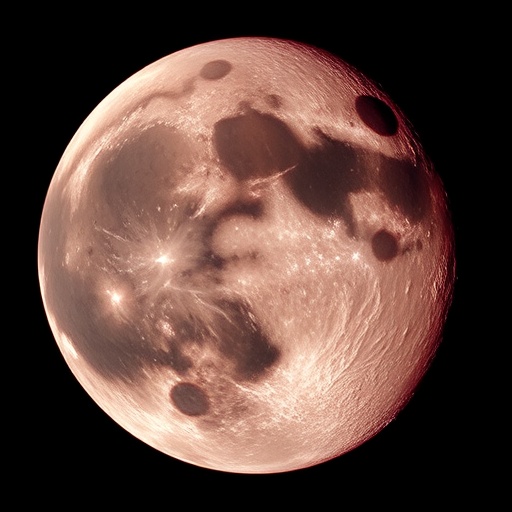
In a groundbreaking study that reshapes our understanding of lunar geology, researchers have unveiled compelling evidence of the reactive formation of magnesiowüstite at the Moon’s core-mantle boundary. This transformative insight offers a nuanced perspective on the Moon’s internal dynamics and its elusive geological processes, providing an unprecedented window into the materials and reactions occurring beneath its surface. Published in Nature Communications, this study revolutionizes the paradigms surrounding the Moon’s inner structure and sheds light on the complex interplay of chemical reactions within extraterrestrial planetary interiors.
The lunar interior, long considered relatively simple due to the Moon’s smaller size and reduced geological activity, is now emerging as a site of fascinating chemical complexity. The research team employed state-of-the-art experimental petrology techniques combined with high-pressure and high-temperature simulations, replicating the extreme conditions at the Moon’s core-mantle boundary. These trials enabled the identification of magnesiowüstite formation — an iron-magnesium oxide previously thought to be prevalent mostly within Earth’s deep mantle, now confirmed to exist within the lunar subsurface environment.
Central to this discovery is the reactive mechanism underpinning the genesis of magnesiowüstite. Unlike simple crystallization or phase transitions, the formation process appears to involve redox reactions between the iron-rich core components and the overlying silicate mantle materials. This reactive interface suggests a dynamic chemical environment where materials from the lunar core and mantle interact actively, challenging the long-held notion of a chemically inert boundary layer.
The implications extend beyond mere mineralogy. Magnesiowüstite, known for its distinct electronic and magnetic properties, could significantly influence the Moon’s geophysical characteristics, including its seismic discontinuities and magnetic anomalies. Detecting these properties enhances the potential for remote sensing techniques to map the core-mantle boundary with greater precision, refining lunar interior models that have traditionally been hindered by sparse subsurface data.
Furthermore, this discovery bridges gaps in comparative planetology, illuminating how terrestrial planets and their satellites evolve internally. The reactive formation of magnesiowüstite on the Moon mirrors processes theorized to occur within Earth’s lower mantle, establishing a shared geochemical pathway. Such insights foster a deeper understanding of planetary differentiation — the process through which planetary bodies develop layers with distinct compositions and physical states.
The methodology employed in this research is equally remarkable. By synthesizing magnesiowüstite under carefully controlled laboratory conditions that mimic lunar pressures exceeding tens of gigapascals and temperatures of several thousand kelvin, the scientists could monitor phase transformations in real-time. Advanced spectroscopy and X-ray diffraction techniques provided critical evidence for the presence and stability of magnesiowüstite, confirming that these conditions are conducive to its in-situ formation rather than mere contamination or experimental artifact.
Importantly, the reactive formation signals that the lunar core and mantle are not isolated domains but interact chemically in a manner previously unappreciated. This interaction zone might serve as a reservoir of unique mineral phases that influence the Moon’s thermal evolution. The kinetics of the reactions encountered may also offer clues about core crystallization rates and mantle convection patterns, crucial for modeling the Moon’s thermal and magnetic history.
This revelation challenges pre-existing models that envisioned the lunar core-mantle boundary largely as a static, compositional divide. Instead, the boundary emerges as a chemically active frontier, where significant mass exchange and mineral reformation occur. Understanding this boundary better also enhances interpretations of seismic data from recent lunar missions, potentially refining conclusions about the Moon’s internal layers and their thicknesses.
Moreover, this research carries implications for lunar exploration strategies. Future missions designed to probe the Moon’s subsurface layers could target signatures of magnesiowüstite as an indicator of boundary conditions and core composition. Knowledge of the precise mineral phases at the core-mantle interface can optimize drilling operations and sampling protocols, aiming to retrieve pristine, representative materials that decode the Moon’s geochemical history.
From a broader perspective, the study’s findings illuminate the significance of oxygen fugacity — a measure of oxygen’s chemical availability — in governing lunar interior reactions. Variations in oxygen fugacity affect iron and magnesium partitioning between metallic and silicate phases, explaining the prevalence of magnesiowüstite in reactive zones. These parameters help decode the redox gradient within the Moon, which is vital for understanding the distribution of elements and volatiles, including those with implications for lunar habitability and resource utilization.
Additionally, this work encourages a reexamination of lunar analog materials and meteorites. Samples from the Apollo missions and lunar meteorite collections may harbor signals of magnesiowüstite formation, previously unrecognized due to assumptions about lunar mineralogy. Reanalysis of these samples with the new reactive formation model may yield fresh insights, rekindling lunar science research with reinterpretation of old data.
In essence, the discovery of reactive magnesiowüstite formation at the lunar core-mantle boundary is a landmark contribution to planetary science, offering a paradigm shift in our understanding of lunar interior dynamics. It highlights the intricate and ongoing chemical processes shaping the Moon, transforming it from a static celestial relic into a dynamically evolving planetary body governed by complex geochemical phenomena.
The study’s blend of experimental rigor, theoretical modeling, and planetary contextualization offers a blueprint for future investigations into planetary interiors, extending from the Moon to other terrestrial bodies like Mars and Mercury. As humanity’s exploration ambitions turn increasingly celestial, the detailed knowledge of planetary interiors will underpin not only scientific knowledge but also practical endeavors such as mining and habitat construction.
Ultimately, this research elevates lunar science into a new era, where the Moon is not just an object of passive observation but a vibrant world with a chemical heartbeat resonating deep beneath its surface. The reactive formation of magnesiowüstite becomes emblematic of this newfound dynamism, inviting scientists and explorers to probe further into the mysteries locked within our nearest celestial neighbor.
Cite Scienmag News
Violet Maxwell. (April 23, 2026). Magnesiowüstite Forms Reactively at Moon’s Core Boundary. Scienmag. https://scienmag.com/magnesiowustite-forms-reactively-at-moons-core-boundary/
Violet Maxwell. "Magnesiowüstite Forms Reactively at Moon’s Core Boundary." Scienmag, 23 April 2026, https://scienmag.com/magnesiowustite-forms-reactively-at-moons-core-boundary/. Accessed 5 September 2026.
Violet Maxwell. "Magnesiowüstite Forms Reactively at Moon’s Core Boundary." Scienmag. April 23, 2026. https://scienmag.com/magnesiowustite-forms-reactively-at-moons-core-boundary/


