


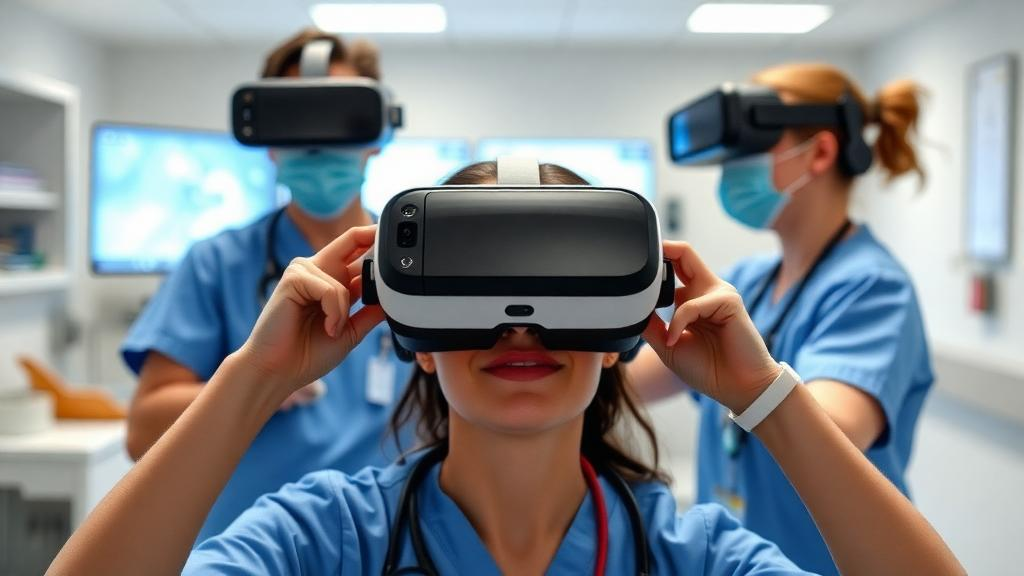
Virtual simulation has moved from the margins of nursing education to its very center, and a sweeping new analysis has finally mapped just how far and fast that shift has gone. In a scoping review published in BMC Nursing, researchers led by Hannan Dong and Dongying Li of Nanchang University combed through nearly six thousand records to identify 198 primary studies on virtual simulation in nursing education published between January 2019 and December 2025. The picture that emerges is one of explosive growth, technological diversification, and a field whose evidence base is expanding faster than its methodological rigor can keep pace.
The numbers tell a striking story. Only two relevant studies were published in 2019, but by 2025 that figure had climbed to 82, with almost two-thirds of all included studies, 64.6 percent, appearing in just the last two years of the review window. This surge tracks closely with the COVID-19 pandemic, which forced nursing schools worldwide to replace in-person clinical placements and simulation laboratories with digital alternatives almost overnight. What began as an emergency workaround, the review suggests, has hardened into a mainstream pedagogical approach that continues to accelerate even as campuses have fully reopened.
Geographically, the research boom is heavily concentrated. South Korea led the field, producing 21.2 percent of the included studies, followed by the United States at 18.7 percent, with China and Taiwan together contributing 11.1 percent. That East Asian dominance is one of the review’s most notable findings, and it cuts both ways: it reflects serious national investment in simulation-based training in the region, but it also raises questions about how well findings from these settings generalize to nursing programs in other countries, health systems, and cultural contexts. The authors flag this geographic concentration as a key constraint on the evidence base.
Technologically, the field is dominated by immersive experiences. Interactive immersive virtual reality, typically delivered through head-mounted displays that let students manipulate virtual instruments and interact with virtual patients, and 360-degree or 180-degree video-based virtual reality together accounted for 63.1 percent of the included studies. Screen-based virtual simulation, which runs on ordinary computers and requires no special hardware, made up 23.7 percent, while augmented reality, which overlays digital information onto the real world, accounted for a comparatively modest 4.0 percent. The distribution suggests that despite the cost and logistical burden of headsets, educators and researchers have gravitated toward the most immersive formats available, perhaps betting that presence and interactivity translate into deeper learning.
The methodological profile of the literature is equally revealing. Quasi-experimental designs were the most common study type at 27.8 percent, followed closely by randomized controlled trials at 22.7 percent. That nearly a quarter of the field consists of randomized trials is a point in its favor, since such designs are the gold standard for establishing causal effects. Yet the review also uncovered persistent weaknesses: small sample sizes, a scarcity of longitudinal follow-up that would show whether learning gains persist beyond the immediate post-test, and inconsistent outcome measures that make it difficult to compare results across studies or pool them in meta-analyses.
What are nursing educators actually measuring when they deploy these technologies? Three outcomes dominate the literature. Self-confidence and self-efficacy were assessed in 44.4 percent of studies, knowledge acquisition in 42.4 percent, and learner satisfaction in 39.4 percent. The review reports that favorable findings were commonly reported across these outcomes, meaning students generally emerged from virtual simulation feeling more capable, knowing more, and enjoying the experience. But the authors are careful to note an important limitation of their own work: this scoping review did not chart the direction or magnitude of effects, and no formal methodological quality appraisal was undertaken. In other words, the review maps where the field has been, not how strong the ground is.
That distinction matters for anyone hoping to draw practical conclusions. A scoping review, conducted here according to the Joanna Briggs Institute methodology and reported against the PRISMA-ScR checklist, is designed to chart the breadth of a literature rather than weigh the quality of individual studies. The team searched four major databases, PubMed, CINAHL via EBSCOhost, the Web of Science Core Collection, and Scopus, on 15 January 2026, with two reviewers independently screening records and extracting data and a third adjudicating disagreements. The protocol was retrospectively registered on the Open Science Framework, and the authors published their complete data extraction matrix, covering all 198 studies, as supplementary material, an unusually transparent move that allows other researchers to scrutinize and reuse the dataset.
The technical breadth captured in the review also hints at where the field is heading. Beyond the headline categories of virtual, augmented, and mixed reality, the included studies span a wide range of nursing education domains, from fundamental clinical procedures to complex scenario-based decision making. The authors standardized heterogeneous labels from the original papers into consistent categories for technology type, delivery format, outcome measures, sample-size bands, and educational domain, a data harmonization effort documented in their supplementary files. This kind of infrastructure matters because a literature growing this fast risks fragmenting into incompatible silos of terminology and measurement unless someone takes the time to build a common map.
The review’s conclusions are measured but pointed. Virtual simulation has been implemented across a broad range of nursing education contexts, and the mapped studies predominantly reported positive learning outcomes. However, the authors identify four constraints that warrant attention: limited longitudinal follow-up, geographic concentration in East Asia, small samples, and inconsistent outcome measures. Their prescription is standardized, multi-site research, ideally with agreed-upon instruments and designs that follow students long enough to show whether virtual simulation produces durable clinical competence rather than a temporary boost in test scores or confidence.
For nursing schools weighing investment in headsets, simulation software, and faculty training, the review offers both encouragement and caution. The sheer volume of recent research, and the consistency of positive findings on confidence, knowledge, and satisfaction, suggests that virtual simulation is no passing fad but a durable fixture of clinical education, one that proved its worth when the pandemic severed students from real wards. At the same time, the field’s reliance on small, short-term, regionally concentrated studies means that the boldest claims about virtual simulation, that it can replace or even surpass traditional clinical experience, still outrun the evidence. The next phase of this research story, the authors imply, will be less about proving that the technology can engage students and more about demonstrating, with rigorous and comparable methods, that it makes them better nurses.
Subject of Research: Use of virtual simulation technologies in nursing education
Article Title: Virtual simulation in nursing education: a scoping review
Article References: Dong, H., Zhou, C., Xing, L., & Li, D. (2026). Virtual simulation in nursing education: a scoping review. BMC Nursing, 25(1), Article 780. https://doi.org/10.1186/s12912-026-05295-3
Image Credits: AI Generated
DOI: 10.1186/s12912-026-05295-3
Keywords: virtual simulation, nursing education, virtual reality, augmented reality, scoping review, nursing students, educational technology, simulation-based training, COVID-19, clinical education, self-efficacy, knowledge acquisition
Cite Scienmag News
Courtney Benton. (October 19, 2026). Virtual Reality Reshapes Nursing Education, Landmark Review of 198 Studies Finds. Scienmag. https://scienmag.com/virtual-reality-reshapes-nursing-education-landmark-review-of-198-studies-finds/
Courtney Benton. "Virtual Reality Reshapes Nursing Education, Landmark Review of 198 Studies Finds." Scienmag, 19 October 2026, https://scienmag.com/virtual-reality-reshapes-nursing-education-landmark-review-of-198-studies-finds/. Accessed 19 October 2026.
Courtney Benton. "Virtual Reality Reshapes Nursing Education, Landmark Review of 198 Studies Finds." Scienmag. October 19, 2026. https://scienmag.com/virtual-reality-reshapes-nursing-education-landmark-review-of-198-studies-finds/


