


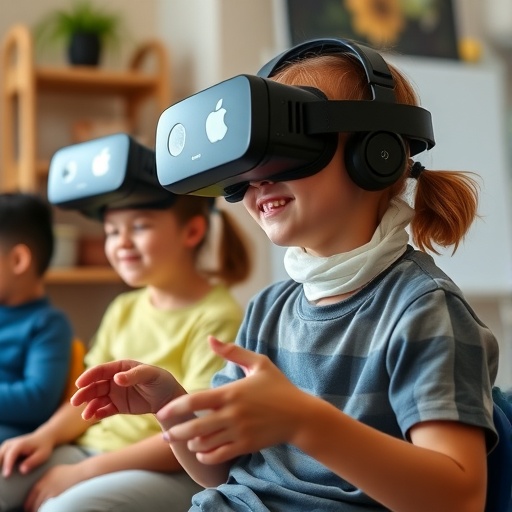
Communication challenges during childhood can have profound and lasting effects on social development, often hindering a young person’s ability to engage with peers and thrive in educational environments. Social Communication Disorders (SCD), characterized by persistent difficulties in both verbal and non-verbal communication, pose significant obstacles for affected children and adolescents. Traditional therapeutic methods have had some success but often fall short in providing immersive and engaging learning experiences needed for real-world social skill acquisition. Recent advancements in virtual reality (VR) technology, however, offer promising avenues for bridging these gaps.
The emerging field of VR in therapeutic and educational contexts has attracted increasing interest due to its potential to simulate real-world interactions in a controlled, safe environment. At Flinders University, Dr. Weifeng Han and colleagues have conducted an extensive literature review that consolidates current knowledge about the use of VR as a mediating tool in addressing Social Communication Disorder. Their synthesis highlights the nuanced ways VR technology can support young people with SCD in developing critical social skills and improving interactive capacities before applying these skills in everyday scenarios.
Unlike traditional therapies which often struggle to replicate the complexity of social interactions or to maintain patient engagement, VR provides an immersive, interactive experience that can be tailored to individual needs. Through wearable VR glasses and innovative interfaces, children and adolescents are offered motivating environments where they can repeatedly practice social cues, emotional recognition, and conversational turn-taking without the pressure or unpredictability of real-world encounters. This repeated, scaffolded practice is crucial for creating neural pathways that support improved communication performance outside of therapy.
An important aspect underscored by the research is the ability of VR systems to incorporate real-time gaze and attention tracking. These technologies allow therapists and educators to monitor how users engage with virtual peers and environments, providing objective measurements of eye contact, attentional shifts, and other subtle communication markers. Such data-driven insights are essential for tailoring interventions and evaluating progress with greater precision than traditional observational assessments.
Furthermore, the integration of cognitive science principles into VR-based interventions is a notable strength. By managing cognitive load effectively within VR settings, these applications optimize learning conditions—enabling users to process complex social information incrementally without becoming overwhelmed. This approach enhances the acquisition of social communication skills in a manner consistent with how the brain naturally learns: through repeated, context-rich exposure combined with feedback.
The review, covering studies from 2010 through 2024, examines VR interventions across populations including those with autism spectrum disorder (ASD)—a group notably impacted by SCD—alongside broader cohorts facing similar communicative challenges. This breadth of research demonstrates VR’s versatility as a platform for inclusive education, supporting diverse learners in both specialized and mainstream settings. VR’s customizable nature means it can address a wide variety of social contexts and learning styles, a vital factor in maximizing accessibility and effectiveness.
One of the exciting potentialities of VR lies in its role as a bridge between therapeutic settings and daily social life. By replicating naturalistic environments where social rules and cues are embedded seamlessly, VR creates a “safe space” for rehearsing difficult interactions. This safety is particularly critical for individuals who may experience anxiety or sensory overload in face-to-face exchanges. The ability to control variables such as conversational pace, environmental noise, and social complexity adds layers of accessibility previously unattainable.
Despite these clear advantages, the researchers caution that VR intervention is still in relatively early stages with significant areas left to explore. For example, standardization in outcome measurement across VR studies remains lacking, complicating efforts to quantify clinical effectiveness universally. Longitudinal investigations are also needed to confirm whether skills learned in virtual contexts transfer sustainably to real-world social interactions over time.
Looking ahead, the implementation of VR in education and therapy will require thoughtful design and delivery strategies. Factors such as user interface simplicity, content relevance, and integration with existing pedagogical frameworks are all critical considerations. Collaborative efforts between educators, clinicians, software developers, and cognitive scientists will be essential to enhance usability and therapeutic impact.
Beyond autism and general SCD populations, future research directions include expanding VR applications to developmental language disorders and neurological conditions with communication deficits. Training programs that equip professionals with the knowledge to effectively employ VR tools in diverse settings will be crucial to scaling access and ensuring quality of intervention.
In conclusion, VR technology holds transformative potential to revolutionize intervention approaches for Social Communication Disorder by combining safe, immersive environments with precise measurement and cognitive science-based learning principles. Dr. Han’s review offers a comprehensive foundation upon which future innovation can build, setting an agenda for rigorous study and practical implementation that promises meaningful improvements in the social lives of millions of children and adolescents worldwide.
News Publication Date: 5-Sep-2025
Web References:
https://www.mdpi.com/2226-471X/10/9/226
http://dx.doi.org/10.3390/languages10090226
Cite Scienmag News
Courtney Benton. (October 8, 2025). Virtual Reality Programs Enhance Social Communication Skills in Children. Scienmag. https://scienmag.com/virtual-reality-programs-enhance-social-communication-skills-in-children/
Courtney Benton. "Virtual Reality Programs Enhance Social Communication Skills in Children." Scienmag, 8 October 2025, https://scienmag.com/virtual-reality-programs-enhance-social-communication-skills-in-children/. Accessed 3 September 2026.
Courtney Benton. "Virtual Reality Programs Enhance Social Communication Skills in Children." Scienmag. October 8, 2025. https://scienmag.com/virtual-reality-programs-enhance-social-communication-skills-in-children/


