


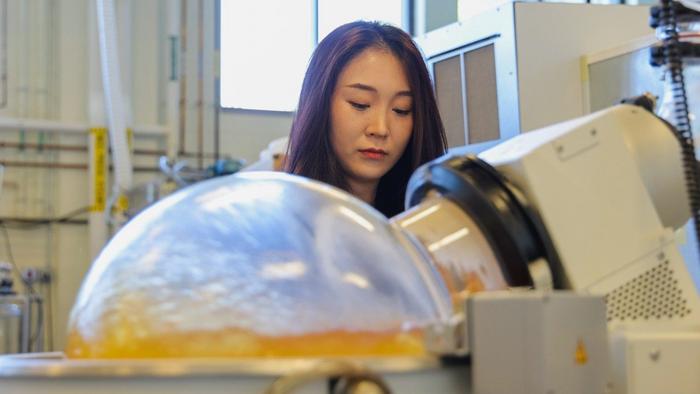
Extraordinary amounts of energy, water, and capital are put into food systems. However, anywhere from 30 to 40 percent of the food that is produced ends up in landfills in the United States.

Credit: Photo by Luke Hayes for Virginia Tech.
Extraordinary amounts of energy, water, and capital are put into food systems. However, anywhere from 30 to 40 percent of the food that is produced ends up in landfills in the United States.
What if there was a way to convert it into something we use every day?
Researchers in Virginia Tech’s College of Agriculture and Life Sciences are doing just that by developing biodegradable bioplastics from food waste to give those materials a new – and useful – life.
“By creating cost-effective bioplastics that naturally decompose, we can reduce plastic pollution on land and in oceans and address significant issues such as greenhouse gas emissions and economic losses associated with food waste,” said lead researcher Zhiwu “Drew” Wang, associate professor in the Department of Biological Systems Engineering and director of the Center for Applied Water Research and Innovation.
The project tackles the challenge of oceanic plastic pollution that is becoming even more prevalent with microplastics affecting nearly 88 percent of all marine species, according to the World Wildlife Fund. Because they can quickly biodegrade in sea water, the Virginia Tech bioplastics have the potential to reduce the effect of pollution on marine life across the globe.
The first-of-its kind pilot project will develop and demonstrate an affordable modular bioprocessing system to produce biodegradable bioplastics from food waste.
Researchers will harness microorganisms to convert food waste into fats, which are then processed into bioplastics. This process, akin to fermentation in microbreweries, ensures that the produced bioplastics can be easily composted, mitigating marine pollution caused by microplastics. The project aims to demonstrate the feasibility and scalability of this bioprocessing system on both national and global levels.
“By creating environmentally sustainable plastics, we hope to benefit people, companies, waste management systems, and communities worldwide,” said Wang, a researcher from the College of Agriculture and Life Sciences and the College of Engineering.
Collaborating with other experts at Virginia Tech, as well as both undergraduate and graduate students, including Haibo Huang in the Department of Food Science and Technology and Young Kim in the Department of Sustainable Biomaterials, the team focuses on the purification of polyhydroxyalkanoates (PHA) and the creation of high-value bioplastic products.
“There are many the ways to generally improve sustainability in the world,” Kim said. “There are two primary methods right now. One is to use more recycling and recyclable material. The other way is to use biodegradable material. Using bioplastic is a viable option to solve our increased plastic pollution. Our approach is to improve the sustainability using biodegradable option.”
These biodegradable products include home compostable packaging, which has become increasingly popular.
Now more than a year in, this project involves student researchers who are hoping to contribute to more sustainable packaging for our world.
“Our first step is to make single-layer film to see if it can be utilized as an actual product,” said Chen Shin, a senior in packaging and system design. “If it has good oxygen and water vapor barriers and other properties, we can move to the next step. We aim to replace traditional coated paper products with PHA. Current paper products are often coated with polyethylene or polyactic acid, which are not fully degradable. PHA is fully biodegradable in nature, even in a backyard environment.”
Polyethylene or polyactic acid coatings are often found on single-use plastics, which can include disposable coffee mugs, films covering food, or even the ice cream cups enjoyed on a hot summer day.
For Chloe Taylor, a senior in sustainable biomaterials, joining the project has been a highlight of her college career.
“It inspired me to pursue graduate studies because traditional plastics are unsustainable,” Taylor said. “We aim to create bioplastics that are viable alternatives and can be used in everyday products without harming the environment.”
A $2.4 million grant from the U.S. Department of Agriculture is funding this applied research.
Cite Scienmag News
Alan Morgan. (July 8, 2024). Virginia Tech researchers work to create biodegradable bioplastics from food waste. Scienmag. https://scienmag.com/virginia-tech-researchers-work-to-create-biodegradable-bioplastics-from-food-waste/
Alan Morgan. "Virginia Tech researchers work to create biodegradable bioplastics from food waste." Scienmag, 8 July 2024, https://scienmag.com/virginia-tech-researchers-work-to-create-biodegradable-bioplastics-from-food-waste/. Accessed 5 September 2026.
Alan Morgan. "Virginia Tech researchers work to create biodegradable bioplastics from food waste." Scienmag. July 8, 2024. https://scienmag.com/virginia-tech-researchers-work-to-create-biodegradable-bioplastics-from-food-waste/

