


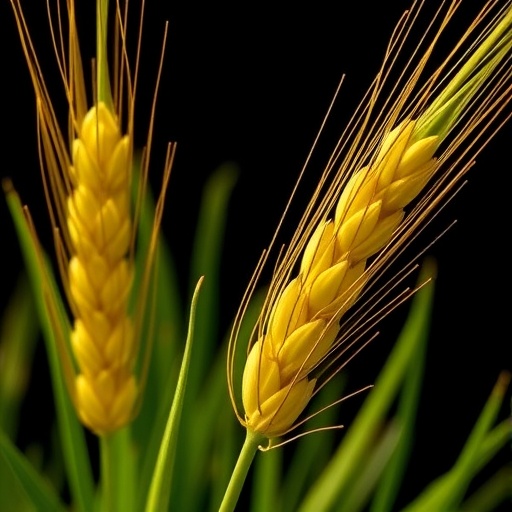
In a groundbreaking advancement within cereal crop genetics, a collaborative team of scientists from China and the United States has unveiled a novel male sterility gene in barley (Hordeum vulgare L.), a crop of global agricultural and economic significance. This discovery, published in the Journal of Integrative Agriculture, lays critical groundwork for hybrid barley breeding by isolating a gene responsible for male sterility, with far-reaching implications for yield enhancement through heterosis exploitation.
Barley ranks as the fourth most cultivated cereal worldwide, underpinning diverse industries such as brewing and livestock feed production. However, achieving significant yield improvements has persistently challenged agricultural scientists, primarily due to barley’s complex genetic architecture and the limitations of conventional breeding methods. The exploitation of heterosis—or hybrid vigor—offers a compelling solution, yet the development of efficient hybrid seed production systems relies heavily on identifying and harnessing male sterility genes.
The research team embarked on this quest by focusing on an ethyl methanesulfonate (EMS)-induced mutant population derived from the widely cultivated barley variety ‘Tamalpais.’ Their meticulous screening culminated in the identification of a completely male sterile mutant, designated N13401. This mutant exhibited a distinct failure to produce functional pollen, a hallmark characteristic that renders it invaluable for hybrid seed production by preventing self-fertilization.
To delineate the genetic basis underlying this male sterility, the scientists employed an innovative genetic mapping approach that combined bulked segregant RNA sequencing (BSR-Seq) with classical forward genetics. BSR-Seq leverages high-throughput sequencing technologies to identify genetic markers linked to phenotypic traits by contrasting pooled RNA samples from mutant and wild-type individuals. However, initial mapping efforts were constrained by limited polymorphic markers. This shortage stemmed from the genetic homogenization typical of domesticated barley varieties, which hampers fine mapping resolution.
Overcoming this bottleneck called for a strategic pivot. The team harnessed the extensive genetic diversity present in wild barley relatives, which have remained genetically diverse due to evolutionary pressures absent in cultivated lines. By crossing the EMS-induced mutant with wild barley strains, they generated an F2 mapping population rich in polymorphisms. This novel population facilitated high-resolution fine mapping of the msgN13401 locus to a 576.9-kilobase interval on chromosome 2H.
Subsequent analysis using whole-genome resequencing within this refined genetic interval unveiled three compelling candidate genes. These genes are hypothesized to play roles in proline biosynthesis regulation, DNA binding, or vacuolar metal transport—processes integral to cellular function and pollen development. Notably, none of these candidates corresponds to any previously characterized male sterility gene, underscoring the novelty of msgN13401 and expanding the genetic toolkit available for barley breeding.
The implications of these findings are profound. Male sterility genes such as msgN13401 can revolutionize hybrid seed production by facilitating controlled pollination without the laborious process of manual emasculation. This not only accelerates the breeding cycle but also enables the harnessing of heterosis, which manifests as increased yield, resilience, and adaptability of hybrid cultivars. By introducing this genetic locus into breeding programs, researchers and breeders stand poised to significantly enhance barley productivity.
Furthermore, this study exemplifies the power of integrating wild relatives into genetic research. The approach of leveraging wild barley’s genetic diversity to circumvent the limitations imposed by domestication-induced uniformity provides a valuable roadmap for similar research across numerous crop species where genetic diversity is crucial for trait discovery.
Beyond its breeding applications, the identification of candidate genes involved in central metabolic pathways provides exciting opportunities for fundamental research into the molecular mechanisms managing pollen viability and development. Understanding how these genes influence starch accumulation within pollen grains could unravel new facets of plant reproductive biology, with potential downstream applications in crop science.
The research was spearheaded by Prof. Fei Ni and Juan Qi from Shandong Agricultural University, whose collaborative work bridges cutting-edge genomic technologies and classical genetics to address longstanding challenges in cereal crop improvement. Their pioneering strategy—the coupling of BSR-Seq with the creation of new mapping populations from wild relatives—sets a benchmark for future genetic studies in both barley and other cereals.
In light of these discoveries, the scientific community anticipates a wave of follow-up research. Functional validation studies, gene editing experiments, and large-scale field trials will be essential to translate these genetic insights into practical breeding innovations. The eventual goal is the development of superior hybrid barley varieties that can effectively meet the escalating food, feed, and industrial demands globally.
Contact information for correspondence has been provided by the authors, facilitating further scientific dialogue and potential collaborative ventures aimed at accelerating the application of this novel knowledge. This research forms a cornerstone for genetic innovation, promising to transform barley breeding and contribute to the broader mission of sustainable agriculture in the face of global challenges.
Web References:
10.1016/j.jia.2025.12.077
Cite Scienmag News
Alan Morgan. (May 26, 2026). Precise Mapping of Male Sterility Gene Uncovers Impaired Pollen Starch Accumulation in Barley. Scienmag. https://scienmag.com/precise-mapping-of-male-sterility-gene-uncovers-impaired-pollen-starch-accumulation-in-barley/
Alan Morgan. "Precise Mapping of Male Sterility Gene Uncovers Impaired Pollen Starch Accumulation in Barley." Scienmag, 26 May 2026, https://scienmag.com/precise-mapping-of-male-sterility-gene-uncovers-impaired-pollen-starch-accumulation-in-barley/. Accessed 4 September 2026.
Alan Morgan. "Precise Mapping of Male Sterility Gene Uncovers Impaired Pollen Starch Accumulation in Barley." Scienmag. May 26, 2026. https://scienmag.com/precise-mapping-of-male-sterility-gene-uncovers-impaired-pollen-starch-accumulation-in-barley/


