


At first glance, the simple sea sponge is no creature of mystery.

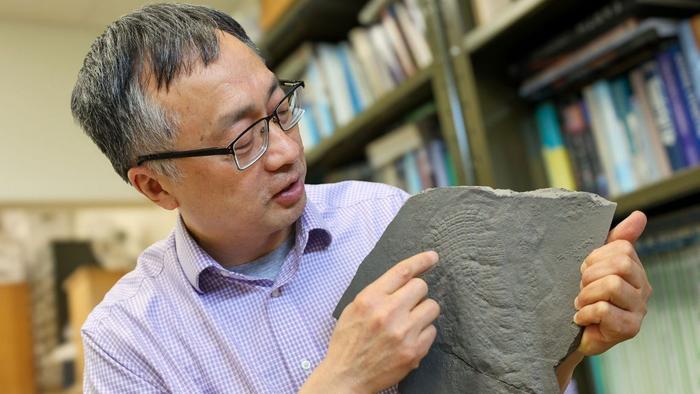
Credit: Photo by Spencer Coppage for Virginia Tech.
At first glance, the simple sea sponge is no creature of mystery.
No brain. No gut. No problem dating it back 700 million years. Yet convincing sponge fossils only go back about 540 million years, leaving a 160 million-year gap in the fossil record.
In a paper released June 5 in the journal Nature, Virginia Tech geobiologist Shuhai Xiao and collaborators reported a 550 million-year-old sea sponge from the “lost years” and proposed that the earliest sea sponges had not yet developed mineral skeletons, offering new parameters to the search for the missing fossils.
The mystery of the missing sea sponges centered on a paradox.
Molecular clock estimates, which involve measuring the number of genetic mutations that accumulate over time, indicate that sponges must have evolved about 700 million years ago. And yet there had been no convincing sponge fossils found in rocks that old.
For years, this conundrum was the subject of debate among zoologists and paleontologists.
This latest discovery fills in the evolutionary family tree of one of the earliest animals, explaining its apparent absence in older rocks and connecting the dots back to Darwin’s questions about when it evolved.
Xiao, who recently was inducted into the National Academy of Sciences, first laid eyes on the fossil five years ago, when a collaborator texted him a picture of a specimen excavated along the Yangtze River in China.
“I had never seen anything like it before,” said Xiao, a faculty member in the College of Science. “Almost immediately, I realized that it was something new.”
Xiao and collaborators from the University of Cambridge and the Nanjing Institute of Geology and Paleontology began ruling out possibilities one by one: not a sea squirt, not a sea anemone, not a coral. They wondered, could it be an elusive ancient sea sponge?
In an earlier study published in 2019, Xiao and his team suggested that early sponges left no fossils because they had not evolved the ability to generate the hard needle-like structures, known as spicules, that characterize sea sponges today.
Xiao’s team members traced sponge evolution through the fossil record. As they went further back in time, sponge spicules were increasingly more organic in composition and less mineralized.
“If you extrapolate back, then perhaps the first ones were soft-bodied creatures with entirely organic skeletons and no minerals at all,” Xiao said. “If this was true, they wouldn’t survive fossilization except under very special circumstances where rapid fossilization outcompeted degradation.”
Later in 2019, Xiao’s international research group found a sponge fossil preserved in just such a circumstance: a thin bed of marine carbonate rocks known to preserve abundant soft-bodied animals, including some of the earliest mobile animals.
“Most often, this type of fossil would be lost to the fossil record,” Xiao said. “The new finding offers a window into early animals before they developed hard parts.”
The surface of the new sponge fossil is studded with an intricate array of regular boxes, each divided into smaller, identical boxes.
“This specific pattern suggests our fossilized sea sponge is most closely related to a certain species of glass sponge” said Xiaopeng Wang, a postdoctoral researcher at the Nanjing Institute of Geology and Paleontology and the University of Cambridge.
Another unexpected aspect of the new sponge fossil is its size.
“When searching for fossils of early sponges I had expected them to be very small,” said Alex Liu, a collaborator from the University of Cambridge. “The new fossil is about 15 inches long with a relatively complex, conical body plan, which challenged many of our expectations for the appearance of early sponges.”
While the fossil fills in some of the missing years, it also provides researchers with important guidance about how to search for these fossils — which will hopefully extend understanding of early animal evolution further back in time.
“The discovery indicates that perhaps the first sponges were spongey but not glassy,” Xiao said. “We now know that we need to broaden our view when looking for early sponges.”
Journal
Nature
Method of Research
Observational study
Subject of Research
Animals
Article Title
A late-Ediacaran crown-group sponge animal
Article Publication Date
5-Jun-2024
Cite Scienmag News
Drew Townsend. (June 5, 2024). Virginia Tech researcher’s team discovers ‘missing’ sea sponges. Scienmag. https://scienmag.com/virginia-tech-researchers-team-discovers-missing-sea-sponges/
Drew Townsend. "Virginia Tech researcher’s team discovers ‘missing’ sea sponges." Scienmag, 5 June 2024, https://scienmag.com/virginia-tech-researchers-team-discovers-missing-sea-sponges/. Accessed 4 September 2026.
Drew Townsend. "Virginia Tech researcher’s team discovers ‘missing’ sea sponges." Scienmag. June 5, 2024. https://scienmag.com/virginia-tech-researchers-team-discovers-missing-sea-sponges/

