


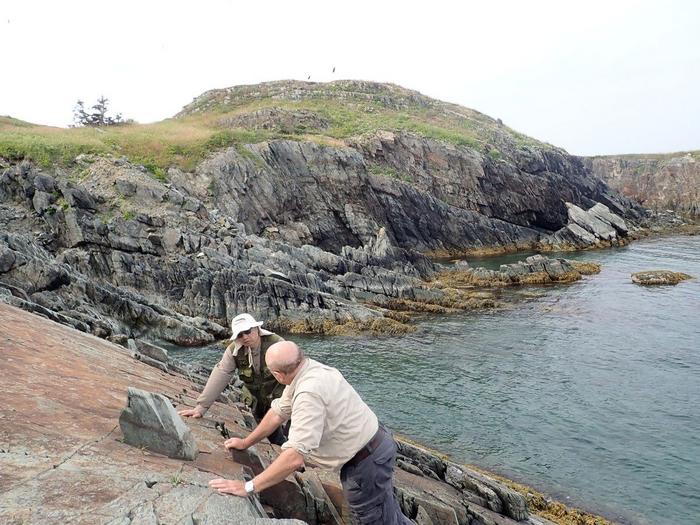
In a groundbreaking study published in the journal Science, Virginia Tech geobiologist Shuhai Xiao and his dedicated team have significantly expanded the timeline of life’s evolution on Earth, tracing biodiversity back almost 2 billion years. The research highlights a critical era in the Proterozoic Eon, a period stretching from 2.5 billion to 539 million years ago, characterized by life forms that were predominantly smaller and less robust than those that would follow. This new insight sheds light on the complex tapestry of Earth’s history, illustrating the interplay between environmental changes and biological diversity.
The research team undertook an extensive analysis, collecting and analyzing fossil data from across the globe. This meticulous compilation results in a robust chart of life that not only encompasses the more recent evolutionary history but also includes the often-overlooked Proterozoic life. The findings are particularly remarkable because the organisms of this time, such as early eukaryotes, were primarily soft-bodied and lacked the hard skeletons that contribute to fossilization. As a result, they have left scant physical remnants for scientists to study, making this research all the more significant.
One of the central revelations of this research is the identification of the first eukaryotic organisms. These complex life forms, distinguished by their nucleated cells, are pivotal in the history of life on Earth, eventually evolving into more complex multicellular organisms. The study posits that eukaryotes emerged no later than 1.8 billion years ago, with their diversity stabilizing during a period known as the "boring billion." This era, spanning from approximately 1.45 billion to 720 million years ago, was characterized by reduced species turnover, which raises fascinating questions regarding the evolutionary mechanisms at play during a time when biological innovation appeared to stall.
Under Xiao’s leadership, the team utilized a cutting-edge graphic correlation program that provided increased temporal resolution in their findings. This methodological advancement allowed for a clearer understanding of how the species counted fluctuated over time, revealing intricate patterns of diversification and extinction that shaped the progress of life. These patterns inform scientists about the evolutionary paths taken by early eukaryotes, hinting at the broader ecological relationships that governed their existence.
As the research unfolded, the team examined how environmental alterations influenced evolutionary dynamics. Notably, they unearthed compelling connections between significant climatic events and shifts in biodiversity. The Ice Ages, periods marked by extreme glaciation, proved to be pivotal moments in this narrative. These frigid conditions, which enveloped much of the Earth between 720 million and 635 million years ago, acted as a reset button for evolutionary trajectories. Following these icebound epochs, a surge in eukaryotic species diversification took place, suggesting that climatic upheavals can spur biological innovation and complexity.
In considering why eukaryotic evolution seemed sluggish during the "boring billion," Xiao raises intriguing questions about the environmental and evolutionary factors at play. The potential catalysts for this dramatic increase in biodiversity post-Ice Age could include shifts in atmospheric composition, notably rises in oxygen levels, or an evolutionary arms race between competing organisms vying for resources in a recovering ecosystem. Each hypothesis presents a unique lens through which scientists can investigate the interconnectedness of climate change and evolutionary processes.
The repercussions of this study reverberate through various scientific disciplines, drawing attention from evolutionary biologists, paleontologists, and climate scientists alike. The quantitative analysis of Proterozoic biodiversity acts as a tool for future researchers, who can delve deeper into the unresolved mysteries regarding the intricate balance of life on Earth. Xiao’s analysis serves as a historical lens through which current biodiversity crises can be understood, providing context for contemporary discussions surrounding conservation and ecological stability.
This research does not stand alone; rather, it is the result of collaborative efforts between several esteemed institutions and scholars. Among them, co-authors from universities across the globe—from Hong Kong to California—contributed their expertise and perspectives, enriching the results with diverse insights. The study emphasizes the importance of collaboration in elucidating Earth’s complex history and illustrates how interdisciplinary approaches can lead to new discoveries in the realms of biology and paleontology.
As the discourse surrounding biodiversity and climatic change gains urgency in today’s world, findings like these underscore the relevance of understanding our planet’s past. By articulating the evolutionary stories embedded in the rock record, researchers like Xiao not only deepen our appreciation for life’s history but also inform current strategies to address ecological challenges. The pathways of evolution are not only historical narratives; they are crucial for initiating informed dialogue about the future of our planet’s diverse ecosystems.
In conclusion, the work led by Shuhai Xiao and his colleagues represents a significant leap forward in our understanding of the origins of life on Earth. By capturing a broader picture of biodiversity that incorporates the complex history of Proterozoic organisms, this study serves as a foundation for future inquiry into how past life forms responded to environmental shifts. It reinforces the idea that to navigate contemporary biodiversity challenges, we must first comprehend the intricate processes that have shaped life through the ages.
Cite Scienmag News
Violet Maxwell. (December 23, 2024). Virginia Tech Research Expands Earth’s Life Timeline by Nearly 1.5 Billion Years. Scienmag. https://scienmag.com/virginia-tech-research-expands-earths-life-timeline-by-nearly-1-5-billion-years/
Violet Maxwell. "Virginia Tech Research Expands Earth’s Life Timeline by Nearly 1.5 Billion Years." Scienmag, 23 December 2024, https://scienmag.com/virginia-tech-research-expands-earths-life-timeline-by-nearly-1-5-billion-years/. Accessed 5 September 2026.
Violet Maxwell. "Virginia Tech Research Expands Earth’s Life Timeline by Nearly 1.5 Billion Years." Scienmag. December 23, 2024. https://scienmag.com/virginia-tech-research-expands-earths-life-timeline-by-nearly-1-5-billion-years/


