


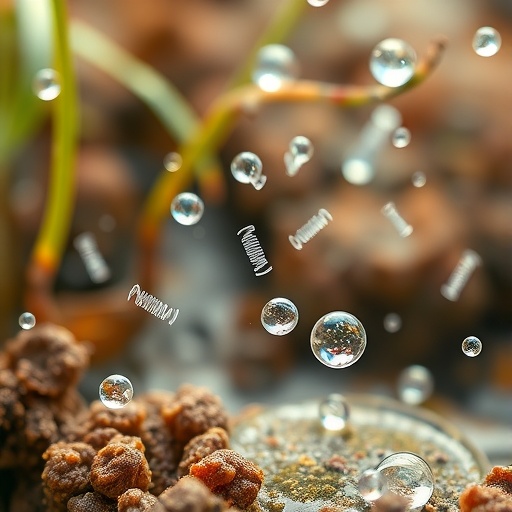
Microplastics have long been framed as one of the defining pollution problems of the modern era, a ubiquitous haze of fragmented plastic debris now found from the deep ocean to mountain snow. But a growing body of evidence suggests that the particles themselves may be only part of the story. A new review published in Energy & Environment Nexus argues that microplastics should be understood not merely as contaminants in their own right, but as mobile platforms—what the researchers vividly describe as “pollutant shuttles”—capable of transporting toxic chemicals, pathogenic microorganisms and antibiotic resistance genes across ecosystems, through food webs, and even across the boundaries that separate water, soil and air.
The review, led by researchers from Jiangxi Agricultural University with corresponding author Jingliang Shi, synthesizes current knowledge on the dual role of microplastics as vectors for both chemical and biological contaminants. Its central contention is that risk assessments focused solely on the plastic particles have systematically underestimated the environmental hazard, because they ignore the cargo these particles can carry and the ecological interactions they facilitate. “Microplastics should not be considered isolated particles in the environment,” Shi explains. “They can interact with chemicals and microorganisms, transport them between environmental compartments and, under certain conditions, amplify their ecological effects. Understanding when these processes become dominant is essential for realistic risk assessment.”
At the heart of the chemical dimension of this problem lies what toxicologists call the “Trojan horse effect.” Because plastic particles present large, often hydrophobic and chemically reactive surfaces, they readily adsorb persistent organic pollutants, heavy metals and a wide range of other contaminants from their surrounding environment. Once these loaded particles are ingested by organisms—whether filter-feeding mollusks, plankton, fish or grazing livestock—the physiological conditions of the digestive tract can alter the chemistry at the particle surface, causing pollutants to desorb precisely where the organism is most vulnerable to absorption. In effect, the microplastic delivers a concentrated dose of toxins that the surrounding environment alone might never have supplied.
The review also emphasizes a crucial and often overlooked size dependence in how this delivery occurs. Conventional microplastics, those particles larger than roughly one micrometer, generally deliver their chemical cargo through the gastrointestinal tract, releasing adsorbed pollutants into the gut where they may cross the intestinal lining. Nanoplastics, however—particles smaller than about one micrometer—present a fundamentally different and more troubling scenario. At these scales, the particles themselves may cross biological membranes, penetrating tissue barriers and distributing their associated pollutants directly to internal organs. This distinction matters for anyone attempting to model exposure, because it means that the same mass of plastic can produce qualitatively different toxicological outcomes depending on how finely it has been fragmented.
The biological dimension of the microplastic problem may prove even more consequential than the chemical one. When plastic particles enter the environment, they are rapidly colonized by microorganisms, forming dense microbial communities that scientists have dubbed the “plastisphere.” Far from being a random assemblage, this biofilm is a structured, functional ecosystem with its own chemical microenvironment. Within the protective matrix of the biofilm, pathogens can survive longer than they would in open water or soil, shielded from UV radiation, desiccation and predation. More alarmingly, the plastisphere can serve as a refuge for antibiotic resistance genes, and the extreme proximity of diverse microbial species packed into a biofilm creates ideal conditions for horizontal gene transfer—the process by which bacteria exchange genetic material directly, potentially accelerating the spread of antimicrobial resistance through the environment.
What makes the review’s analysis particularly compelling is its demonstration that the chemical and biological vector effects do not operate independently. Instead, they form what the authors describe as a bidirectional positive feedback loop. Pollutants adsorbed onto plastic surfaces can exert selective pressure on the microbial communities colonizing that surface, favoring tolerant or resistant strains and thereby enriching the biofilm in resistance determinants. In the other direction, the biofilm itself alters the physical and chemical properties of the plastic surface—adding extracellular polymeric substances and reactive functional groups—which can increase the particle’s subsequent capacity to adsorb further pollutants. Each process amplifies the other, meaning that a microplastic particle that has been in the environment for some time may be far more dangerous than a fresh one, accumulating both a richer chemical payload and a more hazardous microbial community.
Recognizing that the field has largely moved past the question of whether microplastics act as vectors and toward the question of when and how strongly they do so, the authors propose a three-tiered regulatory framework organized around physical, chemical and biological drivers. The physical tier concerns the particle itself: size, shape and degree of aging all influence how a particle travels through environmental compartments and how reactive its surface is. The chemical tier concerns the surrounding environment: polymer chemistry and ambient conditions such as pH, salinity and organic matter content govern the rates of pollutant adsorption and desorption. The biological tier concerns the living dimension: biofilm formation, ingestion by organisms and subsequent transfer through food webs determine how the particle’s cargo ultimately reaches and affects living systems. By structuring risk assessment this way, the authors argue, researchers and regulators can move beyond simplistic descriptions of microplastic abundance toward a mechanistic understanding of hazard.
The review goes further, identifying specific conditions under which the combined chemical and biological vector effects become particularly significant—and therefore particularly dangerous. These include situations of strong microbial selective pressure even at relatively low contaminant concentrations, which can drive resistance enrichment without any obvious chemical alarm signal; biofilms with high extracellular polymeric substance content, which provide both habitat stability and enhanced adsorption capacity; highly aged microplastics whose surfaces have accumulated oxygen-rich functional groups, making them substantially more chemically active than pristine particles; and prolonged exposure scenarios exceeding thirty days, over which time biofilms mature and pollutant loads can accumulate substantially. Each of these conditions offers a concrete, testable criterion that could inform monitoring priorities in real ecosystems.
This framework also exposes a fundamental weakness in how microplastic toxicity is currently studied. Most laboratory experiments rely on short-term exposures at concentrations far higher than organisms encounter in nature, producing results that the authors argue poorly represent chronic environmental conditions. The real hazard, they contend, lies not in acute toxicity from an overwhelming dose of plastic, but in the slow, cumulative effects of particles that have spent weeks or months in the environment, growing biofilms, adsorbing pollutants and shuttling genes between microbial communities. Addressing this gap will require long-term observations under environmentally realistic conditions, improved exposure models that track particle aging and cargo evolution over time, and a shift in the field’s basic assumptions about what a toxicity experiment should look like.
The practical implications extend into pollution management and governance as well. The authors call for targeted removal of high-risk aged microplastics—the particles most likely to have accumulated dangerous chemical and biological cargo—rather than undifferentiated cleanup efforts that treat all particles as equivalent. They also advocate for more unified approaches to global microplastic governance, a notable appeal given that plastic pollution, microbial communities and antimicrobial resistance all recognize no political boundaries. In an era when antimicrobial resistance is projected to become one of the leading causes of death worldwide, the possibility that plastic debris is quietly serving as an incubator and distribution network for resistance genes gives an entirely new urgency to what was once considered primarily a litter problem.
Perhaps the most significant contribution of the review is conceptual. By reframing microplastics as dynamic platforms that connect chemical pollution, microbial ecology and antimicrobial resistance across ecosystems, it dissolves the artificial boundary between plastic pollution research and the study of other environmental hazards. A fragment of plastic in a river is simultaneously a pollutant, a chemical sorbent, a microbial habitat and a potential vehicle for disease and resistance. Understanding and managing that multiplicity—and identifying the thresholds at which these vector effects tip from background noise into genuine ecological threat—is, the authors argue, the central challenge facing the next generation of microplastic research.
Cite Scienmag News
Juliet Wilcox. (September 5, 2026). Microplastics may ferry chemicals, pathogens and antibiotic resistance genes through ecosystems. Scienmag. https://scienmag.com/microplastics-may-ferry-chemicals-pathogens-and-antibiotic-resistance-genes-through-ecosystems/
Juliet Wilcox. "Microplastics may ferry chemicals, pathogens and antibiotic resistance genes through ecosystems." Scienmag, 5 September 2026, https://scienmag.com/microplastics-may-ferry-chemicals-pathogens-and-antibiotic-resistance-genes-through-ecosystems/. Accessed 5 September 2026.
Juliet Wilcox. "Microplastics may ferry chemicals, pathogens and antibiotic resistance genes through ecosystems." Scienmag. September 5, 2026. https://scienmag.com/microplastics-may-ferry-chemicals-pathogens-and-antibiotic-resistance-genes-through-ecosystems/


