


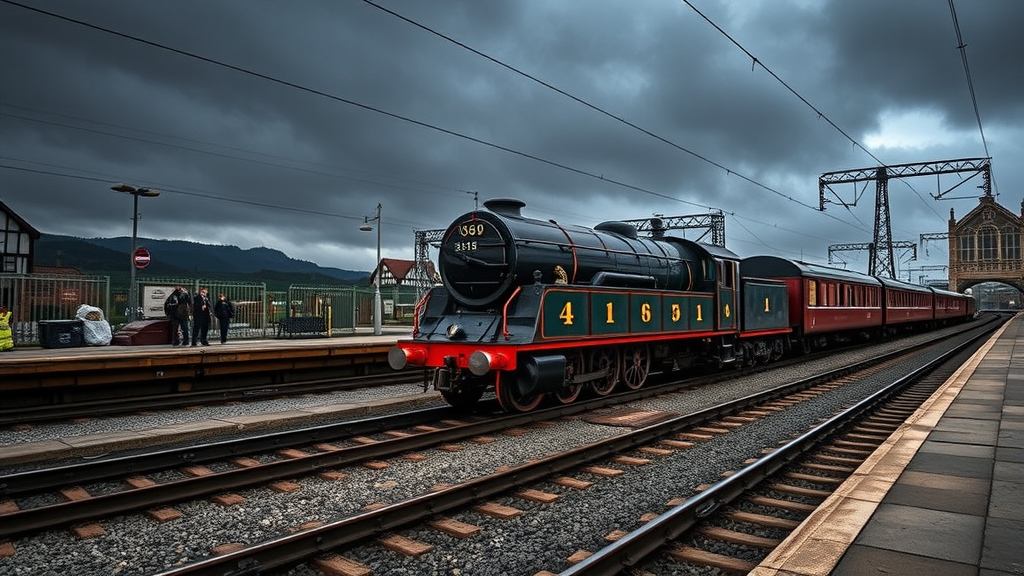
A mystery that has puzzled historians of science for nearly two centuries has finally been resolved. An international team of researchers led by Lancaster University has re-examined one of the most widely cited accounts of space weather interfering with human technology, and found that the date attached to the famous Exeter train delay was wrong by seven years. The investigation, published in the American Geophysical Union journal Space Weather, shows that the incident almost certainly took place on 18 October 1848 rather than 18 October 1841, the date given in an influential article published in Nature in 1871. The correction matters because the Exeter event has long been promoted as potentially the earliest recorded example of space weather affecting technology, a claim the new research overturns while confirming that the story itself was genuine.
The tale at the centre of the investigation is a striking one. The first practical electric telegraph networks were deployed during the 1840s, and as solar activity rose in the years that followed, Victorian telegraph operators began to experience strange and unexplained electrical effects caused by geomagnetic disturbances. According to the original account, the 10:05 p.m. train departing Exeter in Devon was delayed by 16 minutes when a very intense magnetic disturbance interfered with the electric signalling telegraph equipment used to determine whether the railway line ahead was clear. Without a working telegraph link, the signalman could not confirm that the track was unoccupied, and the train was held until the disturbance subsided. It is a vivid illustration of solar activity reaching down into everyday Victorian life through the copper wires of a young technology.
Professor Jim Wild of Lancaster University’s School of Physics and Astronomy, the lead author of the study, worked with scientists from the British Geological Survey, Natural Resources Canada, Baylor University, RMIT University and STFC RAL Space to test whether the account could withstand modern scrutiny. The team encountered a critical problem almost immediately: the railway line referenced in the story did not open until 1846, almost five years after the alleged 1841 incident. A train could not have been delayed on a line that did not yet exist. That single discrepancy opened the door to a broader re-examination of the event, and suggested that the date recorded in the 1871 Nature article might simply have been a typographical error, with 1848 misprinted as 1841.
To establish what really happened, the researchers assembled an unusually rich body of evidence, combining railway timetables, historical newspaper reports, solar observations, auroral accounts and digitised geomagnetic records. Their investigation identified a strong geomagnetic disturbance on 18 October 1848, exactly the kind of event that would have disrupted telegraph signalling. Crucially, the same date is accompanied by reports of sunspots and aurora seen across the United Kingdom and continental Europe, an independent signature of heightened solar and geomagnetic activity. Taken together, the evidence provides compelling support for the conclusion that the Exeter delay occurred in 1848, and that the earlier date was a clerical slip that propagated through the scientific literature for 178 years.
The correction changes the historical record in an important way. While the Exeter incident remains one of the earliest documented examples of space weather disrupting technology, it was not the first. The earliest credible report currently known is interference with telegraph systems on the Midland Railway in March 1847. That distinction shifts the timeline of humanity’s first encounter with the space environment back to the earliest years of the electric telegraph, and it demonstrates how quickly engineers of the 1840s began to notice that their new networks were sensitive to forces they could not yet explain. Geomagnetic disturbances induce currents in long conductors, and telegraph lines stretching across the countryside were effectively enormous antennas that picked up the electrical signature of a restless magnetosphere.
Professor Wild reflected on the significance of the finding for how society understands the hazard. Space weather is often discussed as a modern challenge because of contemporary dependence on satellites, communications systems and electricity networks, yet the study shows that society has been experiencing the effects of space weather on technology for almost as long as electrical technologies have existed. The Exeter train delay, he noted, is a fascinating story because it sits right at the point where emerging technologies first began to encounter the realities of the space environment. By combining historical archives with scientific observations, the team was able to show that the event almost certainly happened in 1848 rather than 1841, and although this means it is not the earliest recorded space weather impact, it remains one of the first clear examples of solar activity disrupting critical infrastructure.
The research also carries a methodological lesson that extends well beyond railway history. Dr Mike Hapgood, Visiting Scientist and space weather expert at STFC’s RAL Space, described the work as having a hint of a detective story, piecing together a wide range of archived records to better understand a historically severe space weather event. He emphasised the importance of preserving older records, which give scientists the evidence base they need to interpret past events and strengthen future predictions. Digitised geomagnetic measurements, newspaper archives and railway timetables proved to be complementary strands of evidence, and their combination allowed the team to date a geomagnetic storm with a precision that no single source could have provided. For researchers reconstructing the history of solar activity, the study is a demonstration of how much information still lies waiting in nineteenth-century archives.
The physical mechanism behind the Exeter delay is well understood today. When the Sun ejects clouds of magnetised plasma toward Earth, the resulting shock compresses the planet’s magnetic field and drives rapidly varying electric currents in the ionosphere. Those variations, in turn, induce voltages in long conductors on the ground, a phenomenon now known as a geomagnetically induced current. In the 1840s these currents manifested as spurious signals, erratic needle deflections and intermittent failures on telegraph circuits, sometimes strong enough to disrupt railway signalling entirely. The same physics operates today, but the conductors are high-voltage transmission lines, pipeline networks and the grounding systems of power transformers, and the consequences of a severe storm can range from GPS errors to regional blackouts.
Nearly two centuries after the Exeter delay, railways and other critical infrastructure remain vulnerable to space weather, although through very different technologies including power systems, signalling equipment, satellite navigation and communications networks. Professor Wild observed that the research highlights space weather as not a new threat but a long-standing natural hazard. The technologies affected have evolved from railway telegraphs to satellites, communications networks and power systems, but the challenge remains the same: understanding the risk and ensuring society is resilient to its impacts. The continuity is striking, since a signalman waiting for a telegraph needle to settle in 1848 and a grid operator monitoring geomagnetic indices today are responding to the same solar-driven disturbance in Earth’s magnetic environment.
Dr Hapgood added a note of caution about the future. While today’s space weather capabilities are far more advanced than anything available in the 1800s, the modern technologies society depends on are also much more vulnerable to solar storms. Deepening the understanding of these events, he argued, is essential for preparing for and mitigating the impacts of space weather, especially as the world looks forward to a decade of ambitious space developments that will face the challenge of a new solar cycle in the 2030s. The Exeter story, corrected at last, thus serves a double purpose: it resets the historical record of humanity’s first technological encounter with the Sun’s outbursts, and it reminds a technology-dependent civilisation that the hazard has never gone away, only changed its address.
Subject of Research: Historical reconstruction of an 1848 geomagnetic disturbance that delayed a train in Exeter, correcting the date of one of the earliest recorded space weather impacts on technology
Article Title: Mystery of one of the earliest recorded space weather impacts solved
Article References: Mystery of one of the earliest recorded space weather impacts solved. (n.d.). Original publication
Image Credits: AI Generated
DOI: Not provided
Keywords: space weather, geomagnetic storm, telegraph, Exeter, railway history, solar activity, aurora, sunspots, geomagnetically induced currents, Lancaster University, Space Weather journal, Victorian technology
Cite Scienmag News
Cameron Wolfe. (September 26, 2026). Victorian train delay that rewrote the history of space weather finally explained. Scienmag. https://scienmag.com/victorian-train-delay-that-rewrote-the-history-of-space-weather-finally-explained/
Cameron Wolfe. "Victorian train delay that rewrote the history of space weather finally explained." Scienmag, 26 September 2026, https://scienmag.com/victorian-train-delay-that-rewrote-the-history-of-space-weather-finally-explained/. Accessed 4 October 2026.
Cameron Wolfe. "Victorian train delay that rewrote the history of space weather finally explained." Scienmag. September 26, 2026. https://scienmag.com/victorian-train-delay-that-rewrote-the-history-of-space-weather-finally-explained/


