


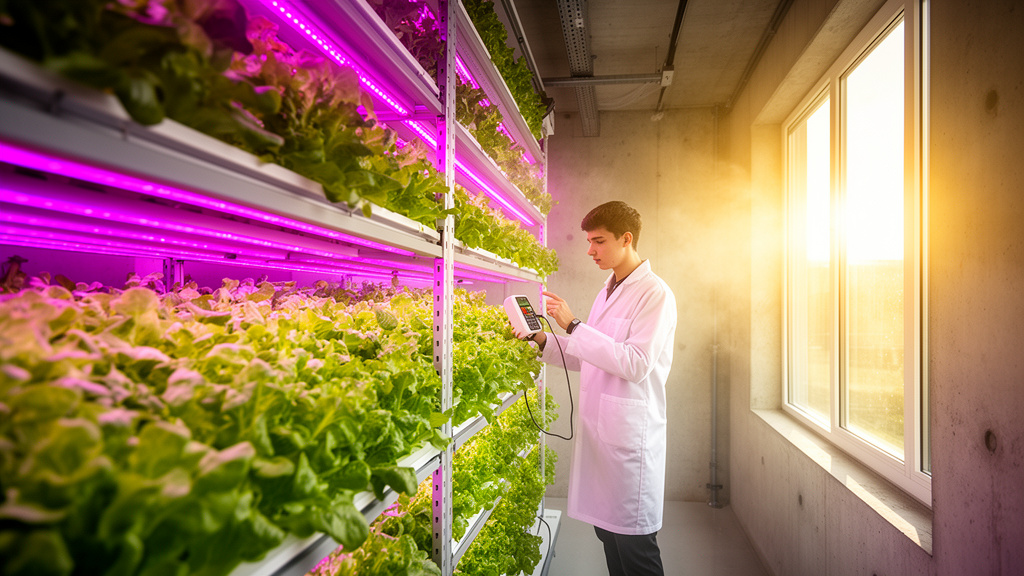
Vertical farming has spent the past decade being simultaneously celebrated as the future of food and dismissed as an energy-guzzling dead end. A new commentary by Francesco Orsini of the University of Bologna, published in npj Sustainable Agriculture, argues that both camps are partly right and partly wrong, and that the disagreement stems less from the technology itself than from how researchers choose to measure sustainability. The core physics is not in dispute: replacing sunlight with electric light always carries an energy penalty, and no amount of engineering will make an LED-driven farm more energy-efficient than a field basking in free solar radiation. But, Orsini contends, energy efficiency is only one lens, and depending on where analysts draw the boundaries of the system they are studying, vertical farming can look either indefensible or genuinely transformative.
The most pointed critique of vertical farms comes from comparisons with high-tech greenhouse horticulture, which is arguably the fairest benchmark since both technologies target the same market: high-value crops that demand consistent quality, uniformity, and year-round supply. In that comparison, greenhouses enjoy a decisive structural advantage. They harvest natural sunlight directly, and although they still require cooling, ventilation, shading, and CO2 management to hold optimal growing conditions, their electricity demands are far lower than those of a fully artificial-light facility. Work by Stanghellini and Katzin, cited in the commentary, drives the point home with a stark example: when lettuce is produced in a vertical farm in Northern Europe, its carbon footprint exceeds that of lettuce shipped from Southern Europe, even after accounting for long-distance transport. On that reading, hydroponic greenhouses already deliver many of the benefits marketed as unique to vertical farming, including high productivity, controlled environments, reduced water use, and lower pesticide demand, without the crushing electricity bill.
The numbers behind that efficiency gap are sobering. Reviewing the available literature, Orsini notes that vertical farms achieve an energy productivity of roughly 0.08 to 0.13 kilograms of fresh weight per kilowatt-hour, a figure that reflects the fundamental thermodynamics of converting electricity into photosynthetically useful light and then into edible biomass. Enthusiasm for applying vertical farming to staple crops has therefore run into hard limits: the energy required per unit of edible biomass for grain crops is enormous, and powering such facilities with renewables would itself demand vast tracts of land, partially erasing the land-sparing benefits that make indoor farming attractive in the first place. This is why, in practice, the vertical farming industry has concentrated on fresh-cut leafy vegetables and microgreens, crops with high market value, a high harvest index, small physical size, and short production cycles that suit stacked, tightly controlled environments.
Yet the same body of literature contains a second, more optimistic reading, and the difference lies in the analytical boundaries. When assessments extend beyond direct electricity consumption to include water-use efficiency, land-use efficiency, transport distances, post-harvest losses, and urban integration, the balance shifts. Vertical farms reach extraordinary productivity, up to 350 kilograms of fresh weight per square meter per year in commercial facilities, and their water-use efficiency, at about 140 grams of fresh weight per liter of water, is roughly double that of high-tech greenhouses. Shorter supply chains and reduced processing requirements can also cut post-harvest losses, an often-overlooked source of waste in conventional horticulture. None of this overturns the energy penalty, but it reframes the question: a technology that is inefficient in kilowatt-hours may still be efficient in land, water, and food actually delivered to consumers.
Context, the commentary argues, is what determines whether that reframing matters. In Northern European greenhouses, supplemental heating and lighting already account for a substantial share of production energy, which narrows the gap with indoor farms. In dense urban districts, vertical farms can in principle recapture waste heat, CO2, and water from surrounding buildings and infrastructure, improving resource circularity at the neighborhood scale; pilot work in Amsterdam has even explored recovering nutrients from urine wastewater for building-integrated agriculture. Where the electricity grid is dominated by renewable energy, the carbon cost of artificial lighting falls dramatically, further tilting the comparison. The same vertical farm that is difficult to justify in a sunny region with low-carbon power and established greenhouse production may become genuinely valuable where conventional controlled-environment agriculture requires heavy heating, cooling, or long-distance distribution.
Orsini also highlights a hybrid model that sidesteps the either-or framing altogether: using vertical farms for seedling propagation and early-stage crop growth before transplanting into greenhouses. Seedlings and young transplants are small, sensitive, and short-cycle, making them ideal candidates for the precise environmental control that indoor facilities provide, while the energy-intensive indoor phase is kept brief. The mature crop then finishes under sunlight in the greenhouse, capturing solar energy where it counts most. This division of labor, along with vertical farming’s demonstrated potential for herbs, medicinal plants, and vegetable transplants, suggests the technology’s strongest role may be as a specialized component within production chains rather than a standalone replacement for them.
The commentary situates these findings within the concept of City-Region Food Systems, in which urban and peri-urban production are integrated through shorter supply chains, resource circularity, and tighter links between food, energy, and waste-management infrastructure. In that framing, vertical farming is not a competitor to greenhouses but a complementary technology whose value depends on place, crop, and system design. Electricity mix, climate, water availability, transport infrastructure, opportunities for waste-heat and CO2 recovery, and proximity to consumers all alter the relative performance of the two systems. A single performance indicator, Orsini warns, cannot settle the question, and comparisons against horticulture in general, rather than against functionally equivalent high-tech production, produce misleading conclusions.
The commercial turbulence of the industry reinforces the point that technical performance alone does not guarantee sustainability. InFarm, a German vertical farming company that raised around 500 million dollars, collapsed into bankruptcy in 2023, and 80 Acres Farms, despite operating an extensive indoor-farming network and supplying a large retail market, recently decided to cease operations. Orsini is careful not to read these failures as proof that vertical farming is inherently unsustainable. Instead, he treats them as reminders that financial resilience, capital requirements, market structure, and operational scalability must be evaluated alongside resource-use efficiency. A system can be agronomically elegant and still fail economically if the business model assumes universal applicability rather than a defensible niche.
The upshot is a deliberately modest but actionable conclusion. Vertical farming will never outperform sunlight-driven production on raw energy efficiency, and in some contexts the honest answer to whether it makes sense will remain no. But in renewable-powered urban systems, in northern climates where greenhouse energy demand is already high, in hybrid production chains, and in the cultivation of high-value or quality-sensitive crops, it may prove a valuable complement to greenhouses rather than a rival. The productive question, Orsini argues, is not whether vertical farming is sustainable in the abstract, but under what circumstances, and for which crops, it delivers a measurable system-level advantage. The challenge for research and policy is not to crown a winner between vertical farms and greenhouses, but to map the niches where each technology contributes most effectively to sustainable food systems.
For a field that has swung between hype and backlash, that message amounts to a call for analytical discipline. Sustainability assessments, the commentary suggests, should state their system boundaries explicitly, compare vertical farms only with functionally comparable production systems, and incorporate water, land, circularity, transport, and CO2 supply considerations alongside energy metrics. Only then can growers, investors, and policymakers distinguish the configurations of vertical farming that genuinely improve food-system performance from those that merely relocate environmental burdens from the farm to the power plant.
Subject of Research: Comparative sustainability of vertical farming and greenhouse horticulture
Article Title: Efficiency and opportunities in vertical farming and greenhouse horticulture
Article References: Orsini, F. (2026). Efficiency and opportunities in vertical farming and greenhouse horticulture. npj Sustainable Agriculture, 4(1), Article 85. https://doi.org/10.1038/s44264-026-00197-y
Image Credits: AI Generated
DOI: 10.1038/s44264-026-00197-y
Keywords: vertical farming, greenhouse horticulture, controlled-environment agriculture, energy efficiency, urban agriculture, resource circularity, water-use efficiency, land-use efficiency, hybrid production systems, city-region food systems, LED lighting, sustainable food systems
Cite Scienmag News
Alan Morgan. (October 9, 2026). Vertical Farming Cannot Beat the Sun, but Physics Is Not the Whole Story. Scienmag. https://scienmag.com/vertical-farming-cannot-beat-the-sun-but-physics-is-not-the-whole-story/
Alan Morgan. "Vertical Farming Cannot Beat the Sun, but Physics Is Not the Whole Story." Scienmag, 9 October 2026, https://scienmag.com/vertical-farming-cannot-beat-the-sun-but-physics-is-not-the-whole-story/. Accessed 9 October 2026.
Alan Morgan. "Vertical Farming Cannot Beat the Sun, but Physics Is Not the Whole Story." Scienmag. October 9, 2026. https://scienmag.com/vertical-farming-cannot-beat-the-sun-but-physics-is-not-the-whole-story/


