


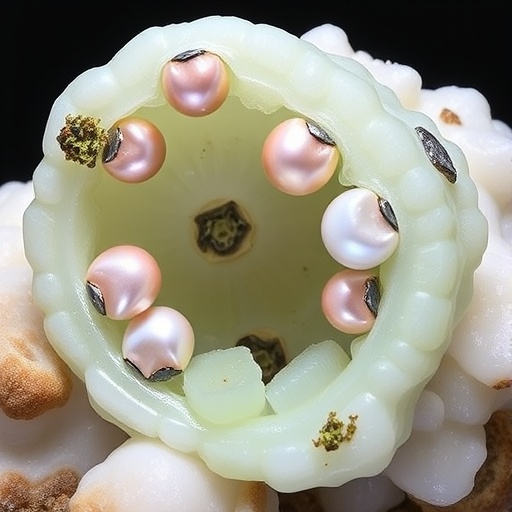
Recent research has illuminated the fascinating world of pearls, especially the unique composition of those deriving from marine mollusks of the genus Pinctada. Pearls, long esteemed for their beauty, hold more than just aesthetic value; they offer clues about environmental conditions and the biological processes of the organisms that produce them. This latest study sheds light on an intriguing mineral form known as vaterite that was identified within these natural saltwater pearls. Such discoveries not only heighten our appreciation of biogenic materials but also advance our understanding of biomineralization processes.
Throughout the years, pearls have been crafted and revered for their iridescence and charm. Multiple layers of aragonite and conchiolin typically compose traditional pearls, but the presence of vaterite in saltwater pearls adds a new dimension to our understanding. Vaterite, a less stable polymorph of calcium carbonate, is recognized for its unique crystalline structure. Its presence suggests that environmental factors during the formation of these pearls might influence the biochemical processes managed by the mollusks producing them. The proliferation of vaterite speaks to the adaptability of these creatures in their marine ecosystems.
Vaterite’s instability compared to aragonite raises intriguing questions about the conditions required for its formation. Researchers are keen to uncover the specific environmental parameters, such as temperature fluctuations and salinity levels, that could promote the formation of vaterite in saltwater pearls. By exploring these facets, scientists can begin to map how external conditions affect internal biological processes. Such discussions bridge gaps between geology, biology, and chemistry, illustrating nature’s complexity.
The study’s authors, Zhou, Jin, and Homkrajae, meticulously investigate the occurrence of vaterite, confirming its presence through rigorous analytical techniques. Utilizing methods such as X-ray diffraction and scanning electron microscopy, the research team was able to precisely identify the mineral structures. Their findings show that vaterite is not merely a byproduct of irregular formation but a component that might suggest finer applications and implications for understanding other biogenic materials within marine environments.
Understanding the role of vaterite in saltwater pearls could unlock new applications in materials science and biotechnology. The crystallization process exhibited by mollusks presents potential for biomanufacturing, where naturally derived materials can inspire innovation in creating sustainable products. The intricate process of pearl formation can inspire genetic and biochemical studies aimed at enhancing or replicating these phenomena in various industrial applications.
The implications of this research extend beyond just the novelty of mineral forms found in mollusks. By analyzing the pearls’ properties, researchers can infer health information about the surrounding environments where these organisms thrive. Changes in mollusk mineralization could serve as indicators of oceanic health, reflecting broader ecological conditions. Through this lens, vaterite doesn’t just add diversity to pearl composition; it also acts as a nugget of information relating directly to marine biology and environmental science.
As the study reveals the intricate relationship between marine biology and mineralogy, it proposes a multifaceted approach to studying other organisms capable of biomineralization. This exploration can widen our scope of understanding, paving the way for future studies of bio-inspired materials. Understanding how mollusks adapt their carbonate mineral forms in response to environment-driven challenges could lead to breakthroughs in multiple scientific fields.
Additionally, the research invites the art of pearl cultivation to reconsider its practices. Recognizing the presence of vaterite could influence future breeding and cultivation strategies. Pearl farmers can examine how environmental conditions affect the quality and properties of their products. This knowledge could foster unique marketing opportunities, positioning vaterite pearls as distinct offerings in the luxury goods market.
Colleagues in related fields are already excited about the findings and eager to pursue follow-up studies. This work not only establishes a baseline for vaterite studies in marine pearls but also effectively opens the door for interdisciplinary collaboration. Within the scientific community, the exploration of new mineral forms pertinent to organisms will invariably lead to richer dialogues and holistic studies of life’s interconnectedness.
Equipped with these newfound insights, experts also anticipate exploring the potential health benefits of pearls beyond their ornamental use. Traditionally considered a luxury item, these pearls might also come with beneficial properties, such as boosting wellness or serving therapeutic uses. Through this intricate web of discovery, pearls are seen not just as jewelry but as potential vessels of well-being.
The research further highlights the necessity of preserving marine ecosystems. As climate change continues to pressure ocean environments, the ability of organisms like mollusks to adapt is critical. The study marks a clarion call for stewardship over our oceans, advocating for protections that ensure these organisms can thrive in changing conditions.
As a compelling new volume in ongoing research on pearls and their properties, this study on vaterite exemplifies the unforeseen depth within natural materials. It illuminates how even the most beautiful entities are steeped in complex biological narratives. As scholars pursue these threads of inquiry, they may discover an entire universe of interactions that inform science, art, and environmental health.
In conclusion, the discovery of vaterite in natural pearls from Pinctada mollusks ushers in an exciting new chapter in the study of biomineralization and marine biology. This intricate interplay between environment and organism reflects a broader narrative of adaptation and resilience. As further research unfurls, the tale of these pearls promises to reveal even more secrets about our planet’s oceans and their inhabitants.
Cite Scienmag News
Drew Townsend. (October 29, 2025). Vaterite Discovered in Saltwater Pearls of Pinctada. Scienmag. https://scienmag.com/vaterite-discovered-in-saltwater-pearls-of-pinctada/
Drew Townsend. "Vaterite Discovered in Saltwater Pearls of Pinctada." Scienmag, 29 October 2025, https://scienmag.com/vaterite-discovered-in-saltwater-pearls-of-pinctada/. Accessed 3 September 2026.
Drew Townsend. "Vaterite Discovered in Saltwater Pearls of Pinctada." Scienmag. October 29, 2025. https://scienmag.com/vaterite-discovered-in-saltwater-pearls-of-pinctada/


