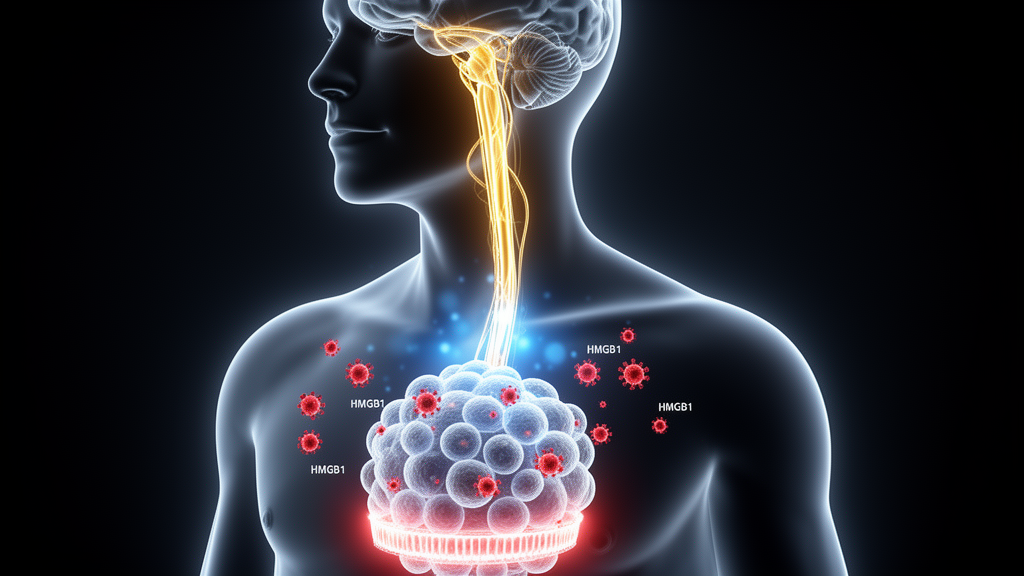
A new perspective published in Bioelectronic Medicine argues that the failure of drugs designed to neutralize the inflammatory protein HMGB1 may stem from targeting the wrong variable. Rather than the sheer amount of HMGB1 floating outside cells, the authors propose that what matters is its accessibility: whether the protein is free to assemble into pathogenic complexes, engage receptors, enter cells, and deliver inflammatory cargo to the cytosol. The article, written by Huan Yang, Michael Brines, and Ulf Andersson and published on 24 June 2026, weaves this idea into the established framework of the inflammatory reflex and the cholinergic anti-inflammatory pathway, positioning vagus nerve stimulation as a bioelectronic strategy that could act upstream of inflammation rather than merely damping cytokine signaling after the fact.
HMGB1, or high mobility group box 1 protein, is a highly conserved nuclear protein found in nearly all cells. Inside the cell it participates in chromatin organization and transcriptional regulation. Outside the cell, it acts as an alarmin, released by activated, stressed, or dying cells, and drives inflammatory responses through receptors including RAGE, the receptor for advanced glycation end products, and Toll-like receptor 4. It also contributes to nociception and persistent pain in inflammatory settings. Despite extensive preclinical evidence implicating HMGB1 in sepsis, arthritis, ischemia-reperfusion injury, neuropathic pain, and other disorders, therapeutic strategies designed to bind or neutralize extracellular HMGB1 have not yet delivered broad clinical benefit, a record that motivates the authors’ central question: are current strategies aimed at the right target?
The inflammatory reflex, first articulated by Tracey and colleagues, is a neural circuit that detects inflammatory signals and transmits efferent vagus nerve activity to restrain cytokine production and tissue injury. The cholinergic anti-inflammatory pathway is a mechanistic arm of this reflex in which acetylcholine signaling through alpha7 nicotinic acetylcholine receptors limits innate immune activation. This framework has provided the foundation for bioelectronic medicine and for developing vagus nerve stimulation as a way to control inflammation. The new perspective does not overturn that biology; instead, it places existing observations into a unifying model with direct relevance to inflammation and pain.
The pivotal conceptual move is to treat HMGB1 not as just another cytokine-like signaling protein but as a regulated carrier of inflammatory material. A defining feature of extracellular HMGB1 is its ability to bind a broad range of damage-associated and pathogen-associated molecular patterns, or DAMPs and PAMPs. This property reflects the structural flexibility and positive charge of HMGB1, which favor association with negatively charged ligands such as nucleic acids, microbial products, and other inflammatory mediators. These features enable HMGB1 to organize multiprotein or multimolecular complexes that preserve inflammatory cargo in a form competent for cellular delivery. A wide spectrum of confirmed binding partners includes DNA, RNA, nucleosomes, histones, interleukin-1 family members, the complement protein C1q, phosphatidylserine, lipopolysaccharide, lipoteichoic acid, hormones, bacterial toxins, and viral proteins including the SARS-CoV-2 spike protein.
The delivery mechanism centers on RAGE. RAGE-dependent endocytosis is described as a major route of HMGB1-mediated cellular entry: HMGB1-containing complexes are internalized through dynamin-dependent pathways and delivered to endolysosomal compartments, where acidic conditions enable HMGB1 to destabilize lysosomal membranes. This step is pivotal because it determines whether inflammatory cargo is degraded or instead escapes into the cytosol to engage intracellular sensors. As one detailed example, HMGB1 can bind extracellular lipopolysaccharide, promote its internalization through RAGE, and facilitate lysosomal leakage that allows LPS to reach the cytosol and activate inflammasome signaling through inflammatory molecules such as caspases. Notably, HMGB1 contains two distinct RAGE-binding sites, whereas interactions with other cognate receptors appear to involve only a single binding interface. Consistent with a central role for RAGE in HMGB1 trafficking, RAGE deficiency abolishes HMGB1 internalization, whereas genetic deletion of TLR2 or TLR4 does not prevent HMGB1 uptake.
Against this backdrop, the authors propose that acetylcholine can prevent HMGB1 inflammatory entry in two ways: by limiting its release and by impairing uptake of HMGB1-containing complexes. During injury or infection, HMGB1 is actively secreted by macrophages, nociceptors, microglia, and astrocytes through a mechanism requiring its hyperacetylation and translocation from the nucleus to the cytosol. In the presence of acetylcholine, however, signaling through the alpha7 nicotinic acetylcholine receptor promotes SIRT1-dependent deacetylation, favoring nuclear retention of HMGB1 and reducing its extracellular release. This mechanism provides a direct molecular bridge between acetylcholine released from the vagus nerve or other cells and the availability of an alarmin capable of driving inflammation and pain. Ongoing work continues to study how alpha7nAChR activation reduces RAGE-mediated endocytosis of HMGB1-containing complexes; plausible mechanisms include downregulation of RAGE, inhibition of RAGE transmembrane uptake, and modification of cytoskeletal dynamics.
The pain connection is a distinctive element of the argument. Nociceptors release HMGB1 in injured and inflamed tissues, where the protein can amplify neuroimmune signaling and sustain peripheral sensitization. That observation places HMGB1 at a biologically meaningful intersection between immune activation and pain. Inhibiting HMGB1 release from immune cells and nociceptors may therefore influence both inflammatory biomarkers and patient-centered pain outcomes. Both acetylcholine and alpha7nAChR-specific agonists inhibit neural HMGB1 release by retaining the protein within the nucleus, according to work cited in the perspective.
The translational implication is that vagus nerve stimulation, already an FDA-approved modality for rheumatoid arthritis, epilepsy, depression, and other conditions, could act not only by suppressing inflammatory cytokine production but also by controlling upstream HMGB1 accessibility. Electrical stimulation of the vagus nerve can activate pathways that increase cholinergic signaling, reduce HMGB1 release, and potentially diminish formation and uptake of HMGB1-containing complexes. Because HMGB1 is a late mediator in the host response to injury and infection, interventions that reduce HMGB1 mobilization may remain effective even after disease onset, a point the authors say helps explain the translational appeal of vagus nerve stimulation in inflammatory and pain-related disorders. Since the technology is already established in other indications, it offers a practical platform for testing whether control of HMGB1 accessibility improves human disease.
The reframing also explains why neutralization strategies may underperform despite strong experimental evidence implicating HMGB1 in disease. Therapies directed solely at extracellular HMGB1 after its release may fail when the protein is masked within complexes, measured incompletely, or already engaged in cellular delivery pathways. By contrast, interventions that reduce HMGB1 mobilization or block its accessibility may interrupt the process earlier. The authors frame their proposal as a testable hypothesis rather than a demonstrated clinical result, and they outline practical predictions. First, successful bioelectronic interventions should reduce not only soluble inflammatory mediators but also the formation and uptake of HMGB1-containing complexes. Second, early clinical and biomarker studies could pair vagus nerve stimulation with serial measurement of HMGB1 species and pain outcomes in disorders where both inflammation and symptoms are measurable.
The perspective stops short of claiming clinical efficacy for this specific mechanism; no new human trial data are presented, and the authors explicitly describe their contribution as a model that does not alter the established biology of HMGB1 but reorganizes it. What the argument offers, if it withstands testing, is a coherent account of a stubborn translational gap and a concrete research agenda: clinical studies of vagus nerve stimulation that track changes in HMGB1 mobilization, complex formation, and clinically meaningful pain outcomes alongside conventional cytokine biomarkers. If HMGB1 accessibility is indeed a regulated gateway for inflammation and pain, the gateway, rather than the traffic already through it, may be the more promising target for the next generation of bioelectronic therapies.
Subject of Research: A perspective on vagus nerve control of HMGB1 accessibility as a bioelectronic strategy for inflammation and pain
Article Title: Vagus nerve control of HMGB1 accessibility: a bioelectronic strategy for inflammation and pain
Article References: Yang, H., Brines, M., & Andersson, U. (2026). Vagus nerve control of HMGB1 accessibility: a bioelectronic strategy for inflammation and pain. Bioelectronic Medicine, 12(1), Article 15. https://doi.org/10.1186/s42234-026-00209-9
Image Credits: AI Generated
DOI: 10.1186/s42234-026-00209-9
Keywords: HMGB1, vagus nerve stimulation, bioelectronic medicine, cholinergic anti-inflammatory pathway, RAGE, inflammation, pain, alpha7 nicotinic acetylcholine receptor, inflammasome, DAMPs, PAMPs, nociceptors
Cite Scienmag News
Denise Maddox. (October 28, 2026). Vagus nerve stimulation may curb inflammation by controlling HMGB1 access to cells. Scienmag. https://scienmag.com/vagus-nerve-stimulation-may-curb-inflammation-by-controlling-hmgb1-access-to-cells/
Denise Maddox. "Vagus nerve stimulation may curb inflammation by controlling HMGB1 access to cells." Scienmag, 28 October 2026, https://scienmag.com/vagus-nerve-stimulation-may-curb-inflammation-by-controlling-hmgb1-access-to-cells/. Accessed 29 October 2026.
Denise Maddox. "Vagus nerve stimulation may curb inflammation by controlling HMGB1 access to cells." Scienmag. October 28, 2026. https://scienmag.com/vagus-nerve-stimulation-may-curb-inflammation-by-controlling-hmgb1-access-to-cells/