


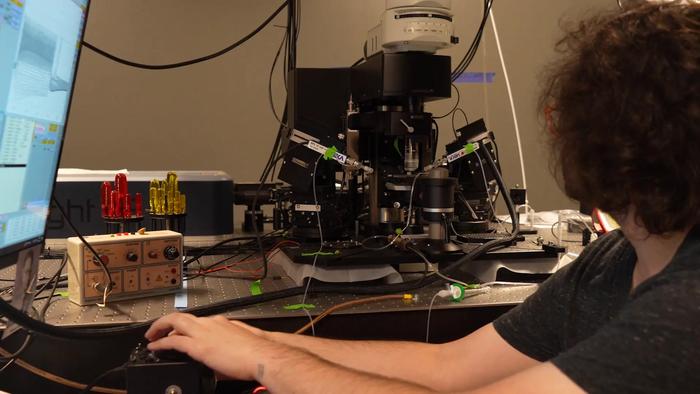
TAMPA, Fla. (May 24, 2024) – Through high-tech imaging and virtual reality, a University of South Florida medical engineering professor is creating a detailed map of the brain that can be used to better understand developmental disorders, such as autism, and provide earlier, more effective treatments for brain injuries and diseases.

Credit: University of South Florida
TAMPA, Fla. (May 24, 2024) – Through high-tech imaging and virtual reality, a University of South Florida medical engineering professor is creating a detailed map of the brain that can be used to better understand developmental disorders, such as autism, and provide earlier, more effective treatments for brain injuries and diseases.
Funded by a $3.3 million grant from the National Institutes of Health, George Spirou is expanding on his four decades of brain research to focus on the part of the brain that processes sound, called the calyx of Held – the largest nerve terminal in the human brain. Auditory dysfunction is often the source of symptoms of disorders, such as autism, which typically result in social and cognitive impairment.
“Even though we’re focusing on a specific part of the brain involved in hearing, the information we gather can help us understand serious developmental disorders that happen when the brain doesn’t develop properly early on,” Spirou said. “Our findings could also pave the way for innovative strategies to repair and reconnect damaged neural circuits affected by disease and injuries later in life.”
Using high-resolution imaging technology combined with image analysis inside the Auditory Development and Connectomics Laboratory at USF, Spirou is creating the most accurate developmental timeline for any neural system in the brain. They’re able to capture the journey of neurons in mice from birth to their establishment of intricate synaptic connections. According to the NIH, mice and human brains have very similar neuron types and connections.
With software created by Spirou and his colleagues, he and his doctoral student, Daniel Heller, are using virtual reality to intricately examine the neurons captured in the images and analyze the synapses through an immersive experience. While developing neural systems have been studied, Spirou said not at this combined level of temporal and spatial resolution.
“Between the fourth and fifth gestational months, the number of neurons in the nervous system just explodes almost exponentially and synapses are forming at a rate of about a million per second during that time, which is an incredible number when you consider there are almost 100 trillion synapses in an adult human brain,” he said. “I like to think of it as there are about 100 billion stars in the Milky Way, and there are about that many neurons in the brain.”
Heller has worked alongside Spirou for several years, even following him from West Virginia University to USF in 2019, so he could continue learning Spirou’s interdisciplinary and collaborative approach to research. Now close to graduation, Heller’s dissertation is largely focused on this project.
“At the cellular level, the physical manifestations of these disorders are caused by developmental defects in brain connectivity,” Heller said. “From a clinical perspective, researching therapeutics for these disorders is difficult without a better understanding of how the brain develops under normal conditions, and results in treating symptoms rather than aiming for a global cure.”
Over the next five years, their goal is to pinpoint what signals drive the precise formation of this particular neural system – a missing detail that once understood, would reveal how formation works in other neural circuits. In the event of an injury in a mature brain, this information would be helpful to help reorganize and possibly reconnect neurons to help patient recovery through surgery and other treatment options.
“I am totally fascinated by what’s happening at this stage of development in the brain and how the brain directs its own formation – that to me is enough to get me up in the morning and come in to do our work,” Spirou said.
Spirou and Heller are available to comment on the research. Please contact John Dudley (jjdudley@usf.edu or 814-490-3290) to schedule an interview.
This research is in collaboration with UC San Diego, Oregon Health & Science University, and the University of North Carolina at Chapel Hill, and uses syGlass VR software developed by Dr. Spirou and his colleagues.
###
About the University of South Florida
The University of South Florida, a high-impact research university dedicated to student success and committed to community engagement, generates an annual economic impact of more than $6 billion. With campuses in Tampa, St. Petersburg and Sarasota-Manatee, USF serves approximately 50,000 students who represent nearly 150 different countries. U.S. News & World Report has ranked USF as one of the nation’s top 50 public universities for five consecutive years, and this year USF earned its highest ranking ever among all universities public or private. In 2023, USF became the first public university in Florida in nearly 40 years to be invited to join the Association of American Universities, a prestigious group of the leading universities in the United States and Canada. Through hundreds of millions of dollars in research activity each year and as one of the top universities in the world for securing new patents, USF is a leader in solving global problems and improving lives. USF is a member of the American Athletic Conference. Learn more at www.usf.edu.
Cite Scienmag News
Cassandra Pierce. (May 24, 2024). USF researcher using VR to map the brain, understand and treat disorders such as autism. Scienmag. https://scienmag.com/usf-researcher-using-vr-to-map-the-brain-understand-and-treat-disorders-such-as-autism/
Cassandra Pierce. "USF researcher using VR to map the brain, understand and treat disorders such as autism." Scienmag, 24 May 2024, https://scienmag.com/usf-researcher-using-vr-to-map-the-brain-understand-and-treat-disorders-such-as-autism/. Accessed 3 September 2026.
Cassandra Pierce. "USF researcher using VR to map the brain, understand and treat disorders such as autism." Scienmag. May 24, 2024. https://scienmag.com/usf-researcher-using-vr-to-map-the-brain-understand-and-treat-disorders-such-as-autism/

