


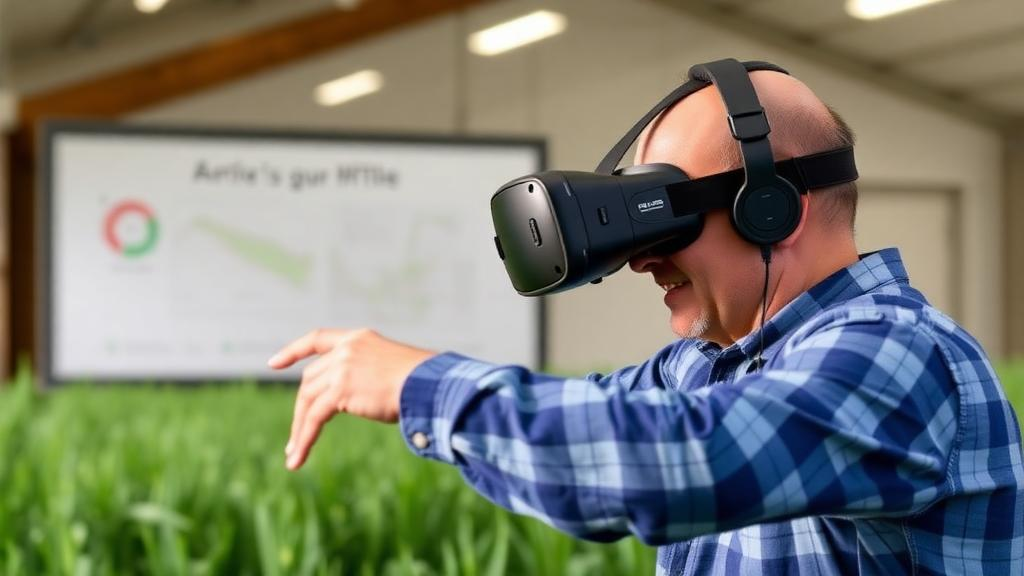
A small college in upstate New York is betting that a headset may be the key to unlocking technical education for farmers who cannot afford to leave their fields. SUNY Cobleskill Agriculture and Technology has been awarded a $30,000 grant from the U.S. Department of Agriculture’s National Institute of Food and Agriculture (NIFA) to build a prototype virtual reality course in agricultural engineering, a project designed to bring hands-on style training to rural and place-bound learners without requiring them to set foot on a campus. Over the next two years, faculty at the college will design the learning architecture of the course, build a working VR module, and prepare the groundwork for a larger study comparing how students perform in the virtual environment against those taught in a traditional classroom.
The funding comes through NIFA’s Capacity Building Grants for Non-Land-Grant Colleges of Agriculture program, often abbreviated NLGCA, which exists specifically to strengthen institutions that do not hold land-grant status. SUNY Cobleskill is one of 24 institutions nationwide to receive a Capacity Building Grant this year, part of a broader $5 million investment NIFA is making to expand education, research, and outreach capacity at non-land-grant agricultural colleges. The Research Foundation for SUNY will administer the award on behalf of the State University of New York, handling the fiscal oversight that allows faculty to focus on course development rather than grant management.
The premise behind the project is deceptively simple: agricultural engineering is a discipline built on physical systems, and learning it has traditionally demanded physical presence. Students need to stand next to an irrigation pump, trace the hydraulics of a tractor, or inspect the geometry of a grain auger to understand how these machines work and why they fail. For farmers running working operations, however, traveling to a campus for a semester is rarely feasible. The result is a persistent skills gap in rural communities, where equipment downtime can translate directly into lost productivity and where reliance on outside specialists adds costs that many small farms struggle to absorb.
Virtual reality offers a possible bridge across that gap. In a well-designed VR environment, a learner can walk around a three-dimensional model of agricultural machinery, manipulate components, observe how systems interact, and repeat procedures as many times as needed without risk to equipment or livestock. The technology has matured considerably in recent years, with consumer-grade headsets now capable of rendering detailed interactive scenes at a fraction of the cost of earlier systems. For disciplines like agricultural engineering, where the objects of study are large, expensive, and often geographically dispersed, the ability to simulate equipment in a virtual space could make technical instruction dramatically more accessible.
Dr. Ian MacDonald, Interim Assistant Vice President for Academic Affairs and Dean of Faculty at SUNY Cobleskill, framed the grant as a matter of educational equity. “Access to a quality education shouldn’t depend on how far someone lives from a college campus,” MacDonald said in the announcement. According to MacDonald, the project aims to give rural farmers a way to gain skills that could reduce how much they spend on outside specialists, cut down on time lost to non-functioning equipment, and strengthen their farms’ overall productivity, all without requiring them to leave or pause their operations in the process. That framing positions the VR course not as a novelty but as a practical tool aimed at measurable economic outcomes for working farms.
The two-year plan laid out under the grant is deliberately staged. In the first phase, faculty leaders will map out course learning objectives across three delivery formats: in-person instruction, conventional online learning, and virtual reality. This cross-format alignment is a critical technical step, because a VR module that teaches different skills, or teaches them to a different depth, than its classroom counterpart would make meaningful comparison impossible. By defining what students should know and be able to do regardless of format, the team establishes the common yardstick against which the virtual course will eventually be judged.
By the end of the grant period, the team expects to have a working VR course module in hand, along with a proposal for a follow-on NLGCA grant. That follow-on proposal would fund a formal pilot of the course with actual students and, importantly, a controlled comparison of their outcomes against a traditional in-person classroom. This experimental design reflects a growing expectation in educational technology research that immersive tools must demonstrate learning gains, not just engagement, before they are adopted at scale. The prototype phase is where the pedagogical heavy lifting happens: translating laboratory procedures and machine diagnostics into interactive scenarios that preserve the tactile and spatial reasoning that agricultural engineering demands.
The choice of agricultural engineering as the test subject is strategic. The field sits at the intersection of mechanical systems, power technology, soil and water management, and precision agriculture, and it is precisely the kind of discipline where place-bound learners face the steepest barriers. A farmer in a remote county may be an expert in the biological side of the operation yet lack formal training in the machinery that underpins it. When a combine fails during harvest or an irrigation system goes down mid-season, the difference between a quick fix and a week of lost production often comes down to technical knowledge. Delivering that knowledge through VR means the classroom can travel to the farm rather than the other way around.
The project also speaks to the evolving mission of institutions like SUNY Cobleskill, which describes itself as SUNY’s leading institution of Agriculture and Technology and emphasizes hands-on learning as its guiding principle. As SUNY’s flagship for the intersection of agriculture and technology, the college has built its identity on personal, collaborative learning experiences designed to move students from classroom knowledge to career application. A VR initiative extends that philosophy into a new medium, asking whether the college’s signature practical approach can be reproduced in digital form for learners who will never sit in its laboratories. The answer, if the prototype succeeds, could reshape how non-land-grant colleges across the country think about their outreach obligations.
The broader NIFA investment underscores how seriously federal agricultural agencies are taking the capacity problem. The $5 million distributed across 24 Capacity Building Grants this year is intended to help non-land-grant agricultural colleges expand education, research, and outreach in agriculture and related fields, closing the historical resource gap between them and their land-grant counterparts. For SUNY Cobleskill, the $30,000 award is modest by research standards, but prototype grants of this size are designed to generate exactly the kind of preliminary evidence that unlocks larger awards. If the VR module demonstrates that immersive instruction can match classroom outcomes, the follow-on pilot could become a template for delivering agricultural engineering education to the rural communities that need it most, one headset at a time.
Subject of Research: Development of a virtual reality agricultural engineering course for rural farmers funded by a USDA NIFA capacity building grant
Article Title: SUNY Cobleskill Ag & Tech awarded USDA grant to develop virtual reality course in agricultural engineering
Article References: SUNY Cobleskill Ag & Tech awarded USDA grant to develop virtual reality course in agricultural engineering. (n.d.). Original publication
Image Credits: AI Generated
DOI: Not provided
Keywords: virtual reality, agricultural engineering, USDA, NIFA, SUNY Cobleskill, rural education, distance learning, farm technology, capacity building grants, educational technology, place-bound learners, agricultural training
Cite Scienmag News
Denise Maddox. (October 6, 2026). USDA Grant Sends Agricultural Engineering Lessons Into Virtual Reality for Rural Farmers. Scienmag. https://scienmag.com/usda-grant-sends-agricultural-engineering-lessons-into-virtual-reality-for-rural-farmers/
Denise Maddox. "USDA Grant Sends Agricultural Engineering Lessons Into Virtual Reality for Rural Farmers." Scienmag, 6 October 2026, https://scienmag.com/usda-grant-sends-agricultural-engineering-lessons-into-virtual-reality-for-rural-farmers/. Accessed 6 October 2026.
Denise Maddox. "USDA Grant Sends Agricultural Engineering Lessons Into Virtual Reality for Rural Farmers." Scienmag. October 6, 2026. https://scienmag.com/usda-grant-sends-agricultural-engineering-lessons-into-virtual-reality-for-rural-farmers/


