


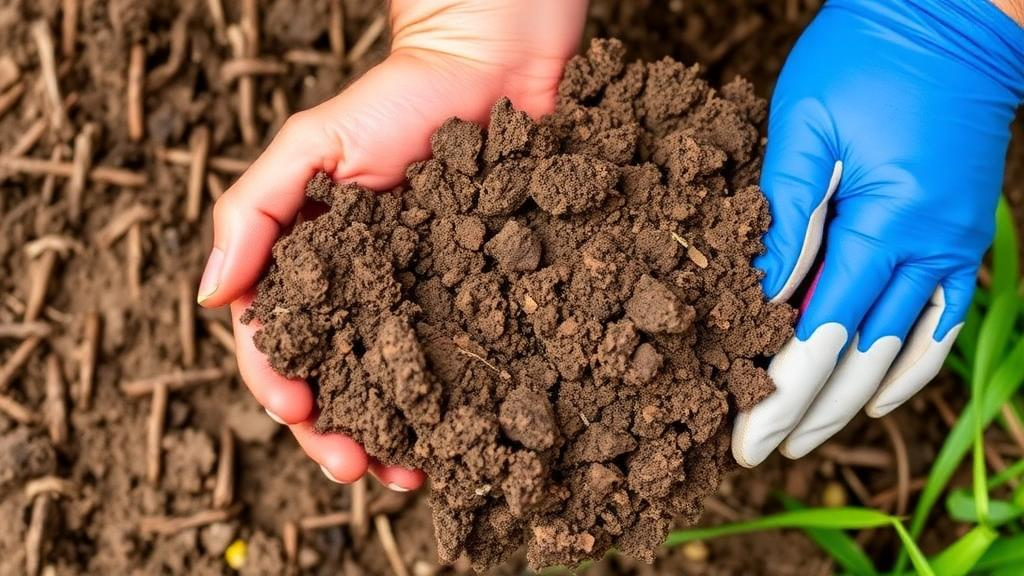
Every year, billions of disposable gloves are pulled on, used once, and thrown away. Most are destined for landfills, where their vulcanized, water-insoluble structure means they will persist for decades. But a new study published in Discover Soil suggests that this mountain of waste natural rubber latex could have a second life underground—as a soil conditioner that measurably improves fertility and accelerates plant growth. The finding, if it survives long-term scrutiny, could turn a stubborn waste stream into a genuine agricultural resource.
The research team, led by Maulik Chauhan of Balkrishna Industries Limited together with Bhakti Patel and Rupande Desai of L. D. College of Engineering in Ahmedabad, India, started from a simple chemical insight. Natural rubber latex gloves are made from polyisoprene, a polymer extracted from the Hevea brasiliensis tree, along with one to two percent non-rubber substances such as proteins, lipids, and carbohydrates. Because polyisoprene is a natural organic compound already circulating through what scientists call the isoprene cycle, the authors reasoned that finely ground glove material might enrich soil organic matter rather than poison it.
The experimental protocol was deliberately thorough. Waste gloves collected from non-contaminated industrial and laboratory sources were washed in distilled water, boiled for an hour to strip away surface impurities, sterilized in a diluted antimicrobial solution containing chlorhexidine and ethanol, dried, and mechanically crushed into fine particles. These particles were then mixed into nursery soil at a loading of ten percent by weight—a ratio chosen after preliminary trials balancing soil workability, moisture retention, and mixing uniformity. Every laboratory experiment was run in triplicate to strengthen statistical reliability.
The team then put the amended soil to work across four phases of testing. In the first, onion bulbs were planted in paired vessels of 500 grams of soil each, one with glove particles and one without, under identical light, irrigation, and temperature conditions. Photographic records taken on days 1, 17, 25, and 32 showed that germination began earlier in the glove-amended soil, and by harvest the treated plants had accumulated noticeably more biomass. Fresh weights were measured immediately, while dry biomass was determined after oven-drying at 60 degrees Celsius for 24 hours until constant weight.
The second phase repeated the design with bean plants and produced the same pattern: improved root development, healthier stems, and consistent gains in plant height and biomass across triplicate runs. Crucially, the researchers observed no toxicity symptoms—no leaf discoloration, no delayed germination, no stunted growth. The third phase moved outdoors, with two two-by-two-meter plots of Napier grass planted under natural conditions of 28 to 35 degrees Celsius. One plot received commercial fertilizer, the other only processed glove particles. After 30 days, the glove-fertilized plot held its own on propagation rate, stem thickness, and plant density.
The fourth phase delivered perhaps the most visually striking result. Flowering plants grown in glove-amended garden soil produced denser, faster blooms than those fed conventional market fertilizer. The authors link this to a surge in available manganese, a micronutrient central to photosynthesis whose deficiency is common in soils with pH above 6. Cereal crops, beans, and potatoes are among the plants that favor higher manganese levels, hinting at where this approach might pay off most.
The laboratory soil analysis told a consistent story. Elemental testing using standard agricultural methods—the Kjeldahl method for nitrogen, the Olsen method for phosphorus, and flame photometry for potassium—revealed increases of 7.94 percent in phosphorus, 36.07 percent in copper, 51.90 percent in manganese, and 5.75 percent in sulfur compared with control soil. Soil pH remained stable, meaning the gloves preserved the soil’s original chemical character. Nitrogen rose slightly, attributed to the protein content of natural latex, while salt levels improved by roughly ten percent. Potassium, notably, did not budge—unsurprising, the authors note, since neither the polymer nor the glove additives contain it.
Statistical analysis confirmed that the growth differences were significant, with treated plants showing approximately 20 to 35 percent higher biomass than controls at p below 0.05. The mechanism, the researchers argue, is a combination of factors rather than rapid rubber degradation. Vulcanized polyisoprene breaks down slowly because sulfur crosslinking locks the polymer network together. Instead, the gains likely come from hydrophilic proteins holding moisture, improved soil aeration, and the gradual release of biodegradable non-rubber constituents and micronutrient-bearing additives such as zinc oxide activators, sulfur curatives, and carbamate and thiazole accelerators—compounds that, at low concentrations, can even act as mild fungicides and insecticides.
The authors are careful not to oversell the result. They explicitly state that waste latex gloves should not replace conventional fertilizers but rather supplement them within integrated nutrient management. And they flag serious open questions: vulcanized rubber fragments slowly and may generate microplastic particles over time; additives such as zinc compounds could accumulate to ecotoxicological levels with repeated application; and the long-term effects on soil microbial communities, nutrient transport, and root interactions remain unquantified. Establishing safe application limits will require dedicated studies on biodegradation behavior, additive migration, and soil ecotoxicology.
Still, the waste-to-wealth logic is compelling, and the future applications extend beyond ordinary farmland. Because the glove particles improve moisture retention and soil stabilization, the authors suggest the approach could benefit arid and erosion-prone regions where water is scarce and soils are weak—potentially reducing both fertilizer and irrigation demand. A ten-year projection of plant biomass included in the study sketches the scale of what controlled, long-term use might achieve. If follow-up research confirms environmental safety, the humble disposable glove may yet trade its place in the landfill for a productive role in the ground.
Subject of Research: Using processed waste natural rubber latex gloves as a soil amendment to enhance soil fertility and plant growth
Article Title: Enhancement of soil fertility using waste natural rubber latex gloves
Article References: Chauhan, M., Patel, B., & Desai, R. (2026). Enhancement of soil fertility using waste natural rubber latex gloves. Discover Soil, 3(1), Article 110. https://doi.org/10.1007/s44378-026-00272-3
Image Credits: AI Generated
DOI: 10.1007/s44378-026-00272-3
Keywords: natural rubber latex, soil fertility, soil amendment, waste management, circular economy, polyisoprene, soil organic matter, micronutrients, manganese, sustainable agriculture, plant biomass, germination
Cite Scienmag News
Alan Morgan. (October 6, 2026). Discarded Rubber Gloves Could Give Farm Soil a Surprising Boost. Scienmag. https://scienmag.com/discarded-rubber-gloves-could-give-farm-soil-a-surprising-boost/
Alan Morgan. "Discarded Rubber Gloves Could Give Farm Soil a Surprising Boost." Scienmag, 6 October 2026, https://scienmag.com/discarded-rubber-gloves-could-give-farm-soil-a-surprising-boost/. Accessed 6 October 2026.
Alan Morgan. "Discarded Rubber Gloves Could Give Farm Soil a Surprising Boost." Scienmag. October 6, 2026. https://scienmag.com/discarded-rubber-gloves-could-give-farm-soil-a-surprising-boost/


