


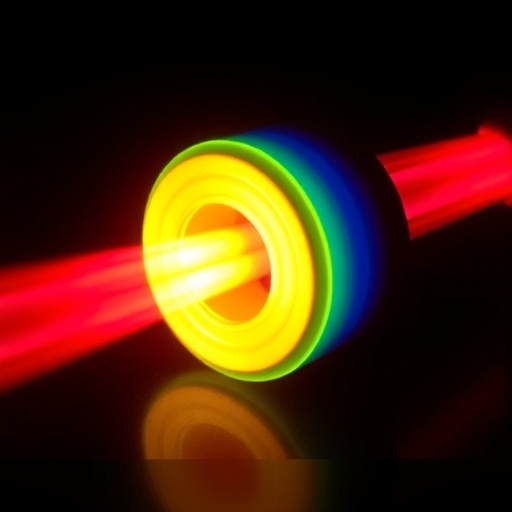
A groundbreaking advancement in the realm of optics has come from a talented team at the University of Southern California’s Viterbi School of Engineering. A group of researchers in the Ming Hsieh Department of Electrical and Computer Engineering has successfully engineered an innovative optical device creating a new paradigm based on the principles of optical thermodynamics. This revolutionary work, published in the esteemed journal Nature Photonics, presents a fresh approach to directing light in nonlinear optical systems—an effort that could have vast implications for the future of technology as we know it.
In the arena of engineering, the quest for effective routing of signals has been a familiar challenge, akin to navigating through a complex maze. In conventional scenarios, routing requires meticulous control and management, often involving troublesome switches, regulatory mechanisms, and electronic systems that can bog down performance due to their inherent complexity. The innovative approach showcased by the USC team proposes a route free from these cumbersome elements. Instead of needing an intricate web of connectors to guide light paths, the device operates on inherent physical principles derived from thermodynamics.
To understand this advancement, one must first grasp the fundamental concept behind routing light effectively. Traditional optical routers mimic the functionality of their electronic counterparts, tasked with directing data signals toward their intended destinations. Yet, the optical router previously relied on electronic controls and switches, leading to constraints that hampered speed and efficiency levels. The USC research team, however, has discovered a design that empowers light to find its own pathway. Rather than imposing strict control, the optical framework allows signals to navigate naturally, akin to a marble autonomously rolling through a maze and finding the exit.
This self-routing capability stems from the innovative structure of the USC device, which operates under principles similar to thermal equilibrium achieved in gases. By considering light’s behavior in nonlinear multimode optical systems—conventional systems often criticized for their chaotic nature—the research presents a new understanding of how light can achieve organized routing without the necessity of external interventions. The USC’s optical thermodynamic device utilizes a two-step process that mirrors the Joule-Thomson expansion phenomenon, allowing light to redistribute and naturally reach an output channel.
Such a development bears extraordinary implications beyond theoretical exploration; it signifies a potential paradigm shift in fields ranging from telecommunications to high-performance computing. As the technological ecosystem grows increasingly reliant on rapid information processing, organizations like NVIDIA are eyeing optical interconnects as a solution to improve efficiency. As conventional electronics face limits in speed and power, the self-organizing features of optical thermodynamics offer a glimpse into transformative next-generation technologies capable of circumventing these limitations with ease.
Moreover, the USC framework unfolds a new frontier of design possibilities, giving rise to advanced photonic devices that embrace the inherent complexities of nonlinear optical systems rather than constraining them. The ability to merge theoretical knowledge with practical applications highlights the significant contributions this research could provide to scientific and engineering communities. This could foster a remarkable evolution in light management and open doors to exciting realms of fundamental research in high-speed data; possibilities include enhanced secure communications and novel paradigms in processing information.
Through meticulous experimentation and theoretical development, the research team has confronted the challenge of translating chaotic optical behaviors into predictable and manageable designs. By recognizing the parallels between the energy transitions of light and those of thermodynamics, they crafted an optical device that routes light exclusively through properties of nature rather than forcing rigid controls. This insightful understanding fundamentally redefines the engineers’ approach regarding light and electromagnetic signal control.
The findings presented in Nature Photonics mark a pivotal moment in the ongoing quest for efficient light routing mechanisms. No longer will engineers need to fear the intricate chaos presented by nonlinear optical systems; instead, they can usher in an era that capitalizes on these understood phenomena, reinforcing a new wave of optical devices and technologies that could underpin future innovations.
In essence, the USC Viterbi team’s work showcases the potential of utilizing thermodynamic principles to address one of electrical engineering’s most challenging aspects. This breakthrough sets the stage for continued research that boldly plunges into the realm of chaos, harnessing it to produce reliable, high-performing devices capable of advanced data routing solutions.
As the team continues its investigation into the realms of optical thermodynamics, the implications of this research promise to ripple through various sectors, enhancing existing technologies and paving the way for the integration of optical solutions into daily applications. With a vision rooted in overcoming previous limitations, the potential for future discoveries could redefine our interaction with technology and information at large.
In conclusion, this transformational research on optical devices serves as a beacon of innovation, illuminating pathways to advance our understanding of photonics in everyday tech. The interplay between chaos and thermodynamic stability could not only transform scientific practices but also influence the next generation of engineers set on designing more effective and reliable systems for an increasingly interconnected world.
Keywords
Applied sciences, Engineering, Electrical engineering, Optics, Photonics, Nonlinear systems, Thermodynamics, Information processing, Telecommunications, High-performance computing.
Cite Scienmag News
Kelsey Dorsey. (October 6, 2025). USC Team Unveils Groundbreaking Optical Device Inspired by Optical Thermodynamics. Scienmag. https://scienmag.com/usc-team-unveils-groundbreaking-optical-device-inspired-by-optical-thermodynamics/
Kelsey Dorsey. "USC Team Unveils Groundbreaking Optical Device Inspired by Optical Thermodynamics." Scienmag, 6 October 2025, https://scienmag.com/usc-team-unveils-groundbreaking-optical-device-inspired-by-optical-thermodynamics/. Accessed 6 September 2026.
Kelsey Dorsey. "USC Team Unveils Groundbreaking Optical Device Inspired by Optical Thermodynamics." Scienmag. October 6, 2025. https://scienmag.com/usc-team-unveils-groundbreaking-optical-device-inspired-by-optical-thermodynamics/


