


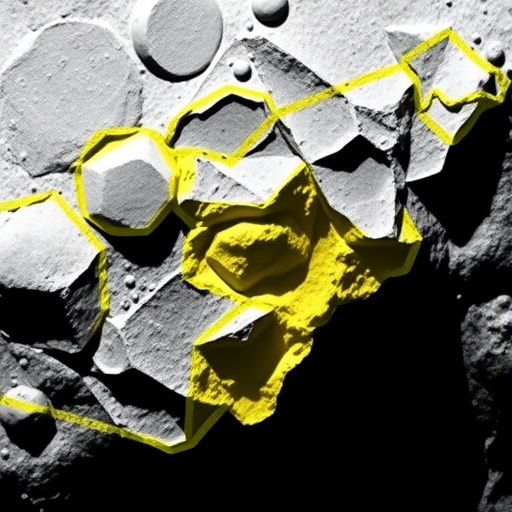
In a groundbreaking study, researchers have embarked on a remarkable journey into the secrets harbored by lunar samples from NASA’s Apollo 17 mission. This mission, which took place in 1972, marked the final chapter of human lunar exploration, and since then, some of the precious geological samples collected have been preserved, sealed, and stored away for future research endeavors. The team, led by a professor from Brown University, has successfully employed cutting-edge analytical techniques to reveal intriguing insights that challenge our understanding of the Moon’s composition and formation.
The core discovery made by this research team revolves around the surprising detection of sulfur compounds in lunar rocks obtained from the Taurus Littrow region during Apollo 17. Initially, it was expected that the sulfur isotope ratios observed would closely mirror those found on Earth. However, the analysis revealed a stark contrast: the lunar samples were found to be significantly depleted in sulfur-33, one of the four stable isotopes of sulfur. This unexpected finding raises questions about the geological and atmospheric processes that have shaped the Moon over its extensive history.
Isotopic signatures, often described as elemental “fingerprints,” are crucial for understanding the origins and evolution of rock samples. The variations in isotopic ratios provide hints about the geological processes that a rock has undergone throughout its life. In the case of lunar and terrestrial rocks, scientists have previously noted similarities in their oxygen isotopes, which led to assumptions that sulfur isotopes would follow suit. James Dottin, the leading researcher, affirms that the initial hypothesis anticipated a consistency in sulfur isotope composition between the Earth and the Moon, making the profound differences detected in the lunar samples all the more astonishing.
Analyzing the samples in question involved utilizing a sophisticated method called secondary ion mass spectrometry, a technique that allows scientists to measure isotopic compositions with unparalleled precision. This technique was unavailable at the time of the Apollo missions, so Dottin and his team were keen to employ it to unlock the lunar samples’ secrets. The samples in focus were carefully selected from a double drive tube, a cylindrical container that was deeply embedded into the Moon’s regolith by Apollo 17 astronauts Gene Cernan and Harrison Schmitt. The meticulous preservation of these samples, placed in a helium chamber by NASA, ensured they were kept in pristine condition for examination long after their return to Earth.
The implications of the findings are twofold, as Dottin discusses. One potential explanation for the bizarre sulfur isotope ratios is that they may represent a remnant of early atmospheric processes on the Moon. It is theorized that the Moon had a transient atmosphere shortly after its formation, which could have allowed for unique photochemical reactions involving sulfur. This conclusion suggests a fascinating possibility that the Moon underwent geological and atmospheric interactions distinctly different from those on Earth.
On the other hand, the second potential explanation for the anomalous sulfur isotopes points toward the Moon’s formation itself. The prevailing theory about the Moon’s origin suggests that a Mars-sized object named Theia collided with Earth. This catastrophic event would have expelled debris, which eventually coalesced to form the Moon. The differences in sulfur isotopic signatures may imply that the sulfur within Theia had a composition that significantly diverged from that of Earth, leading to the recorded variations now observed in lunar samples.
However, the research does not conclusively pinpoint which of these two explanations accurately describes the origin of the anomalous sulfur signatures. Dottin emphasizes the necessity for continued investigation, indicating that future studies of sulfur isotopes from other celestial bodies, including Mars, may provide vital clues to unraveling this cosmic mystery. The overarching goal is to deepen our understanding of isotope distribution within our solar system and elucidate the fundamental processes that shaped planetary bodies.
Moreover, this research not only sheds light on lunar geology but also raises questions regarding the interactions between celestial bodies and the various processes involved in their development. The findings underscore the complexity of the solar system’s evolutionary history and the intricate connections that exist among planets. Such research contributes to a broader comprehension of planetary science and the formation of celestial structures.
This new work represents a significant leap in our understanding of the Moon’s geological past and raises profound questions about its early environment. As scientists continue to explore and analyze samples from the Apollo missions, discoveries like those reported in this study will pave the way for future lunar exploration and deepen our understanding of planetary formation across the solar system. The revelations from these ancient samples hold the potential to reshape our comprehension of the Moon and, by extension, offer insights into the origins and evolution of the Earth itself.
The application of advanced technologies like secondary ion mass spectrometry in analyzing these samples emphasizes the importance of modern scientific advancements to uncover the mysteries of the past. This research acts as a reminder of the potential still left within the samples collected decades ago, beckoning contemporary scientists to revisit and reexamine what was once painstakingly gathered from the lunar surface. The expectation that the Moon could still yield surprises reinforces the argument for ongoing investment in planetary science and exploration.
This study is a testament to how much there is yet to learn about our nearest celestial neighbor. As the mysteries of the lunar mantle and its evolution unfold, the hope is to better understand the processes that not only crafted the Moon but also offer lessons applicable to the exploration of other planetary bodies in our solar system. The continuous pursuit of knowledge in this field is vital for the future of space exploration and the quest to unravel the history of the cosmos.
Keywords
Lunar samples, isotope ratios, Apollo 17, sulfur isotopes, planetary science, geological processes, secondary ion mass spectrometry, Moon formation, sulfur compounds, photochemistry, cosmic evolution, space exploration.
Cite Scienmag News
Violet Maxwell. (October 6, 2025). New Analysis of 1972 Apollo Samples Uncovers Exotic Sulfur Concealed in the Moon’s Mantle. Scienmag. https://scienmag.com/new-analysis-of-1972-apollo-samples-uncovers-exotic-sulfur-concealed-in-the-moons-mantle/
Violet Maxwell. "New Analysis of 1972 Apollo Samples Uncovers Exotic Sulfur Concealed in the Moon’s Mantle." Scienmag, 6 October 2025, https://scienmag.com/new-analysis-of-1972-apollo-samples-uncovers-exotic-sulfur-concealed-in-the-moons-mantle/. Accessed 4 September 2026.
Violet Maxwell. "New Analysis of 1972 Apollo Samples Uncovers Exotic Sulfur Concealed in the Moon’s Mantle." Scienmag. October 6, 2025. https://scienmag.com/new-analysis-of-1972-apollo-samples-uncovers-exotic-sulfur-concealed-in-the-moons-mantle/


