


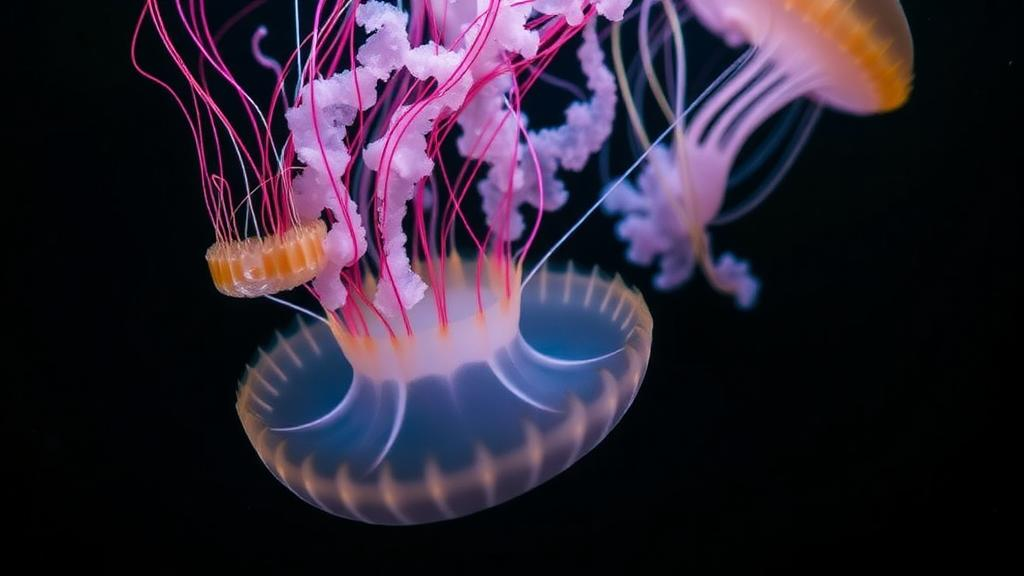
On the shallow, sunlit floors of tropical lagoons and mangrove creeks, a strange animal lies flat against the sediment with its arms raised to the sky. The upside-down jellyfish of the genus Cassiopea spends most of its life in this inverted posture, and a new comprehensive review published in Discover Ecology argues that this peculiar orientation is far more than a curiosity. It is the foundation of a suite of ecological roles that make these jellyfish simultaneously ecosystem engineers, bioindicators of coastal pollution, and increasingly important players in marine food webs, particularly across the Western Atlantic.
The review, led by Ramón Damián Morejón-Arrojo of the Institute of Marine Science in Havana together with colleagues in the United States and Spain, synthesizes decades of scattered research into a single framework for understanding the genus. Cassiopea comprises roughly twelve confirmed species distributed across the tropical and subtropical waters of the Atlantic, Indian and Pacific Oceans, inhabiting coral reefs, mangroves, seagrass meadows and coastal lagoons. Yet the authors found that field-based studies make up only about fourteen percent of the roughly 195 papers published on the genus between 1774 and 2023, and most of that fieldwork has been concentrated in the Western Atlantic, leaving the global ecology of these animals poorly understood.
The key to Cassiopea’s success lies in its biology. Unlike most jellyfish, which drift through the water column, Cassiopea medusae rest bell-down on the substrate with their frilly oral arms pointing upward, maximizing the sunlight that reaches the millions of dinoflagellate algae living inside their tissues. These symbionts, members of the family Symbiodiniaceae, supply up to seventy percent of the jellyfish’s basal energy requirements through photosynthesis. The partnership is so essential that the algae are required for strobilation, the process by which a sessile polyp transforms into a free-swimming juvenile medusa. Without the symbionts, the life cycle simply cannot complete in nature.
That dependence shapes every stage of development. Cassiopea medusae are usually gonochoric, meaning they have separate sexes, and fertilization occurs inside the female’s gastrovascular system. Embryos develop on the oral disc, become ciliated within about forty-eight hours, and by ninety-six hours form swimming planula larvae that eventually settle and metamorphose into polyps. Polyps reproduce asexually by releasing planuloid buds at a rate of two to three per day, and they acquire their algal symbionts only after settling. Larval settlement itself is triggered by specific bacteria such as Pseudoalteromonas and Vibrio and by compounds released from degrading red mangrove leaves, including a peptide of roughly 5.8 kilodaltons. Strobilation typically begins about three weeks after settlement and infection, generally at temperatures above twenty-eight degrees Celsius, and does not occur at twenty degrees or below even when food is abundant.
As adults, the jellyfish are mixotrophs, combining photosynthetic nutrition with active predation. Their bell pulses up to fifty times per minute, drawing water and prey into the space between the subumbrella and the oral arms, where finger-like structures called digitata armed with nematocysts intercept small animals. Gut-content analyses across Panama, Florida, Cuba, the Philippines, Italy and Australia show a remarkably consistent diet dominated by epibenthic crustaceans, especially harpacticoid copepods, along with ostracods, tanaids, mysids, nematodes and other small invertebrates. Larger medusae consume more prey, and the same pulsing that captures food also serves respiration, waste removal, gamete dispersal and the mobilization of nutrients from sediment pore waters, which in turn may boost the productivity of the algal symbionts.
It is this relentless pumping that gives Cassiopea its reputation as an ecosystem engineer. In habitats with little water movement, such as mangrove systems, the jellyfish act as living pumps that mix the water column and draw nutrient-rich interstitial water out of the sediment. They function as hotspots of nutrient excretion and oxygen consumption in the dark, and as oxygen producers and nutrient assimilators in the light, with effects on ammonium regeneration and oxygen concentrations that follow the daily rhythm of their symbionts’ photosynthesis. Their pulsations also release copious mucus loaded with dissolved organic matter, including proteins, lipids and carbohydrates, which fuels microbial growth and shapes biogeochemical cycling in the surrounding water.
The same sensitivity to its environment that makes Cassiopea an engineer also makes it a sentinel. The jellyfish respond rapidly to elevated metals and nutrients, and their tissues can accumulate trace metals such as lithium, copper, manganese and zinc at concentrations up to two hundred times those found in seawater. They have been used as models in ecotoxicological studies of herbicides such as atrazine and hexazinone, and microplastics have been detected in specimens from Florida estuaries, apparently trapped in their oral arms rather than ingested. Remarkably, in polluted habitats the jellyfish appear to tolerate contamination by shifting toward anaerobic metabolism, with elevated activity of glycolytic enzymes such as pyruvate kinase and lactate dehydrogenase allowing energy production even under low-oxygen stress, an adaptation that lets them thrive where many other invertebrates decline.
That tolerance helps explain a troubling pattern: Cassiopea blooms are increasingly associated with human-impacted coasts. Nutrient enrichment from agricultural runoff and coastal development correlates with high densities, with the highest reported abundance reaching about 106 individuals per square meter in Codrington, Barbuda, compared with as little as 0.06 per square meter in Lake Macquarie, Australia. Densities this high can alter benthic invertebrate communities, reduce seagrass cover, and compete with vegetation for light, since the jellyfish often rest directly on top of seagrass shoots. The review also documents an inverse relationship between population density and average bell diameter, likely reflecting competition for prey and nutrients at high densities, although nutrient loading can partially offset this constraint by boosting individual growth.
The genus is also expanding its range, and human activity appears to be a major driver. Invasions have been recorded in Australia, India, Vietnam, the Cape Verde and Canary Islands, the Mediterranean, Hawaii, Brazil and the Caribbean, and one hypothesis links the Indo-Pacific spread to the movement of United States naval vessels during the Second World War. Modified coastal habitats such as marinas and shrimp farms act as springboards for establishment, offering stable food supplies and the higher lipid reserves that support survival during unfavorable conditions. The jellyfish’s environmental tolerance is impressive: they survive temperatures up to thirty-six degrees Celsius, salinities near forty-seven practical salinity units, and pH as low as seven, and they can shrink under starvation or low light and regrow when conditions improve.
Climate change, however, tests even this resilience. Because Cassiopea depends on dinoflagellate symbionts, it is vulnerable to the same thermal bleaching that devastates coral reefs. Bleached individuals have been recorded in Singapore, in a Saudi Arabian lagoon during a historical temperature record of forty-four degrees Celsius, and on the north coast of Havana in 2023, when an asymmetric bleaching event affected 0.44 percent of jellyfish during a heatwave. Recent physiological work shows that bleaching compromises the expression of glucose and glycerol transporters, limiting energy availability during recovery, while symbiont genotype matters: jellyfish hosting Durusdinium species tolerate heat better but receive less carbon than those hosting Symbiodinium, a trade-off between survival and growth. Even pigmentation appears to matter, as specimens with blue appendages showed higher survival under acute heat stress.
The Western Atlantic remains the best-studied region, encompassing both native and invasive populations across the Bahamas, Barbuda, Cuba, Mexico, the Florida Keys and Puerto Rico, and the review’s authors argue that this region offers the richest dataset for understanding the genus’s ecological roles. But they emphasize that the field’s future lies elsewhere. Only by extending research beyond the Western Atlantic, integrating ecological, physiological and molecular approaches, and monitoring the growing frequency of blooms can scientists predict how these inverted jellyfish will reshape tropical and subtropical ecosystems in a rapidly changing ocean. For now, the animal lying quietly on the lagoon floor, pumping water, feeding microbes and accumulating pollutants in its tissues, is revealing itself as one of the most multifaceted small players in the coastal sea.
Subject of Research: Ecological roles of the upside-down jellyfish genus Cassiopea in tropical marine ecosystems
Article Title: Life upside-down: review of ecological roles of Cassiopea (Cnidaria: Scyphozoa) in marine ecosystems—a look at the Western Atlantic
Article References: Morejón-Arrojo, R. D., Mammone, M., López-Figueroa, N. B., Stoner, E. W., & Rodríguez-Viera, L. (2025). Life upside-down: review of ecological roles of Cassiopea (Cnidaria: Scyphozoa) in marine ecosystems—a look at the Western Atlantic. Discover Ecology, 1(1), Article 7. https://doi.org/10.1007/s44396-025-00006-9
Image Credits: AI Generated
DOI: 10.1007/s44396-025-00006-9
Keywords: Cassiopea, upside-down jellyfish, Scyphozoa, Symbiodiniaceae, mixotrophy, symbiosis, ecosystem engineer, bioindicator, jellyfish blooms, Western Atlantic, climate change, marine ecosystems
Cite Scienmag News
Gavin Prescott. (October 2, 2026). Upside-Down Jellyfish Emerge as Ecosystem Engineers and Pollution Watchdogs. Scienmag. https://scienmag.com/upside-down-jellyfish-emerge-as-ecosystem-engineers-and-pollution-watchdogs/
Gavin Prescott. "Upside-Down Jellyfish Emerge as Ecosystem Engineers and Pollution Watchdogs." Scienmag, 2 October 2026, https://scienmag.com/upside-down-jellyfish-emerge-as-ecosystem-engineers-and-pollution-watchdogs/. Accessed 17 October 2026.
Gavin Prescott. "Upside-Down Jellyfish Emerge as Ecosystem Engineers and Pollution Watchdogs." Scienmag. October 2, 2026. https://scienmag.com/upside-down-jellyfish-emerge-as-ecosystem-engineers-and-pollution-watchdogs/


