


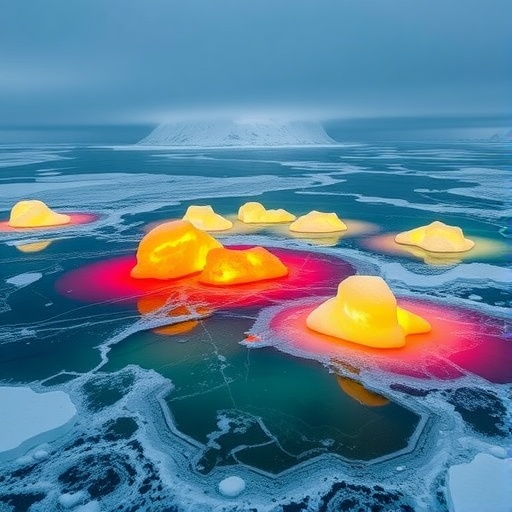
In the rapidly warming Arctic, marine heatwaves are emerging as an unprecedented threat to polar marine ecosystems and global climate systems alike. Unlike heatwaves in lower latitude oceans, these extreme temperature anomalies in the Arctic possess unique characteristics shaped by the region’s distinctive polar climate processes. Recent research spearheaded by the Alfred Wegener Institute and published in Communications Earth & Environment illuminates the evolving nature, underlying drivers, and outstanding scientific uncertainties surrounding Arctic marine heatwaves. This study contributes an essential piece to the global climate puzzle, revealing how the Arctic’s warming oceans are heating faster and more pervasively than the rest of the planet’s waters.
Marine heatwaves are defined as prolonged periods of anomalously high ocean temperatures lasting at least five consecutive days. While this phenomenon has surged worldwide over recent decades, the Arctic’s experience has been largely understudied, despite its critical role as a climate change hotspot. According to Dr. Marylou Athanase, lead author and climate researcher at the Alfred Wegener Institute, the Arctic’s marine heatwaves have notably increased in frequency, intensity, and duration since the 1980s. Sea surface temperatures during these events can rise up to 4 degrees Celsius above seasonal norms, profoundly affecting heat-sensitive polar ecosystems. These shifts also hold profound implications for global climate feedbacks, reinforcing the urgency of intensified Arctic-specific research.
The distribution of marine heatwaves across the Arctic exhibits pronounced regional variability, with the marginal seas consistently identified as hotspots. Surface heatwaves in these areas have warmed by approximately 0.6 degrees Celsius per decade and occur about twice as frequently as the global average marine heatwave rate. The frequency of such events typically ranges from one to three per year in different Arctic sectors. Intriguingly, heatwaves are not confined to surface waters; subsurface layers between 50 and 500 meters often experience heat anomalies of equal or greater magnitude. Contrary to this trend, the seabed shows negligible increases in heatwave intensity and frequency, with some zones even demonstrating declines. Of particular note is the exceptional marine heatwave in 2016 across the Barents Sea, which persisted for over 480 days with sea surface and benthic temperatures elevated about 1 degree Celsius above averages.
Fundamental to understanding Arctic marine heatwaves is recognizing the unique climate processes absent in lower latitude oceans. The presence and dynamics of sea ice play a pivotal role, modulating the heat exchange between atmosphere and ocean. The decline of sea ice cover not only increases solar radiation absorption at the ocean surface via the ice-albedo feedback but also alters ocean stratification through the freshwater input from melting ice. This fresh meltwater forms a thin insulated layer atop saltier ocean waters, where even minimal heat input can translate to outsized temperature spikes. Computational modeling suggests this stratified layer prolongs and intensifies surface heatwaves by approximately 20 percent, a mechanism unique to polar aquatic environments.
Beyond atmospheric heat input, Arctic marine heatwaves are significantly influenced by heat injections from deeper ocean layers. Unlike temperate and tropical oceans—where the warmest waters usually reside near the surface—the Arctic Ocean harbors warm Atlantic-derived waters beneath colder surface layers. Seasonal storms and turbulent mixing events during autumn and winter can induce upwelling of this subsurface heat, transporting it toward the surface and triggering marine heatwave conditions. Estimates indicate that this vertical heat flux accounts for roughly 20 percent of Arctic surface marine heatwaves, underscoring the importance of subsurface ocean dynamics in polar heatwave formation.
Cloud cover patterns in the Arctic introduce additional complexity to marine heatwave mechanisms, deviating fundamentally from processes observed in lower latitude oceans. In temperate regions, marine heatwaves commonly involve a positive feedback loop where reduced low cloud cover increases solar radiation and surface warming. Contrarily, in the Arctic, warming and sea ice retreat foster enhanced evaporation and cloud formation, increasing cloud cover during summer and autumn heatwave events. This augmented cloudiness can reflect incoming sunlight, exerting a cooling effect, but simultaneously traps longwave radiation, redirecting heat back to the ocean surface. Currently, disentangling the relative impacts of solar radiation versus cloud-induced infrared radiation on Arctic marine heatwaves remains a key research question.
The intensification of Arctic marine heatwaves is inextricably linked to broader patterns of global ocean warming and ongoing sea ice losses. The ice-albedo feedback system magnifies warming by reducing reflective surfaces and increasing heat absorption by the ocean. As the sea ice recedes, heat input from the atmosphere becomes more effective, enabling sustained and intensifying marine heatwaves. This intertwined relationship highlights a feedback loop where warming accelerates ice melt, which in turn intensifies heatwave events—a cycle with profound ecological and climatological consequences.
The ecological repercussions of Arctic marine heatwaves are potentially severe. Polar marine ecosystems, adapted to stable, cold conditions, face disruptions in species composition, productivity, and food web dynamics. Even subtle temperature anomalies can cascade through biological communities, altering habitats and threatening endemic species. Given the Arctic Ocean’s integral role in global ocean circulation and climate regulation, these localized changes may propagate far beyond the polar region, influencing weather patterns, carbon cycling, and atmospheric composition worldwide.
Despite recent advances, significant knowledge gaps persist in understanding Arctic marine heatwaves. The polar context introduces complexities absent in other marine environments, necessitating tailored observational campaigns and refined modeling approaches. Long-term observational records remain limited, and the interplay between atmospheric conditions, sea ice dynamics, oceanic heat transport, and cloud processes requires further elucidation. Filling these gaps is vital for improving predictive capabilities and informing mitigation and adaptation strategies in the face of accelerating Arctic change.
Future climate projections indicate the Arctic will endure some of the most pronounced increases in marine heatwave frequency and intensity globally. Simulations forecast these events becoming more frequent, longer-lasting, and more severe as global temperatures rise, exacerbating the impacts on marine ecosystems and the global climate system. This reality underscores the urgency of incorporating polar-specific dynamics into climate models and of international collaborations to monitor, understand, and respond to these emerging threats.
This pioneering synthesis of Arctic marine heatwave research marks a critical step in completing the planetary climate narrative. By identifying unique polar processes—such as sea ice-mediated heat fluxes, subsurface heat injection, and distinctive cloud feedbacks—this study highlights why the Arctic’s marine heatwaves defy assumptions based on lower-latitude paradigms. As Dr. Marylou Athanase notes, the Arctic’s rapid transformation offers both challenges and opportunities to deepen our understanding of climate extremes in a warming world.
In conclusion, Arctic marine heatwaves represent an evolving, complex climate phenomenon characterized by unprecedented intensity and duration relative to global norms. Underpinned by processes unique to the polar environment, these events present acute risks to fragile ecosystems and broader climate systems. This emergent field of polar marine heatwave research is vital for anticipating future changes and safeguarding the Arctic’s environmental integrity amid accelerating global warming.
Cite Scienmag News
Russell Cooper. (June 22, 2026). Unveiling the Science Behind Arctic Marine Heatwaves. Scienmag. https://scienmag.com/unveiling-the-science-behind-arctic-marine-heatwaves/
Russell Cooper. "Unveiling the Science Behind Arctic Marine Heatwaves." Scienmag, 22 June 2026, https://scienmag.com/unveiling-the-science-behind-arctic-marine-heatwaves/. Accessed 4 September 2026.
Russell Cooper. "Unveiling the Science Behind Arctic Marine Heatwaves." Scienmag. June 22, 2026. https://scienmag.com/unveiling-the-science-behind-arctic-marine-heatwaves/


