


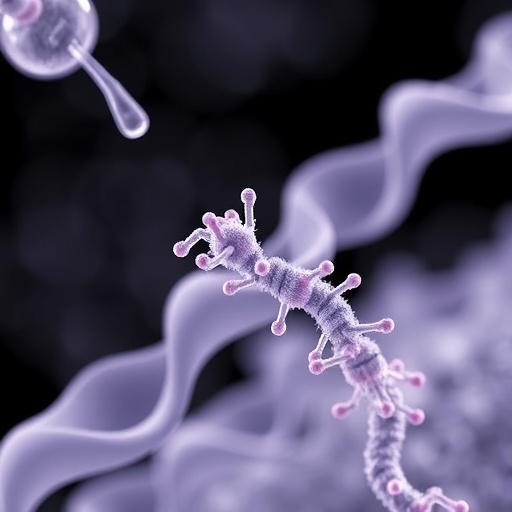
In the realm of molecular recognition, aptamers have long stood out as promising alternatives to antibodies, boasting advantages such as smaller size, ease of synthesis, and lower immunogenicity. Yet, despite these compelling attributes, their therapeutic potential has remained inherently constrained. This limitation stems fundamentally from their compositional nature—aptamers are constructed from four chemically similar nucleobases, unlike antibodies that incorporate twenty chemically diverse amino acids. This disparity restricts the chemical versatility of aptamers and hinders their capacity to engage target proteins with the breadth and complexity antibodies naturally possess. However, a groundbreaking study recently published in Nature Chemistry heralds a transformative advance in this space, presenting a novel approach that vastly expands the chemical landscape of aptamers.
The research team, led by Saliba and colleagues, introduces what they term “alenomers,” a next-generation class of aptamer-like encoded oligomers. Unlike traditional aptamers, alenomers are heavily chemically modified and harness an innovative DNA orthogonal barcode system for sequencing and identification. This barcoded DNA branch functions in tandem with the modified oligomer that engages target proteins, enabling researchers to read and decipher the exact sequence and chemical modifications with remarkable precision. The insight here is profound: by decoupling the chemical modifications of the binding domain from the constraints of enzymatic selection processes, alenomers escape the tight restrictions that have historically hamstrung aptamer chemical diversity.
To bring this vision to life, the researchers employed a comprehensive library-building strategy, assembling approximately 300,000 unique alenomers using cutting-edge automated DNA synthesizers and split-and-pool combinatorial approaches. This scale of diversity within a single library represents an extraordinary leap in the number of candidates available for selection studies compared to conventional aptamer libraries. Each library member’s chemical modifications can be tuned and varied freely, exploring a vast chemical space that was previously inaccessible in nucleic acid-based ligands. The ability to intricately customize these molecules unlocks opportunities to bind protein targets with unprecedented affinity and stability.
Screening these extensive libraries for protein binding capability incorporated next-generation sequencing (NGS) techniques, which capitalized on the orthogonal DNA barcodes to decode binding candidates after selection. This innovation effectively replaces traditional polymerase chain reaction (PCR)-based amplification and enzymatic compatibility requirements with a more flexible, direct molecular reading system. As a result, researchers can identify the optimal alenomers that combine both robust target affinity and enhanced biostability, traits that are critical in translating molecular binders into viable therapeutic agents.
One of the most exciting implications of the alenomers technology is its capacity to extend beyond the four familiar nucleobases that dominate aptamer chemistry. Traditional aptamers must retain enzyme recognition motifs to survive selection pressures, which restricts the scope of chemical modifications that can be introduced. In contrast, alenomers break free from these constraints, embracing diverse chemical functionalities that can mimic or even surpass the complexity observed in protein-based antibodies. This diversification unlocks the potential for stronger and more specific interactions with target proteins, facilitating improved therapeutic and diagnostic applications.
The innovative use of DNA orthogonal barcodes also addresses a longstanding bottleneck in chemically modified oligonucleotide research: the challenge of decoding complex sequences containing unnatural modifications. Prior approaches often faced difficulties in sequencing beyond canonical nucleotide chemistries. By elegantly resolving this problem, the team enables the routine identification of alenomer sequences post-selection, vastly accelerating the discovery pipeline and enabling rational design improvements based on detailed structure-activity relationships.
Beyond just biochemical utility, alenomers offer intriguing avenues for structural insights. Because each modification can be systematically varied and annotated via the DNA barcode, the structural basis of target engagement becomes accessible for high-resolution analysis. This capability fosters a better mechanistic understanding of molecular recognition phenomena, paving the way for the rational engineering of next-generation ligands with tailored properties—such as enhanced binding kinetics, thermal stability, or resistance to enzymatic degradation.
This study also signals a paradigm shift in the design and production of molecular libraries for drug discovery and biotechnology. The automated synthesis of hundreds of thousands of distinct entities, each encoded with a unique DNA barcode and bearing chemically diverse modifications, exemplifies the fusion of synthetic chemistry, molecular biology, and data science. This interdisciplinary approach streamlines how molecular interactions are explored, enabling rapid iterative refinement that may ultimately reduce costs and development times for aptamer-based therapeutics.
Moreover, the therapeutic implications of alenomers are vast. Aptamers have long been viewed as promising biologics for targeted therapy, yet their clinical translation has often been hampered by issues related to stability, off-target interactions, and limited chemical diversity. By expanding the chemical vocabulary to include non-natural modifications, alenomers offer an enhanced stability profile, improved target specificity, and reduced immunogenicity, positioning them as formidable competitors or complements to antibodies in precision medicine.
The profound flexibility and scalability of the alenomers platform could revolutionize personalized medicine as well. Given that alenomers can be custom-tailored to different protein targets with high affinity and stability, future applications might include rapid generation of patient-specific ligands for diagnostics or targeted delivery systems. Additionally, the DNA barcode approach facilitates multiplexed screening and tracking, further streamlining the development pipeline for complex, multi-target therapeutics.
In conclusion, the introduction of alenomers marks a significant technological and conceptual advancement in the field of molecular evolution and therapeutic ligand discovery. By circumventing the traditional constraints imposed by enzymatic selection and limited nucleobase chemistry, this technology opens the floodgates to an exponentially broader chemistry space. Such innovation promises not only to enhance our toolkit for molecular recognition but also to usher in a new era of highly stable, chemically sophisticated oligonucleotide therapeutics with broad biomedical applications.
This pioneering work exemplifies how integrated chemical synthesis, high-throughput selection, and deep sequencing technologies can synergize to overcome long-standing hurdles in aptamer research. As the biomedical community continues to seek alternatives to antibodies that combine efficacy with manufacturability, alenomers may well emerge as the cornerstone of future nucleotide-based biotherapeutics. The study by Saliba et al. elegantly highlights the power of embracing chemical diversity and decoding complexity to unlock the full potential of nucleic acid ligands.
With ongoing research likely to expand the scope and refinement of alenomers, the scientific and medical communities can anticipate a surge of newly discovered molecules tailored to increasingly challenging protein targets. This advancement could directly accelerate efforts in drug discovery, diagnostic development, and fundamental studies of biomolecular interactions—truly setting a new benchmark in the field of aptamer technology and beyond.
Cite Scienmag News
Bethany Barker. (May 8, 2026). Unlocking Aptamer Diversity via DNA Barcodes. Scienmag. https://scienmag.com/unlocking-aptamer-diversity-via-dna-barcodes/
Bethany Barker. "Unlocking Aptamer Diversity via DNA Barcodes." Scienmag, 8 May 2026, https://scienmag.com/unlocking-aptamer-diversity-via-dna-barcodes/. Accessed 4 September 2026.
Bethany Barker. "Unlocking Aptamer Diversity via DNA Barcodes." Scienmag. May 8, 2026. https://scienmag.com/unlocking-aptamer-diversity-via-dna-barcodes/


