


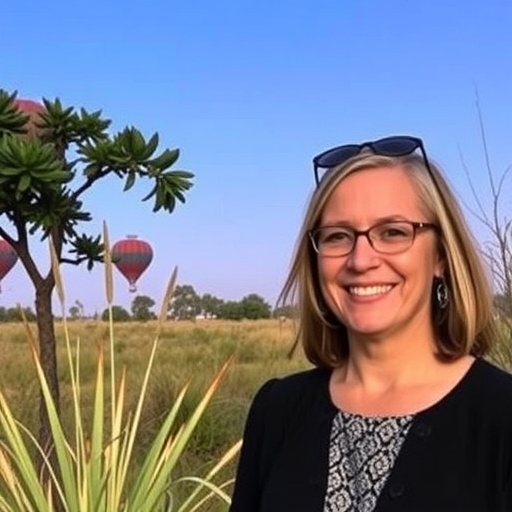
In the increasingly interconnected world of natural resource management, the intersection of environmental consequences and economic activities remains complex and often insufficiently explored. Georgia Kosmopoulou, a distinguished economist at the University of Oklahoma, embarks on a mission aiming to bridge this critical gap. Her work focuses on developing comprehensive analytical frameworks that integrate environmental costs and benefits into economic production and trade assessments, a vital step toward sustainable development in resource-dependent regions.
Kosmopoulou’s upcoming Fulbright Specialist Award project will take her to the Universidad Nacional de San Agustín (UNSA) in Arequipa, Peru, where she will engage with local faculty, administrators, and students over a two-week intensive collaboration. This initiative is designed to foster enhanced interdisciplinary research culture within economics, cultivating academic synergy across traditionally separate scientific domains. By doing so, the project seeks to instill robust mechanisms capable of analyzing the intertwined economic and environmental dynamics intrinsic to regional industries.
The collaboration builds upon a pre-existing partnership between the University of Oklahoma and UNSA, integrating expertise from multiple colleges including the Dodge Family College of Arts and Sciences, Gallogly College of Engineering, and the Mewbourne College of Earth and Energy. Kosmopoulou’s involvement is pivotal, introducing sophisticated economic models into multidisciplinary projects. These models enable researchers to assess the environmental impacts of commodity-based sectors such as agriculture, mining, and agro-industrial exports within a comprehensive economic framework.
One fundamental challenge Kosmopoulou highlights is the traditional siloed nature of academic and policy approaches. The complexities of environmental and economic systems require a collaborative methodology involving economists, engineers, and scientists to provide a deeper understanding of how resource utilization affects ecological systems and economic sustainability. Her efforts are geared towards breaking down disciplinary barriers, demonstrating that integrated analyses can lead to more nuanced policy-making and resource management strategies.
A key research priority in the Arequipa region pertains to developing advanced methodologies for quantifying the environmental repercussions of principal industries, notably the agricultural and mining sectors. These methodologies focus on evaluating the impact on critical natural assets such as water resources, soil quality, and biodiversity. By incorporating ecological indicators into economic evaluations, Kosmopoulou and her colleagues aim to foster decision-making processes that balance industrial growth with environmental stewardship.
Kosmopoulou’s work aligns seamlessly with the broader Fulbright program’s mission, which emphasizes mutual understanding and capacity building through international scholarly exchange and institutional cooperation. Her collaboration with Peruvian colleagues represents a conduit for sharing innovative research methodologies and educational best practices, which contribute to strengthening universities’ roles in addressing complex, global challenges related to sustainability.
The convergence of diverse perspectives is a hallmark of this interdisciplinary endeavor. By engaging with Peruvian scholars and students, Kosmopoulou gains insight into local problem-solving paradigms, enriching her own research outlook. Conversely, her expertise in economic modeling informs regional academic communities, enhancing their capacity to undertake integrated environmental-economic studies critical for the sustainable management of natural resources.
With extensive academic and leadership experience, including key roles at the National Science Foundation and a tenure at the University of Oklahoma beginning in 1997, Kosmopoulou brings a wealth of knowledge to this international engagement. As the senior associate dean for research and graduate education at the Dodge Family College of Arts and Sciences, she has been instrumental in securing significant external research funding and spearheading national initiatives emphasizing interdisciplinary research and benefit-cost analysis.
The Fulbright Specialist Program, administered by the U.S. Department of State, supports such short-term collaborative projects, selecting over 400 American scholars annually who contribute specialized expertise to host institutions worldwide. Kosmopoulou’s selection underscores her stature as a leading figure in economics, equipped to foster cross-cultural academic partnerships that enhance research quality and impact.
The Dodge Family College of Arts and Sciences at the University of Oklahoma, the largest and oldest college within the university, exemplifies interdisciplinary education through its wide array of programs spanning humanities, natural sciences, social sciences, and professional studies. Kosmopoulou’s affiliation with this college situates her at the nexus of multidisciplinary academic inquiry, fostering collaboration that transcends traditional academic boundaries.
Founded in 1890, the University of Oklahoma serves as the flagship public research institution in the state, committed to addressing the educational, cultural, economic, and healthcare needs of the region and beyond. Through initiatives like the Fulbright Specialist Award projects, OU extends its influence globally, promoting sustainable development and academic excellence.
Kosmopoulou’s forthcoming work in Peru represents a model for addressing the grand challenges posed by natural resource use in a changing global environment. By weaving together economic theory, environmental science, and cross-border academic collaboration, she exemplifies how innovative, interdisciplinary research can advance our understanding of sustainable resource management and inform policies that secure future prosperity.
News Publication Date: [Not specified in the source content]
Web References:
– https://www.ou.edu/cas/
– http://www.ou.edu
Cite Scienmag News
Courtney Benton. (May 27, 2026). University of Oklahoma Professor to Investigate Environmental and Economic Impacts of Trade via Fulbright Program. Scienmag. https://scienmag.com/university-of-oklahoma-professor-to-investigate-environmental-and-economic-impacts-of-trade-via-fulbright-program/
Courtney Benton. "University of Oklahoma Professor to Investigate Environmental and Economic Impacts of Trade via Fulbright Program." Scienmag, 27 May 2026, https://scienmag.com/university-of-oklahoma-professor-to-investigate-environmental-and-economic-impacts-of-trade-via-fulbright-program/. Accessed 4 September 2026.
Courtney Benton. "University of Oklahoma Professor to Investigate Environmental and Economic Impacts of Trade via Fulbright Program." Scienmag. May 27, 2026. https://scienmag.com/university-of-oklahoma-professor-to-investigate-environmental-and-economic-impacts-of-trade-via-fulbright-program/


