


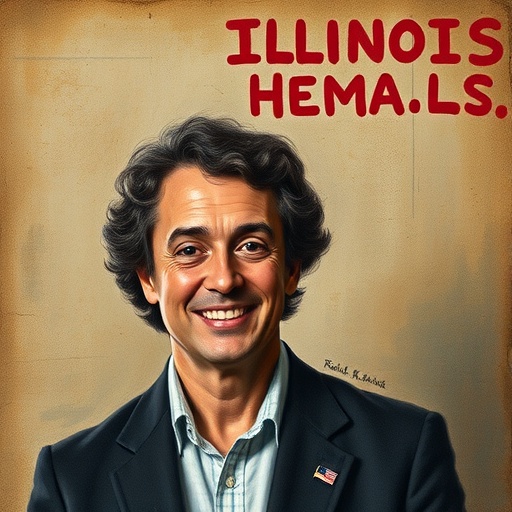
Naturalization is commonly portrayed as the final, celebratory step in an immigrant’s journey toward U.S. citizenship. It is often associated with courtroom ceremonies, raised hands and pledges of allegiance—a formal moment when an individual is said to enter the nation and gain access to its rights and protections. But a new book by University of Illinois Urbana-Champaign scholar Siobhan Somerville argues that the history of naturalization is far less neutral than this familiar story suggests. U.S. citizenship, she shows, has been shaped by changing assumptions about race, sexuality, reproduction, Indigenous identity and colonial power. Her book, Naturalization: A Queer Genealogy of U.S. Citizenship, Race, and Sexuality, examines how legal definitions of belonging helped construct the United States as a settler nation.
Somerville, a professor of English and gender and women’s studies, uses the term “queer genealogy” to describe an analytical method rather than a simple history of LGBTQ+ identity. The approach questions categories that often appear natural or permanent, asking how they were produced through laws, court rulings, administrative decisions and political arguments. By tracing these connections across time, Somerville reveals that citizenship has never been merely a legal status granted to individuals who meet a fixed set of requirements. It has also functioned as a technology of governance: a system for sorting populations, distributing rights, controlling mobility and determining which families and communities could reproduce themselves within the nation.
The first federal naturalization law, adopted in 1790, limited eligibility to “free white persons.” That wording established race as an explicit legal criterion for becoming a U.S. citizen. Although Congress and the courts later created exceptions and modified the rules, the racial requirement remained part of naturalization law until 1952. In practical terms, this meant that citizenship was not initially designed as a universal political identity. It was a restricted category tied to whiteness, freedom from enslavement and the colonial project of building a permanent settler population. Somerville argues that recognizing this history is essential because it demonstrates that race was not an accidental feature of citizenship policy; it was embedded in the legal structure of the republic for most of its existence.
The book also expands the meaning of naturalization beyond the familiar process in which an immigrant applies, completes an examination and takes an oath. Somerville examines “collective naturalization,” through which entire populations were converted into U.S. citizens by congressional action or treaty, often without an individual application or expressed desire to become American. After the Civil War, the Civil Rights Act of 1866 collectively naturalized people born in the United States “of every race and color,” including formerly enslaved people, while excluding many American Indians. The Dawes Act of 1887 later extended citizenship to some American Indians individually, but it linked that status to the dissolution of tribal identities and the transfer of communally held lands into private ownership.
The Indian Citizenship Act of 1924 eventually granted U.S. citizenship collectively to American Indians, although it did not eliminate conflicts between citizenship and tribal sovereignty. In other cases, residents of U.S. territories acquired citizenship through congressional legislation rather than through the individualized naturalization process applied to immigrants. This distinction is technically significant because individual naturalization typically involves scrutiny: applicants may be examined for their residence, political allegiance, moral character, language ability and other qualifications. Collective naturalization operates differently. It can transform an entire population into citizens without the same level of surveillance, while also imposing political and legal consequences on communities that may have distinct systems of land ownership, identity and governance.
Somerville links these policies to settler colonialism, a form of colonial rule in which the central objective is not only to extract resources but to establish a permanent settler population on Indigenous land. From this perspective, citizenship becomes part of a territorial strategy. It can be used to absorb people into the political system, erase or weaken collective identities, redistribute land and define which forms of community life are legally recognizable. Naturalization therefore affected people who had never immigrated to the United States, including Indigenous peoples, formerly enslaved people and residents of U.S. territories. The legal category of citizenship could expand rights in some circumstances while simultaneously supporting the displacement or assimilation of other populations.
The relationship between citizenship and reproduction is another central theme in Somerville’s analysis. The earliest naturalization law addressed not only the status of a new citizen but also the citizenship of that person’s future children. This connection reflected a broader principle of nation-building: citizenship could be transmitted through families, and the state had an interest in defining which families were considered legitimate. In the twentieth century, these ideas became increasingly entangled with sexuality. The Immigration and Nationality Act of 1952 removed the explicit “white person” requirement from naturalization law, but it added provisions concerning adultery and homosexuality. In 1967, the Supreme Court’s decision in Boutilier v. Immigration and Naturalization Service upheld the federal government’s authority to exclude homosexual immigrants, illustrating how sexuality could be treated as a question of national eligibility.
The decision helped expose the relationship between immigration control and state-sponsored ideas about family structure. Somerville describes this system as “heterosettler colonialism,” a framework in which heterosexual partnership and biological reproduction were privileged as foundations of national growth. The Immigration and Nationality Act of 1965 made family reunification a central principle of immigration policy, a change often remembered as a move away from earlier racial quotas. Yet Somerville argues that the shift also reinforced the importance of heterosexual, reproductive families as the preferred units through which people entered and expanded the nation. In this system, immigration policy could appear more inclusive while continuing to favor particular racial, sexual and familial arrangements.
To build her argument, Somerville combines legal and cultural evidence. She analyzes statutes, court decisions, legislative debates and federal interpretations of citizenship rules alongside literary works, journalism and archival materials. This interdisciplinary method is important because citizenship is not produced by law alone. Administrative agencies, newspapers, novels and public debates help determine how legal categories are understood and whose claims to belonging appear credible. Her analysis treats naturalization as both a formal procedure and a cultural narrative—one that can celebrate inclusion while concealing the coercive conditions under which citizenship has been extended, withheld or imposed.
The book concludes with American Samoa and recent legal controversies involving birthright citizenship and collective naturalization. People born in American Samoa are generally U.S. nationals rather than automatically U.S. citizens, a distinction that has generated constitutional and political debate. Some American Samoans have resisted collective naturalization because of concerns that citizenship could affect the legal protection of communal Indigenous lands. Their position illustrates the limits of treating citizenship as an uncomplicated benefit: a status that provides access to rights may also alter systems of land tenure, collective identity and local authority. Somerville argues that the history of naturalization remains urgently relevant as immigration enforcement, deportation and denaturalization policies once again place racialized, Indigenous, gendered and sexual minorities at heightened risk. Understanding citizenship as a historically constructed system, rather than a timeless promise of equality, may be necessary for confronting the contradictions between American ideals of freedom and the continuing structures of settler colonialism.
Web References: https://dukeupress.edu/naturalization; https://english.illinois.edu/directory/profile/sbs
References: Siobhan Somerville, Naturalization: A Queer Genealogy of U.S. Citizenship, Race, and Sexuality; University of Illinois Urbana-Champaign News Bureau.
Cite Scienmag News
Courtney Benton. (August 19, 2026). Illinois professor’s book explores contradictions in U.S. naturalization history. Scienmag. https://scienmag.com/illinois-professors-book-explores-contradictions-in-u-s-naturalization-history/
Courtney Benton. "Illinois professor’s book explores contradictions in U.S. naturalization history." Scienmag, 19 August 2026, https://scienmag.com/illinois-professors-book-explores-contradictions-in-u-s-naturalization-history/. Accessed 3 September 2026.
Courtney Benton. "Illinois professor’s book explores contradictions in U.S. naturalization history." Scienmag. August 19, 2026. https://scienmag.com/illinois-professors-book-explores-contradictions-in-u-s-naturalization-history/


