


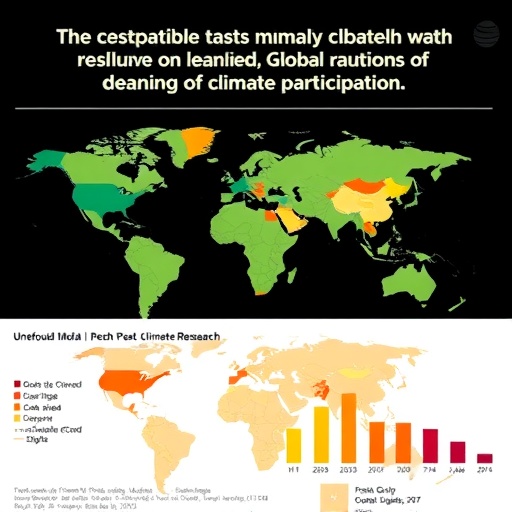
In the ever-intensifying global battle against climate change, the production and dissemination of scientific knowledge play a pivotal role. However, a groundbreaking new study published in Communications Earth & Environment by Sharma, Singh, Bonikowski, and colleagues exposes a deeply embedded and consequential problem: regional inequity in top-tier climate change research. This disparity not only skews the global narrative around climate solutions but also hints at severe implications for policy-making, innovation, and equitable climate action worldwide.
The research team conducted an extensive, multifaceted analysis of climate change publications from leading journals globally, spanning the past two decades. Their findings reveal a pronounced concentration of influential climate research outputs in a handful of wealthier, primarily Western nations, including the United States and members of the European Union. In stark contrast, vast regions of the Global South, such as Sub-Saharan Africa, parts of Asia, and Latin America, remain considerably underrepresented in the highest-impact research categories. This lopsided distribution, the authors argue, mirrors deeper systemic inequalities entrenched in research infrastructure, funding pathways, and geopolitical capital.
At the heart of the study is a rigorous quantitative assessment leveraging bibliometric data, which includes citation counts, journal impacts, and authorship networks. The team employed cutting-edge machine learning techniques to map co-authorship patterns and thematic clusters, revealing that climate change research ecosystems are markedly centralized. Prestigious institutions located in economically dominant countries monopolize not only funding but also the editorial elite of climate journals, further perpetuating a cycle where the perspectives and needs of less affluent regions remain marginalized or overlooked.
The consequences of this inequity go beyond academic metrics; they shape the practical trajectories of climate mitigation and adaptation policies. Regions most vulnerable to climate impacts often generate disproportionately fewer publications that reach leading audiences. This creates a feedback loop: underrepresentation hinders local scientists’ ability to influence global discourse on their own urgent challenges — from rising sea levels displacing communities in the Pacific Islands to desertification threatening livelihoods in the Sahel.
In the technical dimension, the study explores the barriers to equitable knowledge production through the lens of research funding flows and collaborative networks. Research grants from government agencies and international bodies are unevenly distributed, favoring institutions with established reputations and advanced technological resources. The authors quantify a correlation between GDP per capita and research output volume, and highlight how subscription costs for top-tier journals also restrict access for many researchers in developing regions, limiting their ability to publish and engage in academic debates effectively.
Moreover, the analysis delves into language barriers and editorial practices that disproportionately favor English-language publications, inadvertently disadvantaging scientists whose primary research is conducted in other languages. Peer review biases and lack of regional representation on editorial boards exacerbate these challenges, producing a homogenized scientific record that does not fully account for diverse socio-environmental contexts or indigenous knowledge systems.
To address these entrenched issues, Sharma and colleagues advocate for a multifaceted strategy centered on inclusivity and capacity building. They emphasize the need for increased funding directed specifically at underrepresented regions, fostering collaborations that prioritize equitable leadership roles for local scientists. Enhancing open access infrastructure and reducing financial barriers to both publishing and subscribing to major journals are also crucial steps that could democratize climate change science publication.
A significant technical innovation presented within the study is a proposed framework for assessing regional equity in real time, leveraging AI-driven bibliometric tools to enable continuous monitoring and targeted interventions. Such metrics could inform funding agencies, policymakers, and journal editors alike, creating accountability structures that incentivize inclusive practices. Additionally, the study highlights the potential for digital platforms and virtual scientific conferences to transcend geographic constraints and democratize knowledge exchange.
The implications of this research resonate beyond academia, touching the core of international climate negotiations. As the planet edges closer to critical tipping points, the ability of the global scientific community to generate and share diverse solutions reflective of varying regional realities is of existential importance. Research inequity not only throttles innovation but also risks perpetuating a biased understanding of vulnerabilities, adaptation strategies, and socioeconomic trade-offs inherent in climate action.
In a broader context, the study challenges the prevailing metrics of academic success, urging that impact factors and citation indices be complemented by equity-oriented benchmarks. By valorizing research contributions from marginalized regions and communities, the scientific ecosystem can reorient itself towards a more just and responsive structure. The authors highlight promising initiatives, such as regional climate research hubs and collaborative networks anchored in reciprocity, as models to scale up.
Finally, the researchers call for an ethical reckoning within the climate research community. Beyond structural reforms, this entails acknowledging historical and ongoing disparities that influence whose voices are heard and whose knowledge is deemed credible. The urgent nature of climate crises demands a transformation in research culture: one that actively values diversity, fosters inclusiveness, and integrates local experiences with cutting-edge science in a meaningful dialogue.
In sum, the Sharma et al. study offers a meticulous, data-driven critique of geographic disparities in climate science production, presenting both a stark challenge and a hopeful roadmap. To preserve the integrity and efficacy of global climate efforts, the scientific community must prioritize dismantling these inequities and elevate the voices of those on the front lines of environmental change. The future of climate science—and by extension, our global response to climate change—depends on it.
Cite Scienmag News
Violet Maxwell. (May 13, 2026). Unequal Global Participation in Leading Climate Research. Scienmag. https://scienmag.com/unequal-global-participation-in-leading-climate-research/
Violet Maxwell. "Unequal Global Participation in Leading Climate Research." Scienmag, 13 May 2026, https://scienmag.com/unequal-global-participation-in-leading-climate-research/. Accessed 3 September 2026.
Violet Maxwell. "Unequal Global Participation in Leading Climate Research." Scienmag. May 13, 2026. https://scienmag.com/unequal-global-participation-in-leading-climate-research/


