


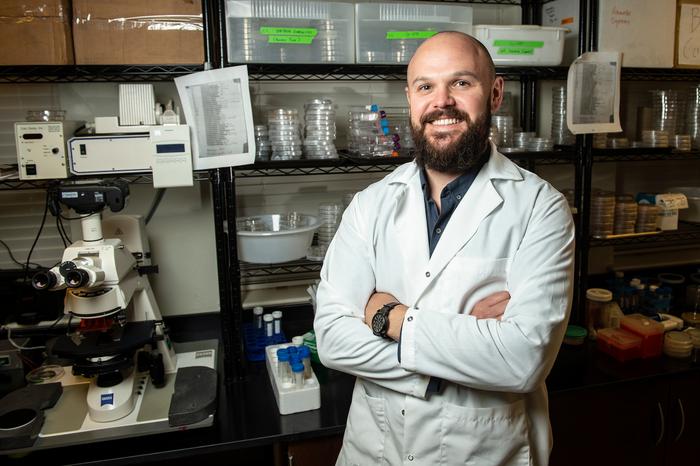
STARKVILLE, Miss.—With a new understanding of past life on the planet through fossils, a Mississippi State biological sciences faculty member is helping researchers better predict Earth’s future.

Credit: Logan Kirkland
STARKVILLE, Miss.—With a new understanding of past life on the planet through fossils, a Mississippi State biological sciences faculty member is helping researchers better predict Earth’s future.
In a new paper published in July in the esteemed peer-reviewed journal Proceedings of the National Academy of Sciences, Donald L. Hall Professor of Biology Matthew Brown unearths a specific area of under-studied fossils: microbial eukaryotes—more specifically, testate amoebae from 750 million years ago. His novel research on testates will continue to help researchers understand Earth’s evolution, thereby allowing better predictions of what the planet may look like millions of years from now.
“Using fossils, we can estimate the divergence times and evolutionary paths leading to today’s testate amoebae found across the globe,” Brown said. “Testates are particularly significant for understanding the history of early Earth and the history of life. They represent some of the earliest confirmed heterotrophic eukaryotes.
“From the data we collected, scientists now can examine the evolutionary history of these intriguing amoebae like never before through bioinformatic approaches called molecular clocks,” he continued. “In evolution, genes and the proteins they encode evolve in a somewhat clock-like manner, making evolutionary changes somewhat predictable and model-able.”
Brown and his co-senior author Professor Daniel Lahr at the University of Sao Paulo, Brazil, collaborated with Brazilian paleontologist Luana Morais; Alfredo Porfirio-Sousa, a visiting scholar from the University of Sao Paulo; Alexander Tice, a previous postdoctoral student in Brown’s lab who is a faculty member at Texas Tech University; and Quentin Blandenier, another past postdoctoral student of Brown’s.
Today, Porfirio-Sousa and Blandenier are recognized as testate amoebae experts in the research community.
Brown also credits Nicholas Fry, Tristan Henderson and Felicity Kleitz-Singleton, all Ph.D. students in his lab, with assistance on his project.
Established in 1914, PNAS is one of the world’s most cited and comprehensive multidisciplinary scientific journals, publishing more than 3,500 global research papers annually.
For more details about MSU’s College of Arts and Sciences or the Department of Biological Sciences, visit www.cas.msstate.edu or www.biology.msstate.edu.
Mississippi State University is taking care of what matters. Learn more at www.msstate.edu.
Journal
Proceedings of the National Academy of Sciences
Method of Research
Data/statistical analysis
Subject of Research
Cells
Article Title
Amoebozoan testate amoebae illuminate the diversity of heterotrophs and the complexity of ecosystems throughout geological time
Article Publication Date
16-Jul-2024
COI Statement
N/A
Cite Scienmag News
Drew Townsend. (August 19, 2024). Understanding of early life ecosystems highlighted in new publication. Scienmag. https://scienmag.com/understanding-of-early-life-ecosystems-highlighted-in-new-publication/
Drew Townsend. "Understanding of early life ecosystems highlighted in new publication." Scienmag, 19 August 2024, https://scienmag.com/understanding-of-early-life-ecosystems-highlighted-in-new-publication/. Accessed 8 September 2026.
Drew Townsend. "Understanding of early life ecosystems highlighted in new publication." Scienmag. August 19, 2024. https://scienmag.com/understanding-of-early-life-ecosystems-highlighted-in-new-publication/

