


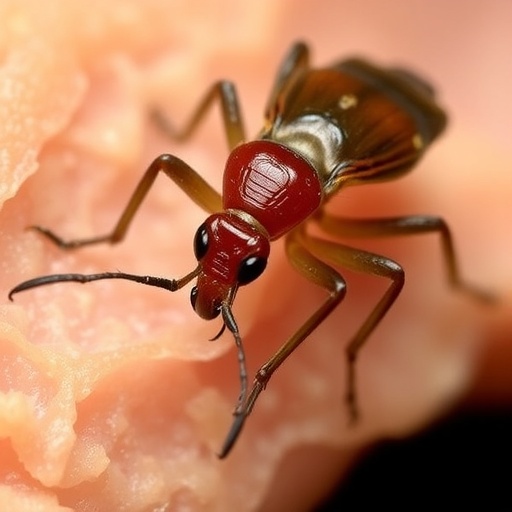
When a human body decomposes, it passes through a predictable sequence of stages, from fresh and bloated through active and advanced decay to a final dry, mummified state. Forensic scientists have long used the insects and mites that colonize corpses to estimate how long a person has been dead, but a new study reveals that the microscopic mouthparts of these cadaver-dwelling mites are exquisitely engineered tools, each species arriving at the right time with the right bite for the food available at that precise stage of decay. The research, published in The Science of Nature, demonstrates that four species of astigmatan mites that persistently infest decomposing bodies are not interchangeable scavengers but specialists whose cheliceral chelae — their jaw-like pincer structures — are morphologically tailored to exploit distinct nutritional niches as the corpse transforms from a protein-rich depot into soil.
Clive E. Bowman of the Mathematical Institute at the University of Oxford and M. Alejandra Perotti of the University of Reading examined the trophic morphology of four mite species known to persist across multiple stages of human cadaver decomposition: Acarus siro, Lardoglyphus zacheri, Sancassania berlesei and Tyrophagus putrescentiae. Using specimens preserved from laboratory cultures originally established at the now-defunct Pest Infestation Control Laboratory in Slough, UK, the researchers cleared the mites in lactic acid, mounted them on microscope slides and examined them using Nomarski interference phase-contrast light microscopy. Twenty female adults of each species were analyzed, with calibrated drawings digitized and measured using ImageJ software.
The analytical framework the team developed centers on what they call an occlusive method — a way of assessing how the two opposing digits of each mite’s chela, the fixed digit and the moveable digit, fit together when the jaw closes. Each digit carries a row of asperities, small peaks and valleys that function like teeth and gullets. By registering the profile heights of these structures along a biomechanically informed reference axis — the adductive output lever moment arm — the researchers produced a vector of seventeen profile measurements for each digit of each specimen. These vectors were then assembled into what the authors describe as average sums-of-squares-and-cross-products (SSCP) matrices, allowing direct comparison of the overall mastication surface design between species without requiring Procrustes transformations.
To quantify how well the peaks on one digit matched the gullets on the other, Bowman and Perotti borrowed a mathematical tool from optimal transport theory: the two-dimensional Wasserstein distance, sometimes called the ‘earth-mover’ distance. This metric measures the minimum amount of work needed to transform one distribution into another. Applied to the mite chelae, it calculates how much the empirical distribution of peaks on the fixed digit must be shifted to match the distribution of gullets on the moveable digit. A low distance indicates a good reciprocal fit between the two digits, like interlocking pinking shears; a high distance indicates that the digits are functionally differentiated, each doing something different during the bite. The researchers then used multidimensional scaling to visualize the relationships among all the digit profiles they had measured.
The results revealed a striking cline in chelal design that runs from Acarus siro through Sancassania berlesei to Tyrophagus putrescentiae, correlating strongly with a decline in surface roughness of the biting surfaces. Acarus siro has the roughest, most heavily toothed digits — what the authors describe as a ‘demolition crusher’ suited to breaking apart dry, tough material such as the native proteins found in grain and in early-stage carrion. Its fixed digits carry more alternate top-bevel-like teeth than any other species examined, consistent with a species that pioneers grain infestations and attacks fresh high-protein sources. At the opposite end of the cline, Tyrophagus putrescentiae has the smoothest digits with the finest teeth, a versatile, multifunctional saprophage equipped like a ‘Swiss-Army pocket knife’ to handle small, soft food morsels such as fungal hyphae and yeast cells that proliferate on decaying flesh in later stages.
Lardoglyphus zacheri stands apart from all three. Its moveable digit is a scimitar-like blade, and its fixed digit bears two distinct pockets roughly four micrometers wide. The researchers calculated that each pocket could trap two to four myofibrils — the contractile threads of muscle tissue, which are typically one to two micrometers in diameter — allowing the mite to grip them behind the teeth and drag them out backward on chelal retraction, much as a carpenter’s pincers pull a nail. With a moveable digit mastication surface of approximately 13.5 micrometers, L. zacheri can slice flesh and extract myofibrillar protein in a way no other cadaver-inhabiting astigmatan can. This ‘soft slicer’ design, the authors suggest, explains why it first appears at the bloated stage of decomposition, when tissues are inflating with gas and becoming soft enough to be opened by an axe-like plunge of the chelae into the flesh.
Sancassania berlesei presents a different puzzle. Although historically associated with mummified remains since the pioneering work of the French forensic entomologist Pierre Mégnin in 1894, its chelal crunch force is not above average for its body size, and the analysis suggests it is a surface grazer unlikely to actively burrow into flesh. The species thrives in exceptionally high humidity — above 95 percent relative humidity — and is known to feed on nematodes and fungi. The researchers note that it is typically found in concealed corpses or enclosed burials where moisture accumulates, and propose that its role may be more about consuming the microfauna and fungi that colonize very wet carcasses than about processing tissue directly.
Perhaps the most ecologically significant finding concerns how the mastication capabilities of the entire mite community change over the five stages of decay. From the bloated stage onward, the minimum chelal bite force found among colonizing species declines steadily, consistent with the progressive breakdown of body tissues. At the mummified dry stage, however, both bite force and the range of mastication surface sizes expand dramatically, reflecting an influx of durophagous specialists — including the soil mite Lepidoglyphus destructor, capable of biting very hard desiccated material — and rhizoglyphine species that normally feed on decayed roots and bulbs. The trophic niche width, as visualized by the number and diversity of feeding types present, widens sharply at this final stage as the cadaver is incorporated into the surrounding soil ecosystem, complete with its diverse saprophagous mite fauna.
The study also confirmed a fundamental asymmetry in how these mites process food. Across all four species, the fixed digit is consistently more ‘toothy’ than the moveable digit, carrying roughly twice as many alternate top-bevel-like teeth on average. Variation among species in fixed digit design is overwhelmingly about the size and pattern of the peaks — what the authors call ‘peakiness’ — while variation in the moveable digit is mainly about the pattern of valleys, or ‘gullet-ness,’ used to scoop decaying material. Food caught on the moveable digit is masticated against the fixed digit rather like an excavation bucket on a building-site machine, scooping material and grinding it against a ridged surface. The fixed digit also sits approximately 30 percent deeper than the moveable digit at the end of the mastication surface, functioning like the strengthened dorsal nail on a primate’s finger to provide leverage and resist flexing during retraction through food.
Taken together, the findings indicate that the succession of astigmatan mites on decomposing bodies is not a random accumulation of opportunists but a structured sequence of species whose feeding apparatuses are objectively matched to the changing physical and chemical properties of the corpse. As Bowman and Perotti conclude, the chelae of these cadaver-inhabiting mites are rationally designed to attack the material present at each stage of decay, helping them to avoid trophic competition with one another. The work opens new avenues for forensic acarology: scanning electron microscopy of mite-damaged cadaver tissues, lipase assays to track fat degradation, and gut-content analyses could all confirm exactly what each differently designed species is eating and when. With so many mite species still unexamined at this level of mechanistic detail, the authors note that there is much left for forensic acarologists to do.
Cite Scienmag News
Drew Townsend. (September 7, 2026). Mouthparts of cadaver-associated astigmatan mites vary for feeding on flesh. Scienmag. https://scienmag.com/mouthparts-of-cadaver-associated-astigmatan-mites-vary-for-feeding-on-flesh/
Drew Townsend. "Mouthparts of cadaver-associated astigmatan mites vary for feeding on flesh." Scienmag, 7 September 2026, https://scienmag.com/mouthparts-of-cadaver-associated-astigmatan-mites-vary-for-feeding-on-flesh/. Accessed 7 September 2026.
Drew Townsend. "Mouthparts of cadaver-associated astigmatan mites vary for feeding on flesh." Scienmag. September 7, 2026. https://scienmag.com/mouthparts-of-cadaver-associated-astigmatan-mites-vary-for-feeding-on-flesh/


