


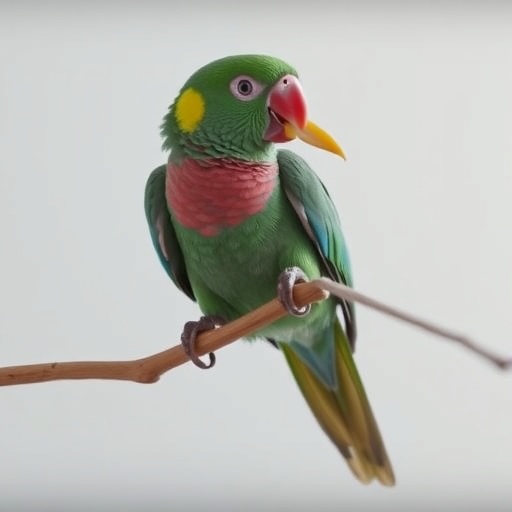
In an extraordinary demonstration of behavioral innovation overcoming physical impairment, researchers have documented how an endangered kea parrot, affectionately known as Bruce, has achieved alpha male status within his captive social group despite missing his entire upper beak. This remarkable case, recently published in the esteemed journal Current Biology, reveals how Bruce has adapted his fighting technique in a way never before observed in kea, turning what would be a debilitating physical limitation into a strategic advantage in social dominance.
Bruce resides at New Zealand’s Willowbank Wildlife Reserve, where his unique behavior first intrigued scientists. While it had been previously noted that he employs pebbles as self-care tools—a groundbreaking example of tool use in kea—it is his novel approach to combat that has now captured the scientific community’s attention. Unlike his peers, who rely on their intact beaks for fighting, Bruce has engineered a “beak jousting” technique using only his exposed lower beak. This specialized fighting style involves both thrusting motions conducted at varying distances, either by extending his neck for close strikes or propelling himself toward an opponent to deliver rapid, impactful blows.
The observational study recorded a total of 227 agonistic interactions among Willowbank’s kea population, including 162 male-to-male conflicts. Bruce participated in 36 of these male dominance bouts and emerged victorious in every single one—a flawless winning streak that solidifies his position as the undisputed alpha. His innovative jousting not only differs quantitatively from traditional beak usage by other kea but also strategically targets distinct areas of opponents’ bodies, maximizing displacement effects. The researchers noted that 73% of Bruce’s jousting attempts led to immediate opponent displacement, a significantly higher efficacy compared to conventional kicking behaviors observed among other males.
Such dominance confers multiple physiological and social benefits, as evidenced by Bruce’s hormonal profile and social privileges. He exhibited the lowest recorded levels of corticosterone metabolites among his cohort, an indicator of reduced chronic stress. Stress hormones like corticosterone typically correlate with social instability or subordination, suggesting that Bruce’s behavioral strategy affords him not just status but enhanced well-being. Additionally, Bruce enjoys preferential access to food resources, often feeding before other group members, and receives allopreening from fellow males—a social grooming behavior that includes even beak cleaning, a rare mark of social acceptance and trust.
The cognitive underpinnings of Bruce’s innovation likely reflect the advanced behavioral flexibility characteristic of kea parrots, which possess large brain sizes relative to many other avian species. This neurological capacity facilitates problem-solving and creative adaptation under environmental or physical constraints. The case exemplifies how individual behavioral plasticity can radically reshape social dynamics and influence fitness even in the face of physical adversity. Moreover, it underscores the importance of considering behavioral compensations when assessing the welfare and rehabilitation strategies for animals with disabilities.
Lead author Alexander Grabham from the University of Canterbury highlights the broader implications of Bruce’s success, noting that while prosthetics or human interventions may intuitively seem beneficial for disabled animals, such measures are not always superior to natural behavioral innovations. In Bruce’s case, the adaptation he developed exceeds what functionality a prosthetic might have allowed, illustrating that species with sufficiently flexible cognition can independently create solutions tailored to their unique challenges.
The researchers’ comprehensive data collection utilized meticulous observation techniques, enabling detailed recording of nuanced fighting postures, target areas, and interaction outcomes. Their approach allowed for a fine-grained analysis of how Bruce’s jousting technique differed from typical aggressive behaviors within his species. This depth of insight is critical for advancing our understanding of ethology—the study of animal behavior—by pushing beyond mere behavioral descriptions into mechanistic and functional interpretations.
Bruce’s journey from a disabled parrot to the alpha male also resonates on a conservation level, illuminating the resilience and intelligence of kea—a species listed as endangered due to habitat loss and predation pressures. Understanding such adaptive behaviors is vital for the development of management and care protocols in captive settings, where individual variation can markedly influence group stability and welfare outcomes. This case challenges conservationists and animal caretakers to rethink interventionist approaches, emphasizing support for natural behavioral innovations when feasible.
Moreover, this research team’s findings contribute to the growing body of knowledge regarding the intersection of disability, cognition, and social hierarchy in non-human animals, a relatively underexplored field. It prompts new questions about the neurological and evolutionary drivers underpinning innovation in response to physical challenges, which may have parallels across taxa. The notion that an individual’s cognitive flexibility can translate into tangible advantages in social dominance offers fresh perspectives for evolutionary biology.
Indeed, Bruce’s story exemplifies the power of cognition not only to navigate environmental complexities but also to modify social structures dynamically. His ability to repurpose a physical limitation into a weaponized behavioral strategy reflects an extraordinary level of agency and adaptation. Future studies may investigate whether such inventive behaviors emerge spontaneously or are culturally transmitted within kea populations, potentially broadening the narrative of animal intelligence and behavioral evolution.
Altogether, the case of Bruce is a compelling testament to the kea’s behavioral sophistication and an encouraging illustration of resilience in the natural world. It challenges preconceived notions about disability’s impact on survival and raises profound ethical questions about human approaches to animal welfare, particularly regarding disabled individuals. As research in this domain advances, Bruce may serve as an emblematic model—showing how disability need not preclude success within complex social environments, provided the cognitive toolkit is sufficiently robust to drive innovation.
Cite Scienmag News
Courtney Benton. (April 20, 2026). Undefeated Alpha Male Parrot Shows Novel “Beak Jousting” Technique, Despite Disability. Scienmag. https://scienmag.com/undefeated-alpha-male-parrot-shows-novel-beak-jousting-technique-despite-disability/
Courtney Benton. "Undefeated Alpha Male Parrot Shows Novel “Beak Jousting” Technique, Despite Disability." Scienmag, 20 April 2026, https://scienmag.com/undefeated-alpha-male-parrot-shows-novel-beak-jousting-technique-despite-disability/. Accessed 5 September 2026.
Courtney Benton. "Undefeated Alpha Male Parrot Shows Novel “Beak Jousting” Technique, Despite Disability." Scienmag. April 20, 2026. https://scienmag.com/undefeated-alpha-male-parrot-shows-novel-beak-jousting-technique-despite-disability/


