


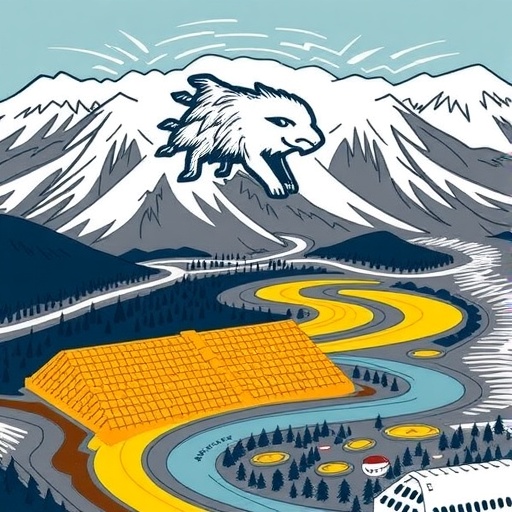
Situated in the remote wilderness of southwestern Alaska lies one of the world’s largest undeveloped gold deposits: the Donlin Gold project. This vast mine contains an estimated 39 million ounces of gold, valued at over $170 billion according to current market prices. Yet beneath the surface of this lucrative resource lie deeply rooted cultural and environmental tensions involving Alaska Native communities, whose voices and ways of life may be transformed or threatened by the mine’s development. A recent study published in the Journal of Anthropological Research sheds new light on the intricate dynamics shaping decisions around the Donlin project, revealing that Indigenous perspectives cannot be distilled into simple support or opposition.
The history behind the current debates begins in 1971, when the Alaska Native Claims Settlement Act (ANCSA) was enacted by the U.S. Congress. This pivotal legislation granted Alaska Native peoples about 11% of the state’s land and resource rights. However, the law introduced a complex shift by requiring Indigenous groups to organize as for-profit corporations. This arrangement transformed Native individuals into corporate shareholders, blending traditional Indigenous identities with capitalist frameworks. This dual identity continues to complicate the ways communities engage with resource extraction today.
With gold prices soaring and numerous key permits granted, the Donlin Gold project edges closer to realization. If it proceeds, Alaska Native corporations would stand to receive billions in revenues, and local residents could enjoy prioritized employment opportunities. However, this economic promise exists alongside a deeply ingrained subsistence lifestyle that remains central to the social fabric and survival of Western Alaska’s Native peoples. For them, hunting and fishing are not recreational activities, but essential practices sustaining communities both nutritionally and culturally.
Subsistence harvests in the region are exceptionally high, exceeding 172 kilograms per person annually—roughly three times the per capita consumption of meat and seafood in Japan. Salmon, moose, and a variety of wild foods provide not only dietary staples but also hold profound cultural significance. This dependence on wild foods underscores the critical balance between economic development and ecological preservation. Any disruption to these natural systems risks undermining the very foundation of Indigenous life and heritage.
Transportation logistics for the Donlin mine add further environmental concerns. The site’s remote location prohibits direct road access, so supplies and ore would be moved primarily by barges navigating the Kuskokwim River. This river acts as a lifeline for many downstream Yup’ik communities whose cultural and nutritional well-being is closely intertwined with salmon spawning grounds. The potential disturbance to these habitats has raised alarm bells among local residents, who worry about contamination and degradation of vital waterways.
Moreover, the gold extraction process employed at Donlin uses cyanide leaching, a chemical technique that separates gold from ore but generates toxic waste materials. The resulting cyanide-laced tailings are stored in massive containment dams, which carry long-term environmental risks. Historical precedents of tailing dam failures elsewhere have fueled skepticism and fear among community members. These concerns have led to legal challenges aimed at compelling further environmental assessments and regulatory oversight.
The diversity of responses to the mine within Alaska Native communities highlights the nuanced and multifaceted nature of their relationship with the project. Downstream communities, especially the Yup’ik, emphasize water and fisheries protection, fearing contamination that would jeopardize traditional subsistence activities. In contrast, upstream Northern Dene groups are more vocal about potential impacts on terrestrial ecosystems and land-based cultural sites. Meanwhile, shareholders residing in urban centers such as Anchorage may prioritize corporate dividends, reflecting a distinct set of interests shaped by different ways of life.
This internal pluralism extends to individual identities, reminding outsiders that a single person can embody multiple, intersecting roles: shareholder, subsistence harvester, and parent concerned for future generations. These overlapping existences do not oppose but coexist, often creating conflicting feelings and choices within individuals. Such complexities defy the reductive portrayals of Indigenous communities as monolithic supporters or opponents of resource projects.
Continued research by scholars such as Hiroko Ikuta, associate professor at Kyushu University and lead author of the study, aims to deepen understanding of the tailings’ potential effects on subsistence ecosystems. Through collecting objective environmental data, the goal is to equip communities with clearer knowledge for informed decision-making processes. Such work underscores the importance of integrating scientific inquiry with cultural context in addressing resource development in Indigenous territories.
The broader implications of the Donlin Gold case resonate globally. Across the Arctic and beyond, Indigenous peoples increasingly confront the challenge of negotiating economic opportunities with the imperative to protect sovereignty, cultural survival, and environmental health. Climate change further exacerbates these pressures, altering landscapes and resource availability. In Alaska, precedents exist where communities have managed to balance development with stewardship, though no universal blueprint for sustainable Indigenous development has emerged.
Ultimately, the study advocates for approaches to Indigenous resource engagement that recognize community diversity, differing visions of well-being, and the influence of externally imposed legal and economic frameworks. The intricacies of identity, risk perception, and aspiration within Alaska Native communities illuminate the need for multifaceted, culturally attuned policies. As the Donlin Gold project moves forward, the intersection of profit, ecology, and Indigenous rights will continue to shape the narrative of this Arctic wilderness, stressing the imperative for nuanced and respectful dialogue.
The unfolding story of the Donlin mine serves as a powerful microcosm of the wider global dialogue about resource extraction on Indigenous lands. Mining projects of this scale generate enormous wealth opportunities, but also profound cultural and ecological dilemmas. In the midst of these tensions, Indigenous voices stand not only as stakeholders but as integral agents defining the future contours of sustainable development, resilience, and cultural continuity in the 21st century.
News Publication Date: 25-May-2026
Web References: http://dx.doi.org/10.1086/740858
Cite Scienmag News
Courtney Benton. (May 29, 2026). How Alaska Native Communities Manage the Implications of a $170 Billion Gold Mine. Scienmag. https://scienmag.com/how-alaska-native-communities-manage-the-implications-of-a-170-billion-gold-mine/
Courtney Benton. "How Alaska Native Communities Manage the Implications of a $170 Billion Gold Mine." Scienmag, 29 May 2026, https://scienmag.com/how-alaska-native-communities-manage-the-implications-of-a-170-billion-gold-mine/. Accessed 4 September 2026.
Courtney Benton. "How Alaska Native Communities Manage the Implications of a $170 Billion Gold Mine." Scienmag. May 29, 2026. https://scienmag.com/how-alaska-native-communities-manage-the-implications-of-a-170-billion-gold-mine/


