


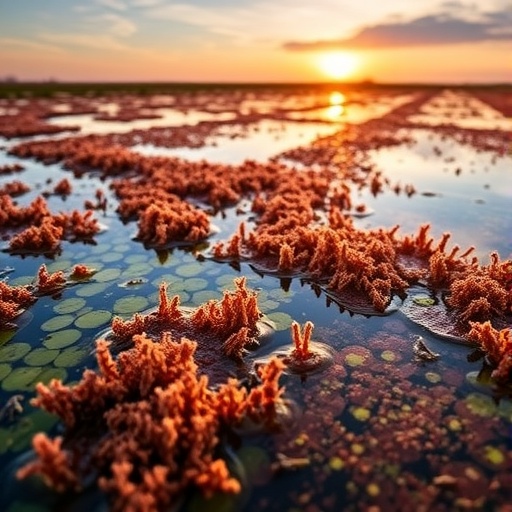
In the realm of intensive agriculture, which largely shapes the modern food supply, a silent and often overlooked community plays an essential role beneath the surface: soil algae. While algae are traditionally recognized as aquatic organisms thriving in oceans, lakes, and rivers, recent research from the Universities of Göttingen and Kassel unveils a thriving and diverse population of algae inhabiting farmland soils. This revelation not only challenges the current understanding of terrestrial ecosystems but provokes a fundamental rethink about biodiversity and ecosystem functioning in agricultural landscapes.
Algae are more than just simple aquatic plants; these photosynthetic microorganisms adapt remarkably well to terrestrial environments, contributing significantly to global vegetation productivity. Emerging evidence suggests soil algae contribute approximately six percent of Earth’s vegetation production, underscoring their substantial ecological significance. Driven by this insight, a multidisciplinary team embarked on a pioneering pilot study to investigate the genotypic composition and temporal dynamics of soil algae communities in wheat fields cultivated near Kassel, Germany.
The study employed cutting-edge molecular techniques, including DNA metabarcoding, to analyze soil samples meticulously collected across three distinct time points within a single agricultural cycle: early spring, midsummer, and autumn. This approach allowed for precise identification and quantification of the soil algae assemblages across seasons, revealing remarkable shifts in their dominance and diversity that had previously gone unnoticed in conventional microbial research focused on bacteria and fungi.
Intriguingly, the findings highlighted pronounced seasonal variations in the composition of soil algae. During the cooler seasons—spring and autumn—yellow-green algae (Xanthophyceae) emerged as the predominant group, flourishing under lower temperatures and in recently exposed soil devoid of dense vegetation cover. These filamentous and single-celled algae thrive in the specific microenvironment created during these periods, characterized by early soil exposure following tillage and lower solar radiation.
Conversely, as the growing season progressed toward late summer, when wheat crops approach harvest, a shift in community structure favored blue-green algae (Cyanobacteria) and green algae. Cyanobacteria, renowned for their nitrogen-fixing capacity, have long been recognized as natural biofertilizers in paddy rice cultivation, especially in Asian contexts. This study extends the perspective by documenting cyanobacterial abundance in Central European arable soils, suggesting their potential contribution to nutrient cycling and soil fertility beyond aquatic and paddy ecosystems.
The discovery of diverse diatom species—single-celled algae primarily known from aquatic habitats—within arable soils further enriches the ecological tapestry uncovered by the researchers. These diatoms, along with green algae, may contribute to soil stabilization, nutrient retention, and microhabitat formation, indicating that soil algae communities are not only diverse but potentially pivotal to sustaining soil structure and health.
Professor Thomas Friedl from the University of Göttingen emphasizes that soil algae are integral components of the soil microbiome, with far-reaching implications for soil fertility and ecosystem resilience. Unlike bacteria and fungi, which dominate soil microbial studies, these photosynthetic microorganisms exert unique influences on soil texture, nutrient dynamics, and moisture retention. Their extracellular polymeric substances contribute to soil aggregation, enhancing aeration and water-holding capacity, elements crucial for crop productivity and drought resilience.
Despite these compelling roles, soil algae remain underrepresented in agricultural research and practice. Professor Miriam Athmann of the University of Kassel notes that both scientists and farmers have historically overlooked how agricultural practices impact these microorganisms. This deficit hinders a comprehensive understanding of sustainable farming systems, as soil algae may hold keys to improving soil health naturally, reducing reliance on synthetic fertilizers, and enhancing crop yields through symbiotic interactions.
The pilot study also contrasted soil algae communities between organically and conventionally managed fields, discovering notable differences in species composition and community structure. While overall diversity was high in both systems, the variation suggests that farming practices modulate algal communities, possibly through differences in soil disturbance, chemical inputs, and crop rotation patterns. These findings open pathways to investigate how agricultural management can harness soil algal biodiversity for ecosystem services.
To build on these insights, the researchers plan an extensive follow-up study involving over 300 soil samples from long-term experimental plots. This research aims to quantitatively assess the impacts of diverse farming systems on soil algal diversity and function, ultimately informing evidence-based guidelines for sustainable agriculture. Such work could empower farmers to consciously foster beneficial soil algae, paving the way for innovative biotechnological applications and ecological intensification strategies.
The implications of understanding soil algae in arable land extend beyond academic curiosity. They touch on critical global challenges such as soil degradation, food security, and climate change adaptation. By integrating soil algal dynamics into agroecosystem management, there is potential to enhance nutrient cycling efficiency, improve soil carbon sequestration, and bolster the resilience of cropping systems against environmental stressors.
This transformative research underscores the necessity to broaden microbial ecology horizons beyond bacteria and fungi, embracing algae as pivotal players in terrestrial ecosystems. It calls for a paradigm shift in agriculture, where belowground biodiversity is recognized and nurtured as a cornerstone of sustainable food production. As soil algae reveal their hidden yet vital presence, they herald a new frontier in ecological science with profound repercussions for the future of farming worldwide.
News Publication Date: 16-Apr-2026
Web References:
https://doi.org/10.3389/fmicb.2026.1813833
References:
Barthel S, et al. Soil algae in arable land: changes in the genotypic community composition across time points and farming systems – a pilot study. Frontiers in Microbiology, 2026.
Cite Scienmag News
Alan Morgan. (May 18, 2026). Uncovering the Hidden Diversity of Algae in Farmland. Scienmag. https://scienmag.com/uncovering-the-hidden-diversity-of-algae-in-farmland/
Alan Morgan. "Uncovering the Hidden Diversity of Algae in Farmland." Scienmag, 18 May 2026, https://scienmag.com/uncovering-the-hidden-diversity-of-algae-in-farmland/. Accessed 3 September 2026.
Alan Morgan. "Uncovering the Hidden Diversity of Algae in Farmland." Scienmag. May 18, 2026. https://scienmag.com/uncovering-the-hidden-diversity-of-algae-in-farmland/


