


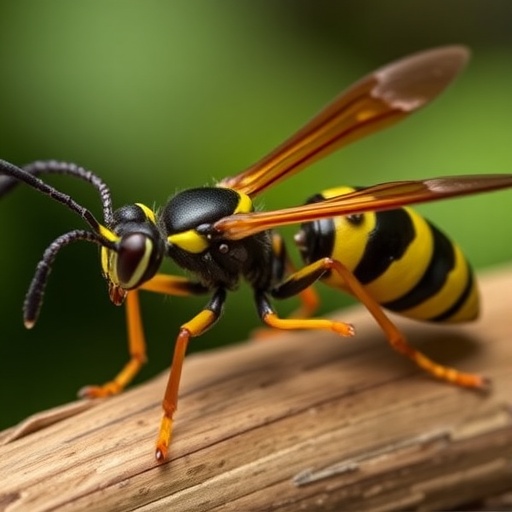
In a remarkable intersection of technology and biodiversity research, a seemingly innocuous Twitter post has paved the way for the discovery of a new wasp species in Japan. This fascinating breakthrough underscores the transformative power of social media platforms in contemporary scientific endeavors, particularly in the realm of entomology and citizen science.
The wasp in question, Eupelmus curvator, was previously thought to inhabit only China. However, a series of striking images shared on Twitter—now rebranded as X—captured an iridescent wasp actively laying eggs on the egg case of a praying mantis, a behavior that sparked curiosity among researchers. Specialists at the Kyushu University Museum swiftly recognized that this insect did not match any known species documented in Japan, leading to its identification as a novel record for the region.
Taisuke Kawano, a leading eupelmid wasp expert at Kyushu University Museum, attributes the discovery directly to the accessibility and immediacy afforded by social media. He recounts how a general user’s photo of a wasp emerging from a mantis egg case was brought to his attention through a colleague’s direct message, setting in motion a series of research steps culminating in the official recognition of Eupelmus curvator in Japan.
This discovery is particularly groundbreaking as it marks the first formal scientific description of the male Eupelmus curvator, a facet of its biology that had eluded entomologists until now. Prior to this, the species was characterized predominantly through female specimens, limiting the comprehensive understanding of its life cycle and ecological role.
Eupelmus curvator displays a specialized parasitic relationship with the egg cases of praying mantises, specifically targeting the Narrow-winged Mantis, Tenodera angustipennis. Unlike most Eupelmus species, which typically parasitize larvae or pupae, E. curvator’s oviposition inside mantis oothecae is unusual, making it a subject of great biological intrigue. In observed cases, such as one egg case collected in Fukuoka, the wasp’s parasitism was so intense that 77 wasps emerged, leaving only a handful of surviving mantis nymphs.
The utilization of social media platforms such as Twitter for “digital collecting” illustrates an evolving paradigm in biodiversity research. Citizen scientists and nature enthusiasts contribute real-time observations that frequently occur outside traditional research schedules and localities. This democratization of data gathering significantly expands the geographic and temporal scope of species monitoring.
The researchers, leveraging direct communication channels on social media, were able to secure actual specimens sent by observant users. This collaborative synergy between amateur naturalists and professional scientists enhances data quality and opens new avenues for detailed taxonomic study, including the employment of cutting-edge imaging techniques.
To accurately document the minute physical characteristics of Eupelmus curvator—which females measure merely 2.2 to 3.2 millimeters excluding the ovipositor—the research team applied advanced macro photography coupled with focus stacking technology. This approach yielded hyper-detailed images elucidating the wasp’s anatomical features, essential for precise taxonomic classification and for differentiating it from closely related species.
Beyond expanding scientific knowledge of a minute parasitoid, this finding highlights the latent biodiversity present even in well-studied regions such as Japan. It suggests that numerous species remain undiscovered, lying in wait to be revealed through innovative research techniques and broad-scale public engagement.
Kawano reflects on the paradigm shift that social media represents for scientific research. These platforms facilitate a continuous influx of observational data, effectively transforming everyday digital interactions into invaluable scientific contributions. The integration of ordinary citizens into research processes not only accelerates discoveries but also cultivates public interest and education in biodiversity conservation.
Interestingly, Kawano himself experiences the blurring of lines between professional duties and personal online activity, acknowledging that social media sometimes doubles as a research tool during leisure browsing. This comment humorously captures the increasingly entwined relationship between modern work practices and digital life.
The study was supported through grants from both the Robert T. Huang Entrepreneurship Center of Kyushu University and the Japan Society for the Promotion of Science, highlighting the importance of institutional backing in facilitating innovative approaches to science in the digital era.
The research findings have been published in the open-access journal Travaux du Muséum National d’Histoire Naturelle “Grigore Antipa”, thereby making the detailed description and bionomic notes of Eupelmus curvator accessible to the global scientific community and further encouraging citizen involvement in biodiversity research.
News Publication Date: 1-Jul-2026
Web References:
- Kyushu University Museum: https://www.museum.kyushu-u.ac.jp/english/
- Robert T. Huang Entrepreneurship Center of Kyushu University: https://www.design.kyushu-u.ac.jp/en/topics/organization/qrec/
- Japan Society for the Promotion of Science: https://www.jsps.go.jp/english/
References:
Kawano T, Imada S, Noguchi S, Toyosaki K (2026) When your posts yield biodiversity findings: social media-facilitated discovery of Eupelmus (Eupelmus) curvator Yang (Hymenoptera, Eupelmidae) in Japan with notes on its bionomics. Travaux du Muséum National d’Histoire Naturelle “Grigore Antipa” 69(1): 1–12. DOI: 10.3897/travaux.69.e171809
Cite Scienmag News
Courtney Benton. (July 1, 2026). Uncovering New Species: How a Twitter Post Revealed a New Wasp in Fukuoka, Japan. Scienmag. https://scienmag.com/uncovering-new-species-how-a-twitter-post-revealed-a-new-wasp-in-fukuoka-japan/
Courtney Benton. "Uncovering New Species: How a Twitter Post Revealed a New Wasp in Fukuoka, Japan." Scienmag, 1 July 2026, https://scienmag.com/uncovering-new-species-how-a-twitter-post-revealed-a-new-wasp-in-fukuoka-japan/. Accessed 4 September 2026.
Courtney Benton. "Uncovering New Species: How a Twitter Post Revealed a New Wasp in Fukuoka, Japan." Scienmag. July 1, 2026. https://scienmag.com/uncovering-new-species-how-a-twitter-post-revealed-a-new-wasp-in-fukuoka-japan/


