


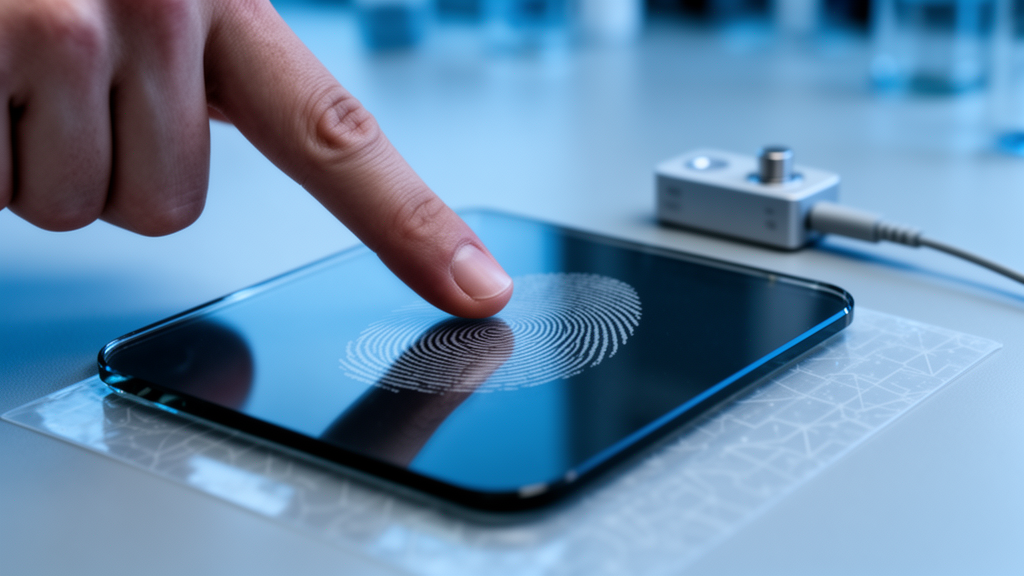
Fingerprints have become the default key to modern life. They unlock smartphones, authorize payments, guard bank accounts, and control access to secure facilities, all in a fraction of a second. Yet the convenience of biometric authentication hides an uncomfortable truth: in nearly every system in use today, your fingerprint is first converted into digital data and then compared against a stored template. Unlike a compromised password, a fingerprint cannot be reset. Once the underlying biometric information leaks, it is compromised for life. A research team at Pohang University of Science and Technology (POSTECH) now proposes a radically different way to think about the problem, one that sidesteps digital storage altogether by letting physics itself perform the authentication.
The study, led by Professor Junsuk Rho of POSTECH’s Departments of Mechanical Engineering, Chemical Engineering, Electrical Engineering, and the Graduate School of Convergence Science and Technology, together with Dr. Seokho Lee and integrated M.S.–Ph.D. student Beomseok Oh of the Department of Mechanical Engineering, was published in the international journal Nature Sensors. Rather than asking how fingerprint data could be stored more safely, the team asked a more fundamental question: what if the fingerprint never needs to be stored as data at all? Their answer is a biometric system in which the required computation happens through the physical interaction between ultrasound waves and the ridges of a finger, with no fingerprint image ever being reconstructed, transmitted, or archived.
At the heart of the technology is a structure known as a metasurface, an artificially engineered material designed to control waves with a precision that natural materials cannot match. In this work, the metasurface manipulates ultrasound, steering its direction, intensity, and phase much the way engineered optical surfaces can shape light. The researchers embedded this capability into an architecture they call a metasurface-driven loop-diffractive neural network, or loop-DNN. In a conventional neural network, computation is carried out digitally by weighted connections between artificial neurons. In the loop-DNN, the metasurface plays an analogous role: its engineered structure performs the mathematical work of the network directly on the acoustic wave as it propagates through the system.
The operating principle is elegantly simple in concept. Ultrasound directed through the metasurface is routed to different physical locations depending on the fingerprint it encounters. When a registered user places their finger on the device, the acoustic energy is concentrated into a designated registered region. When an unregistered fingerprint is presented, the energy is instead directed toward a non-registered region. Authentication then reduces to a straightforward comparison of signal intensities at those two regions. No fingerprint image is reconstructed, no minutiae features are extracted, and no biometric template is compared in software. The decision emerges from the wave itself, a shift the researchers describe as moving from a store-and-compare paradigm to one of physical computation and direct decision-making.
What distinguishes this system from earlier diffractive neural networks is the breadth of wave control it achieves. Conventional diffractive networks primarily modulate the phase of the wave passing through each layer. The POSTECH team went further, controlling not only the phase but also the amplitude and the transmission states of the ultrasound, effectively switching acoustic channels on and off. This combination gives a single metasurface a greatly expanded set of degrees of freedom for manipulating the wave, allowing one physical structure to carry out fingerprint processing that would otherwise demand multiple stages of digital computation. The extra degrees of freedom proved consequential: the researchers observed a general improvement in recognition performance as the design freedom of the metasurface increased.
The experimental results lend weight to the concept. In physical tests using fingerprints from four individuals, the system achieved an accuracy of 97.92 percent across a total of 192 validation samples. The team also conducted numerical analysis using an international fingerprint recognition database, and in that simulation the system reached an accuracy of up to 99.75 percent for a single registered user. Those figures, obtained without any stored fingerprint template, suggest that physical computation can rival the performance of conventional digital matching while removing the most sensitive asset from the attack surface entirely: the biometric database itself.
The security implications are significant. Even when conventional systems encrypt their stored fingerprint data, the authentication process still requires access to that biometric information, which means a sufficiently determined attacker who breaches the system gains something irreplaceable. By eliminating the stored template, the POSTECH approach removes the target. There is no database of fingerprints to steal, no encrypted archive to crack, and no biometric data being sent to a computer for analysis. The computation is completed locally, through the interaction of sound waves with engineered matter, and the output is simply a decision. In an era when large-scale breaches of biometric databases have become a recurring headline, a system with nothing to leak represents a fundamentally different security posture.
Professor Rho framed the work as a change in first principles rather than an incremental improvement. Rather than developing a faster algorithm or stronger encryption technology, he explained, the study changes the starting point of biometric authentication itself. By eliminating the need to separately store biometric information, he noted, the team expects the approach to develop into a new authentication method that can reduce the risk of fingerprint information being exposed through hacking. The statement captures the philosophical core of the research: instead of hardening the vault, remove the vault.
The potential applications extend across sectors where security failures carry severe consequences. Finance, healthcare, and defense all depend on authentication systems whose compromise would be catastrophic, and all three could benefit from biometric verification that leaves no stored data behind. Closer to everyday life, the technology could eventually appear in automobiles, smartphones, and wearable devices, replacing the store-and-compare pipelines that currently sit inside every fingerprint sensor. Because the authentication is performed physically and instantaneously by the metasurface, the approach could in principle deliver decisions with low latency and without the energy cost of digital feature extraction, though the researchers have not yet claimed specific performance figures for power or speed in consumer form factors.
Substantial engineering challenges remain before the concept reaches commercial reality. The current experimental system operates at approximately 40 kilohertz, a frequency far below the megahertz range used by industrial ultrasonic sensors, and miniaturizing the platform toward those higher frequencies is a necessary step for practical devices. The technology must also be extended to support multiple registered users, since the present demonstrations focus on single-user or small-cohort authentication. The research team plans to advance the platform by combining multilayer metasurfaces with digital technologies, a hybrid direction that could preserve the security advantages of physical computation while adding the flexibility of conventional electronics. The work was supported by the POSCO Holdings N.EX.T Impact Program, the Mid-Career Researcher Program of the Ministry of Science and ICT and the National Research Foundation of Korea, the Future-Pioneering Convergence Technology Program, the Doctoral Student Research Incentive Program of the Ministry of Education and the National Research Foundation of Korea, and the InnoCORE Program of the Ministry of Science and ICT. If the team succeeds in scaling the platform, the fingerprint sensor of the future may look less like a camera feeding a database and more like a piece of engineered matter that simply knows who you are, without ever keeping a copy of the answer.
Subject of Research: Metasurface-driven ultrasonic neural network for biometric fingerprint authentication without storing fingerprint data
Article Title: Fingerprint authentication without storing fingerprints
Article References: Fingerprint authentication without storing fingerprints. (n.d.). Original publication
Image Credits: AI Generated
DOI: Not provided
Keywords: fingerprint authentication, biometric security, metasurface, ultrasound, diffractive neural network, physical computation, data privacy, POSTECH, Nature Sensors, acoustic waves, wave manipulation, authentication technology
Cite Scienmag News
Denise Maddox. (October 17, 2026). Ultrasound Metasurface Authenticates Fingerprints Without Ever Storing Them. Scienmag. https://scienmag.com/ultrasound-metasurface-authenticates-fingerprints-without-ever-storing-them/
Denise Maddox. "Ultrasound Metasurface Authenticates Fingerprints Without Ever Storing Them." Scienmag, 17 October 2026, https://scienmag.com/ultrasound-metasurface-authenticates-fingerprints-without-ever-storing-them/. Accessed 17 October 2026.
Denise Maddox. "Ultrasound Metasurface Authenticates Fingerprints Without Ever Storing Them." Scienmag. October 17, 2026. https://scienmag.com/ultrasound-metasurface-authenticates-fingerprints-without-ever-storing-them/


