


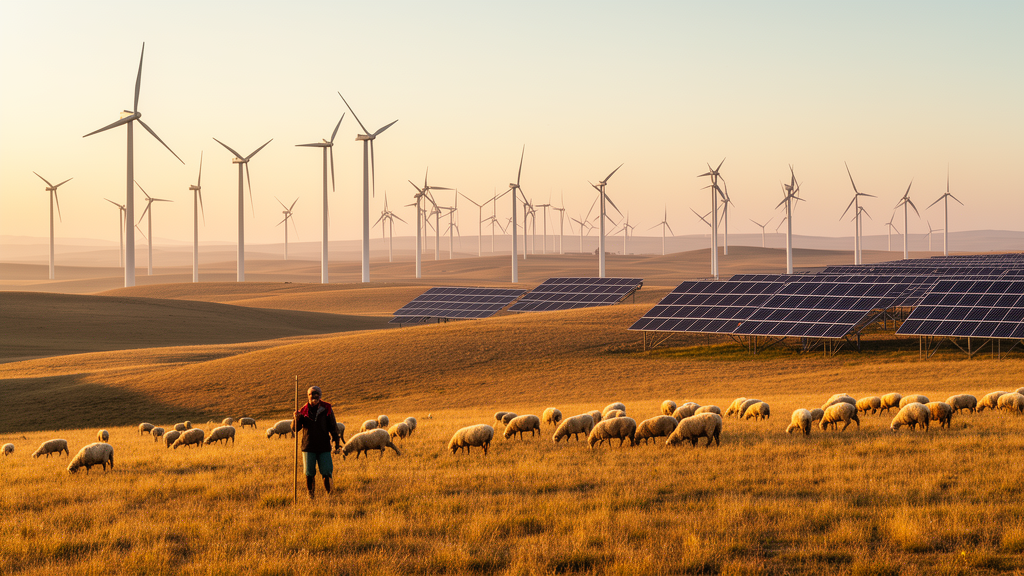
The world’s race to decarbonize is colliding with one of the planet’s oldest land-use systems. As governments and investors scramble to build wind farms, solar arrays and carbon-sequestration schemes, they are increasingly turning their attention to rangelands—the vast grasslands, savannas, steppes and shrublands that cover roughly 54 percent of Earth’s land surface and sustain millions of pastoralists. A new perspective article published in the journal Pastoralism argues that this convergence could either empower some of the world’s most marginalized communities or dispossess them all over again, depending entirely on how green-transition projects are designed and governed.
The research, led by Jonathan Davies and colleagues from institutions in the United Kingdom, India, Kenya and Germany, maps the renewable-energy and carbon-storage potential of the world’s rangelands and examines what happens when green investments arrive in pastoral territories. The findings are striking: more than 82 percent of global rangelands fall into a moderate to high range for solar electricity production, and around 60 percent are commercially viable for wind energy at a 100-meter hub height. These are not marginal landscapes—they are among the most promising sites on Earth for the renewable infrastructure the climate crisis demands.
The authors used global datasets for photovoltaic power potential and wind power density, overlaying them with a rangelands map developed by the International Livestock Research Institute. Solar potential was assessed using Practical Photovoltaic Power Potential (PVOUT), which measures realistic annual electricity generation per unit of installed capacity while accounting for system losses. Wind viability was evaluated using International Electrotechnical Commission classifications, with commercial viability typically beginning above 6.5 meters per second at 80 meters height. The analysis reveals that pastoral lands are not peripheral to the energy transition—they are central to it.
But the same characteristics that make rangelands attractive to investors also make them vulnerable. Rangelands are often sparsely populated, legally ambiguous in tenure, and perceived by outsiders as underused or degraded. The authors document how this perception has historically justified dispossession: colonial and post-colonial governments annexed pastoral land for irrigation schemes, protected areas, urban expansion and infrastructure, usually without recognizing existing rights or providing compensation. Now climate policy is driving a new wave of land acquisition, and the authors warn that without safeguards, the green transition risks repeating these injustices under a sustainable banner.
The paper draws on case studies from India, Kenya and Mongolia to illustrate both the dangers and the possibilities. In Kenya, the heavily criticized Lake Turkana Wind Power Project annexed large areas of pastoral land, blocked migration routes and denied access to culturally significant sites, while benefit sharing remained negligible and token employment favors certain ethnic groups over others. Geothermal projects in the country have occupied significant land, blocked water access and contributed to drinking-water pollution. Wind farms have driven up land values, triggering rushes to claim private titles and intensifying conflict within and between communities.
In India, large tracts of rangeland are legally designated as wasteland, allowing investors to disregard prior occupation and the economic value of established pastoral land use. Large-scale solar projects have removed land from pastoral production, created unfavorable microclimates around installations, and reduced livestock health and productivity. Yet pastoralists have fought back: protests in Gujarat led to the return of project land to community ownership and a 25-year lease agreement with the developer. In Ladakh, the state administration is now planning a pilot solar project designed to accommodate livestock grazing, signaling a shift toward more compatible land-use models.
Mongolia offers a different picture. Wind-farm projects such as the Sainshand Wind Park have compensated herders by identifying alternative seasonal residences, building animal shelters and wells, and helping them register new land. Herders typically retain grazing access to all land except the small footprints where turbines stand. Communities that temporarily lose pasture during construction receive replacement fodder. The Sermsang Khushig Khundii Solar Power Plant was even re-sited after communities raised concerns during consultations about access to important salt ponds. These examples demonstrate that co-existence between energy infrastructure and pastoral livelihoods is not only possible but can generate social acceptance and better economic returns.
Kenya’s Kipeto Wind Farm stands out as perhaps the most equitable model documented. The project leases land from the local community, hired a local lawyer to navigate complex negotiations, and established a community implementation committee. A community trust holds a 5 percent share in the wind farm, and landowners receive 1.4 percent of the gross revenue from each turbine on their land. Households that had to relocate were compensated with newly constructed homes equipped with solar power, and the project built a health center and other community facilities. The county government avoided reclassifying the land from grazing to industrial use, preventing a spike in land rates that would have burdened landowners.
Beyond renewable energy, the paper examines carbon sequestration in rangelands—a sector attracting growing investment as voluntary carbon markets expand. Grasslands store an estimated third of global terrestrial carbon stocks, and improved management could sequester between 240 and 2,000 million tonnes of atmospheric carbon per year. Grasslands have the highest carbon gap density of any land use at 138.3 grams of carbon per square meter annually, and they respond more rapidly to human intervention than forests. However, the authors caution that some carbon schemes in East Africa have been reported as coercive and non-consensual, prone to corruption and aggravating land conflicts. Afforestation projects on rangelands—frequently promoted as nature-based solutions—can actually reduce biodiversity, impair ecosystem function and, in some cases, cause a net loss of carbon from the system.
The authors conclude that a just green transition depends on upholding pastoralist rights, enabling effective participation and ensuring equitable benefit sharing. Projects that succeed do so because they recognize pastoralists’ land rights, engage communities in meaningful and ongoing consultation, and treat pastoralism as a legitimate and valuable land-use practice rather than an obstacle to progress. The green transition does not have to be another chapter in the long history of pastoral dispossession—but making it otherwise will require deliberate policy, strong governance and a fundamental shift in how investors and governments value the world’s rangelands and the people who have sustained them for millennia.
Subject of Research: The potential of pastoral rangelands for renewable energy and carbon sequestration and the risks of land alienation for pastoralist communities during the green transition
Article Title: Pastoral lands and the green transition: opportunities and challenges
Article References: Davies, J., Bhati, S. P. S., Wario, H., Rawat, M., & Waters-Bayer, A. (2026). Pastoral lands and the green transition: opportunities and challenges. Pastoralism: Research, Policy and Practice, 16, Article 16429. https://doi.org/10.3389/past.2026.16429
Image Credits: AI Generated
Keywords: pastoralism, rangelands, green transition, renewable energy, carbon sequestration, land rights, solar power, wind energy, just transition, pastoralist communities, land governance, climate mitigation
Cite Scienmag News
Sloane Callahan. (October 17, 2026). Pastoral Rangelands Become the Battleground of the Global Green Transition. Scienmag. https://scienmag.com/pastoral-rangelands-become-the-battleground-of-the-global-green-transition/
Sloane Callahan. "Pastoral Rangelands Become the Battleground of the Global Green Transition." Scienmag, 17 October 2026, https://scienmag.com/pastoral-rangelands-become-the-battleground-of-the-global-green-transition/. Accessed 17 October 2026.
Sloane Callahan. "Pastoral Rangelands Become the Battleground of the Global Green Transition." Scienmag. October 17, 2026. https://scienmag.com/pastoral-rangelands-become-the-battleground-of-the-global-green-transition/


