


Desertification is one of the most stubborn environmental challenges of our time. Roughly 24 percent of the global land surface across 126 countries is affected, and the livelihoods of about 35 percent of the world’s population depend on ecosystems that are increasingly unstable. In China, desertified land covers 257.37 million hectares, or about 27 percent of the national territory, threatening ecological security, economic development, and public welfare. Yet the country has recorded a remarkable turnaround: sandy land has shifted from an average annual expansion of roughly 343,000 hectares at the end of the last century to an average annual reduction of about 667,000 hectares today. Over the past two decades, spring sand-dust weather has declined in both frequency and intensity, with the annual average number of events falling from 12.5 to 9.6 in recent years.
A new study published in Frontiers in Environmental Science examines how this progress can be made sustainable, focusing on the Taklamakan Desert-fringe Shelter-belt Enclosure Project, or TDSEP, a component of China’s vast Three-Norths Shelterbelt Program. The research, conducted by Hua Li of the Shandong Academy of Governance, uses a multi-case study approach to analyze the symbiotic relationship between the shelter-belt project and six types of desert-based industries embedded within it. The central tension the study addresses is stark: ecological restoration demands large-scale planting, grazing exclusion, and cropland retirement, while local residents in desert areas have traditionally relied on grassland grazing, desert reclamation, and harvesting desert shrubs for fuel and forage. This creates a tangible dilemma of ecological restoration versus subsistence survival.
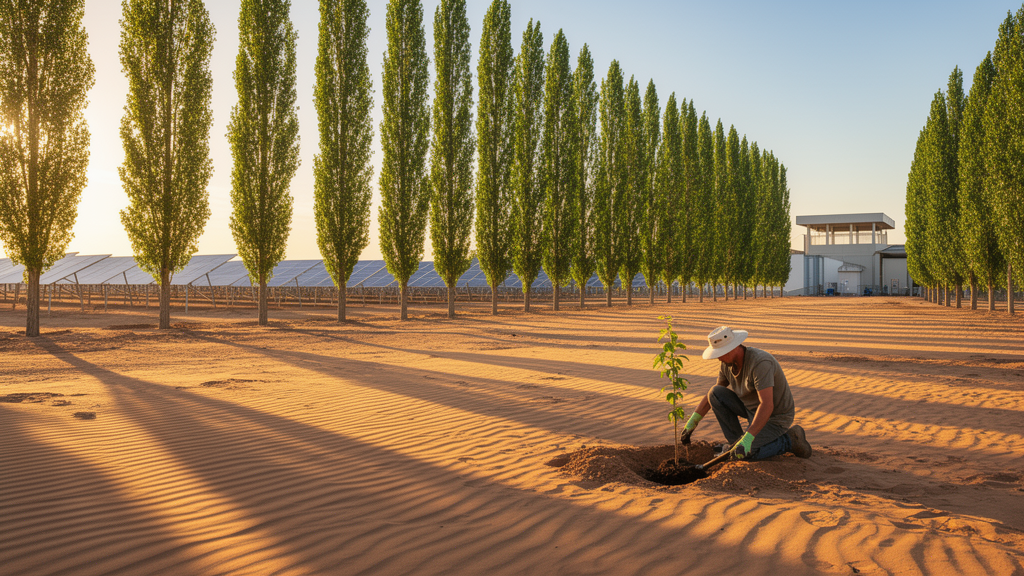
The TDSEP itself is an engineering feat. It consists of a 3,046-kilometer continuous green shelterbelt, described as the world’s longest ecological barrier encircling a desert, with protective belts ranging from 110 meters to 7,500 meters wide. The project integrates biological afforestation using drought-enduring native species such as saxaul, tamarisk, and Populus euphratica, engineering sand fixation through straw checkerboards and high vertical sand barriers, and photovoltaic sand control. Flood irrigation, ecological water diversion, and drip irrigation support windbreak and sand-fixation forests and shrub-herb mixed belts along the desert fringes. According to official data released at the end of 2025, vegetation cover in fringe shelterbelts increased from less than 5 percent to 10 to 15 percent compared with 2022, natural oases expanded by 600 square kilometers, artificial oases grew by 44,900 square kilometers, and desertified land decreased by 5,300 square kilometers. Annual average days of sandstorms fell by 1.5, blowing sand by 2.8, and floating dust by 4.4. Red deer, foxes, and diverse desert bird species have reappeared, and food-web structures of desert ecosystems have been restored.
To understand whether industries built on this ecological foundation can sustain it, the study analyzed six cases spanning fruits, flowers, traditional medicinal herbs, and photovoltaic power. The Yutian County rose industry and the Kunyu City jujube industry both achieved what the researcher classifies as asymmetrical mutualism with the shelter-belt project. Rose cultivation covers 5,466 hectares and generates an output value of 237 million yuan per year, raising the average household income of 8,500 farming families by 18,000 yuan each. Jujube cultivation spans 16,000 hectares, producing 300,000 tons valued at 2.57 billion yuan annually, with an average household income of 100,000 yuan. The Shaya County centralized photovoltaic industry generates 420 million kilowatt-hours annually and provides seasonal employment with a per capita annual income of 10,000 yuan. The most successful arrangement, however, proved to be the Shaya County combination of saxaul, the parasitic medicinal plant Cistanche deserticola, and distributed photovoltaic power, which achieved the only fully symmetric mutualism: cultivation covering 3,200 hectares yields 9,000 yuan per hectare and benefits 1,200 households.
Not every case ended well. The Hetian County walnut and jujube industry drifted from commensalism into symbiotic dysfunction as falling fruit prices failed to cover costs, particularly prohibitive groundwater pumping expenses. The Shache County Eucommia industry fared worse, exhibiting outright parasitism: the responsible enterprise carried out no substantive construction, drilled no wells, planted no seedlings, and defaulted on approximately 20 million yuan owed to contractors before the local government terminated the project. These failures are not merely economic footnotes; they demonstrate how mismatched industries can degrade the very ecological systems on which they depend, transmitting pressure through hydrogeological channels to adjacent green belts.
The study identifies three categories of factors that determine whether the symbiosis between shelter-belt and industry thrives or collapses. The first is the symbiotic environment and material factors of production, with water resources standing out as the foundational constraint. The successful rose and jujube cases benefited from drip irrigation that controlled water consumption and drew on surface water from Kunlun Mountain glacial melt, while the photovoltaic cases used solar power to extract shallow brackish water for drip irrigation. The failed walnut case suffered from inadequate water-saving irrigation and crushing pumping costs. The researcher recommends verifying extraction quotas against groundwater carrying capacity under the principle of determining land and output by water, and establishing a hydrogeological impact assessment system requiring groundwater numerical simulation before project approval.
The second category concerns the compatibility of symbiotic units with local conditions. Species that have undergone long-term natural selection in the extreme arid environment, such as saxaul, tamarisk, sea buckthorn, Populus euphratica, desert rose, and high-end jujube varieties, should be prioritized. Eucommia, a deciduous tree of subtropical to warm temperate zones that prefers warm, humid climates with annual precipitation of 500 to 1,500 millimeters, was introduced at scale without successful pilot trials, with predictable results. In a telling adaptation, the Hetian enterprise eventually replaced 600 hectares of struggling walnut trees with saxaul and four-winged saxifrage better suited to desert conditions, though by then a parasitic relationship with the groundwater resource had already formed.
The third category involves transformative agencies, chiefly leading companies and local governments. Successful cases show the driving effect of capable enterprises: Xinjiang Yutian Guimi Biotechnology built a rose demonstration base, research laboratory, and processing factory producing over 60 product categories; a Schumpeterian entrepreneur achieved jujube variety breeding success in 2005; and China Electric Power Construction Company built a 250-megawatt photovoltaic industrial park in Shaya County covering roughly 667 hectares with a total investment of 1.2 billion yuan. Local government support proved equally decisive, with fixed-asset investment subsidies of approximately 30 percent widely regarded as an effective incentive. In Yutian, the regional forestry bureau allocated 21 million yuan for a rose germplasm and seedling base, and the county invested 45 million yuan in an industry boulevard connecting cultivation areas to a processing park hosting six enterprises that handle 85 percent of the county’s fresh rose procurement. In Shaya, the government built 37 distributed photovoltaic water collection systems serving 4,200 hectares of saxaul with a survival rate exceeding 80 percent, and facilitated replacing conventional grid power with photovoltaic electricity for wells pumping brackish groundwater, achieving saxaul survival rates of 90 percent.
Technological innovation emerges as a cross-cutting enabler. Fully automated grass-grid-planting machines achieve five times the efficiency of manual methods while cutting costs by 40 percent. A water-conveying precision planting device, dubbed a desert injector, can plant 1,600 seedlings daily with stable root establishment in 50-centimeter-deep moist sand layers and a survival rate above 85 percent. Breakthroughs in saline-alkaline water utilization have reduced treatment costs to 2.1 yuan per ton. Yet bottlenecks remain at both ends of the industrial chain: inadequate breeding technology, with some varieties showing severe deterioration in disease resistance and flavor after prolonged cultivation, and insufficient deep-processing capability, with most factories limited to food and beverage products while health supplements, cosmetics, and daily necessities face technical barriers. The study proposes technological market transaction platforms and industry-academia-research collaboration systems to overcome these constraints.
The broader lesson is institutional as much as ecological. Drawing on game theory, the study notes that the shelter-belt project exhibits characteristics of a public good, giving enterprises and farmers a free-rider incentive, while industry profits are excludable, making market mechanisms alone insufficient for optimal allocation of ecological and economic resources. Three benefit-sharing models operate around the Taklamakan: contract farming with minimum protection prices, shareholding cooperation in which farmers contribute land, labor, or capital as equity, and management entrustment services. The enterprise-plus-cooperative-plus-farmer arrangement adopted in the successful cases reduces transaction costs and enhances contract compliance through cooperative supervision. The study also highlights institutional entrepreneurship in land use, noting that converting state-owned sandy land around photovoltaic bases to collective ownership, with use rights of up to 70 years confirmed to individuals, boosted farmer participation and fostered a win-win of increased greenery, enhanced industrial value, improved corporate efficiency, and higher incomes. The author acknowledges limitations, including an unbalanced geographic sample, reliance on secondary data for the failed cases, and a static classification that cannot fully capture the dynamic evolution of real-world symbiosis, pointing toward longitudinal and quantitative research as the field matures.
Subject of Research: Symbiosis between the Taklamakan Desert-fringe shelter-belt enclosure project and desert-based industries in sustainable desertification control
Article Title: Achieving sustainable desertification control: insights from symbiosis between the Taklamakan Desert-fringe shelter-belt enclosure project and desert-based industries
Article References: Li, H. (2026). Achieving sustainable desertification control: insights from symbiosis between the Taklamakan Desert-fringe shelter-belt enclosure project and desert-based industries. Frontiers in Environmental Science, 14, Article 1942065. https://doi.org/10.3389/fenvs.2026.1942065
Image Credits: AI Generated
DOI: 10.3389/fenvs.2026.1942065
Keywords: desertification, Taklamakan Desert, shelterbelt, Three-Norths Shelterbelt Program, symbiosis theory, photovoltaic sand control, Cistanche deserticola, groundwater, drip irrigation, ecological restoration, benefit-sharing, Xinjiang
Cite Scienmag News
Violet Maxwell. (October 17, 2026). Symbiosis Between Shelterbelts and Desert Industries Offers a New Path to Sustainable Sand Control. Scienmag. https://scienmag.com/symbiosis-between-shelterbelts-and-desert-industries-offers-a-new-path-to-sustainable-sand-control/
Violet Maxwell. "Symbiosis Between Shelterbelts and Desert Industries Offers a New Path to Sustainable Sand Control." Scienmag, 17 October 2026, https://scienmag.com/symbiosis-between-shelterbelts-and-desert-industries-offers-a-new-path-to-sustainable-sand-control/. Accessed 17 October 2026.
Violet Maxwell. "Symbiosis Between Shelterbelts and Desert Industries Offers a New Path to Sustainable Sand Control." Scienmag. October 17, 2026. https://scienmag.com/symbiosis-between-shelterbelts-and-desert-industries-offers-a-new-path-to-sustainable-sand-control/


