

Saturday, July 11, 2026
Science
No Result
View All Result
  • Login
  • HOME
  • SCIENCE NEWS
  • CONTACT US
  • HOME
  • SCIENCE NEWS
  • CONTACT US
No Result
View All Result
Scienmag
No Result
View All Result
Home Science News Technology and Engineering

Ultra-fine bubbles revolutionize future of inkjet printing technology

July 11, 2026
in Technology and Engineering
Reading Time: 2 mins read
0
Ultra-fine bubbles revolutionize future of inkjet printing technology

Ultra-fine bubbles revolutionize future of inkjet printing technology

65
SHARES
587
VIEWS
Share on FacebookShare on Twitter
ADVERTISEMENT

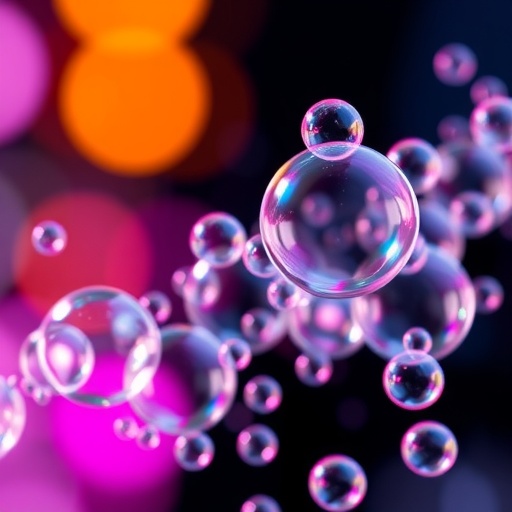
In a breakthrough that could transform inkjet printing in microfabrication, researchers at Tokyo Metropolitan University have demonstrated a novel method to precisely control the drying patterns of nanoparticle-laden droplets without introducing chemical additives. By incorporating ultra-fine, nanoscale bubbles into silica nanoparticle suspensions, the team achieved tunable film morphologies simply by adjusting the bubble concentration, offering a promising route to more uniform coatings essential for advanced microdevices.

The conventional challenge in inkjet printing arises from phenomena like the “coffee ring” effect, where particles migrate to the edges of drying droplets, producing uneven deposits. While surfactants and other additives can modify surface tension to mitigate these patterns, they often remain in the final film, potentially altering the intrinsic properties of the printed materials. This poses a significant problem for sensitive applications, such as microelectronics and MEMS devices, where purity and functionality of deposited nanoparticles are critical.

Led by Professor Arata Kaneko, the researchers circumvented these issues by generating ultra-fine bubbles within aqueous silica nanoparticle suspensions using a specialized bubble generator. These ultra-fine bubbles, nanometers in size, influence the surface tension and wetting characteristics of the suspension without chemically modifying the particles themselves. Depositing one-nanoliter droplets onto silicon substrates via inkjet nozzles, the team observed a striking transformation in drying behavior.

Droplets devoid of bubbles exhibited the classic strong coffee ring pattern. However, suspensions infused with an intermediate concentration of bubbles yielded markedly more uniform particle distributions across the substrate. Increasing the bubble concentration further flipped the effect, causing particles to aggregate predominantly at the droplet centers. This tunable control over particle deposition patterns unlocks new possibilities for functional coatings.

Critically, because the bubbles vanish upon drying, they leave no residues or contaminants that could impair the performance of sensitive nanoparticle materials. This is particularly vital for applications involving conductive nanoparticles or sensing materials like graphene and molybdenum dioxide, whose effectiveness hinges on the pristine condition of their surfaces and precise deposition profiles. The ability to engineer film morphology via bubble concentration rather than surfactant chemistry represents a paradigmatic advance in inkjet printing technologies.

The implications extend broadly to industrial printing processes and the fabrication of microelectronic components, where microscale precision and material integrity are paramount. By enabling additive-free tuning of film morphology, this method enhances the versatility and reliability of inkjet printing for cutting-edge scientific and technological domains.

This innovative approach not only deepens fundamental understanding of drying dynamics in complex fluids but also offers a practical engineering strategy to overcome long-standing limitations in droplet-based deposition. Anticipated future work includes exploring the technique’s applicability to other nanoparticle systems and substrates, as well as scaling considerations for commercial manufacturing.

Supported by JSPS KAKENHI grants JP22H01377 and JP25K01136, and the JKA Promotion Fund under Grant 2024M-394, this research marks a significant milestone in materials engineering and precision printing science, promising new directions for the design of microscale functional films.


Subject of Research: Nanoparticle suspensions and inkjet printing film morphology control
Article Title: Inkjet printing of ultrafine-bubble-added SiO2 nanoparticle suspensions for film morphology control
News Publication Date: 29-May-2026
Web References: http://dx.doi.org/10.1016/j.precisioneng.2026.05.014
Image Credits: Tokyo Metropolitan University

Keywords

Printing, Nanoparticles, Pattern Formation, Surface Tension, Microelectronics, Materials Engineering, Sensors

Tags: advanced inkjet printing for microdeviceschemical-free surface tension controlmicroelectronics fabrication innovationsmicrofabrication coating techniquesnano-scale bubble generationnanobubbles in aqueous suspensionsnanoparticle suspension stabilizationnon-chemical additive surface modificationprecision droplet drying controlsuppression of coffee ring effectultra-fine bubbles in inkjet printinguniform nanoparticle film formation
Share26Tweet16
Previous Post

Polyunsaturated Fatty Acid Synthesis Influences Ferroptosis Sensitivity with Low Arachidonic Acid

Next Post

Polygenic Risk Scores Linked to Social Anxiety Disorder Subtypes

Related Posts

AGA Introduces Nigel, AI Assistant for Gastroenterology and Hepatology
Technology and Engineering

AGA Introduces Nigel, AI Assistant for Gastroenterology and Hepatology

July 10, 2026
Soil Type Influences Impact of Carbon and Nitrogen on Nitrous Oxide Emissions
Technology and Engineering

Soil Type Influences Impact of Carbon and Nitrogen on Nitrous Oxide Emissions

July 10, 2026
AI Enhanced with Cerebellum-Like Function for Improved Learning
Technology and Engineering

AI Enhanced with Cerebellum-Like Function for Improved Learning

July 10, 2026
First Human Trial Explores Immune-Engineered Cell Therapy for Type 1 Diabetes
Technology and Engineering

First Human Trial Explores Immune-Engineered Cell Therapy for Type 1 Diabetes

July 10, 2026
Ultrafast Semiconductor Lasers Generate Self-Starting Harmonic Frequency Combs
Technology and Engineering

Ultrafast Semiconductor Lasers Generate Self-Starting Harmonic Frequency Combs

July 10, 2026
Durable CNT@Ag-MXene Sensor Resists Corrosion Under High Strain
Technology and Engineering

Durable CNT@Ag-MXene Sensor Resists Corrosion Under High Strain

July 10, 2026
Next Post
Polygenic Risk Scores Linked to Social Anxiety Disorder Subtypes

Polygenic Risk Scores Linked to Social Anxiety Disorder Subtypes

  • Mothers who receive childcare support from maternal grandparents show more

    Mothers who receive childcare support from maternal grandparents show more parental warmth, finds NTU Singapore study

    27656 shares
    Share 11059 Tweet 6912
  • University of Seville Breaks 120-Year-Old Mystery, Revises a Key Einstein Concept

    1061 shares
    Share 424 Tweet 265
  • Bee body mass, pathogens and local climate influence heat tolerance

    682 shares
    Share 273 Tweet 171
  • Researchers record first-ever images and data of a shark experiencing a boat strike

    546 shares
    Share 218 Tweet 137
  • Groundbreaking Clinical Trial Reveals Lubiprostone Enhances Kidney Function

    531 shares
    Share 212 Tweet 133
Science

Embark on a thrilling journey of discovery with Scienmag.com—your ultimate source for cutting-edge breakthroughs. Immerse yourself in a world where curiosity knows no limits and tomorrow’s possibilities become today’s reality!

RECENT NEWS

  • Polygenic Risk Scores Linked to Social Anxiety Disorder Subtypes
  • Ultra-fine bubbles revolutionize future of inkjet printing technology
  • Polyunsaturated Fatty Acid Synthesis Influences Ferroptosis Sensitivity with Low Arachidonic Acid
  • Real-Time Pain and Activity Patterns in Older Adults with Chronic Pain

Categories

  • Agriculture
  • Anthropology
  • Archaeology
  • Athmospheric
  • Biology
  • Biotechnology
  • Blog
  • Bussines
  • Cancer
  • Chemistry
  • Climate
  • Earth Science
  • Editorial Policy
  • Marine
  • Mathematics
  • Medicine
  • Pediatry
  • Policy
  • Psychology & Psychiatry
  • Science Education
  • Social Science
  • Space
  • Technology and Engineering

Subscribe to Blog via Email

Enter your email address to subscribe to this blog and receive notifications of new posts by email.

Join 5,146 other subscribers

© 2025 Scienmag - Science Magazine

Welcome Back!

Login to your account below

Forgotten Password?

Retrieve your password

Please enter your username or email address to reset your password.

Log In
No Result
View All Result
  • HOME
  • SCIENCE NEWS
  • CONTACT US

© 2025 Scienmag - Science Magazine

Discover more from Science

Subscribe now to keep reading and get access to the full archive.

Continue reading
