


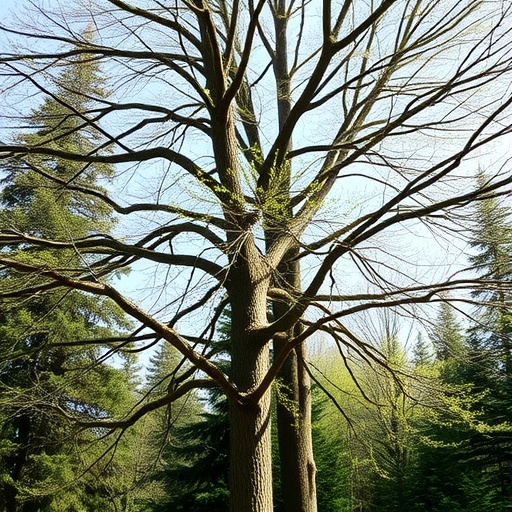
As the verdant resurgence of spring graces forests with fresh buds and vibrant hues, scientists are uncovering new visual indicators of tree health that could revolutionize forest ecology monitoring. Dr. Magali Nehemy, a forest hydrology expert at the University of British Columbia Okanagan, has made a compelling discovery: the subtle orientation of tree branches acts as a direct and observable measure of a tree’s internal water status. This finding unveils a dynamic and previously underappreciated facet of tree physiology during seasonal transitions.
The essence of Dr. Nehemy’s research lies in understanding stem rehydration – a critical phase at the onset of the growing season, when evergreen trees restore their water reserves depleted over winter. By investigating balsam fir trees in Ontario’s Muskoka region, she has demonstrated that branch posture is intrinsically linked to the cyclical water flux within the stem. Trees whose branches lift upward are actively rehydrating, while those exhibiting drooping branches signify water stress, a revelation that has far-reaching implications for ecological surveillance.
To capture these biomechanics, Dr. Nehemy employed state-of-the-art dendrometers alongside high-frequency time-lapse photography. The dendrometers continuously measured minute expansions and contractions in stem radius every 15 minutes, reflecting the tree’s internal hydration dynamics. Complementing this data, time-lapse images captured subtle yet consistent shifts in branch angle over weeks, establishing a direct correlation between hydraulic changes and physical branch orientation. This parallel monitoring confirmed that outward signs in tree architecture can effectively mirror internal physiological processes.
The study further elucidates that branch movement operates as an integrative metric. Unlike transient stem contractions influenced by rapid temperature fluctuations, branch posture responds predominantly to sustained water availability. Intriguingly, Dr. Nehemy notes that night-time freeze-thaw cycles induced sharp stem radius variations but failed to produce immediate changes in branch angle. This decoupling emphasizes that branch positioning is governed more by cumulative water status than by ephemeral thermal factors.
Such findings have monumental importance in the context of ongoing climate change. Northern forests are particularly vulnerable to erratic patterns in snowmelt and precipitation, which modulate water access for trees during critical growth phases. The ability to visually assess forest hydration through non-invasive observation of branch orientation offers a novel, cost-efficient tool to gauge ecological responses to environmental stresses. This method bypasses the need for expensive, complex instrumentation in remote or resource-limited settings.
Moreover, the differential responses between species highlight the complexity of forest ecohydrology. While evergreen conifers like balsam fir exhibit dynamic branch movement aligned with hydration cycles, adjacent deciduous trees lacking leaves remain relatively static. This suggests species-specific physiological adaptations and raises compelling questions regarding interspecies variability in water-use strategies and resilience mechanisms amid shifting climates.
The phenomenon of plant movement in response to environmental stimuli is not new, tracing its scientific inquiry back to pioneer observations by Charles Darwin. Yet, the intersection between mechanical changes in woody branch orientation and underlying water dynamics has remained understudied until now. Dr. Nehemy’s work brings this hidden dimension into focus, suggesting that morphological plasticity extends beyond growth to include real-time adjustments linked with internal water regulation.
Understanding the biomechanics behind this branch movement also intersects with the broader field of forest hydrology. The interaction between xylem water transport, stem elasticity, and turgor pressure likely governs how and when branches adjust their angles. This adds a rich layer of complexity to traditional models of tree physiology, proposing that visible branch posture may be an emergent property of intricate hydraulic feedback loops within the tree.
The study’s observational design, focusing on temporal patterns and correlations, opens pathways for further experimental interrogation. Future research may explore mechanistic causation, probing how environmental variables such as soil moisture gradients, atmospheric vapor pressure deficits, and climatic extremes orchestrate these branch movements. Additionally, expanding the research across diverse taxa and forest types will refine the applicability and predictive power of branch orientation as an ecological indicator.
In practical application, forest managers and ecologists could incorporate branch orientation assessments alongside remote sensing technologies to foster holistic monitoring frameworks. Educating citizen scientists and conservationists to recognize these visual cues could democratize data collection, enabling large-scale phenological tracking that complements traditional sensor networks.
Finally, the discovery underscores an elegant principle: complex physiological states often manifest in simple, observable traits. By decoding the language of tree branch movement, Dr. Nehemy not only enriches our understanding of plant ecophysiology but also equips us with novel tools to steward our forests amidst a changing world. As we continue to grapple with the impacts of altered hydrological cycles, such research exemplifies the ingenuity and interdisciplinarity essential for sustaining forest ecosystems and biodiversity into the future.
News Publication Date: 11-Feb-2026
Web References:
10.1002/hyp.70389
Cite Scienmag News
Drew Townsend. (April 1, 2026). UBC Okanagan Study Reveals How Trees Visually Signal Their Spring Rehydration. Scienmag. https://scienmag.com/ubc-okanagan-study-reveals-how-trees-visually-signal-their-spring-rehydration/
Drew Townsend. "UBC Okanagan Study Reveals How Trees Visually Signal Their Spring Rehydration." Scienmag, 1 April 2026, https://scienmag.com/ubc-okanagan-study-reveals-how-trees-visually-signal-their-spring-rehydration/. Accessed 5 September 2026.
Drew Townsend. "UBC Okanagan Study Reveals How Trees Visually Signal Their Spring Rehydration." Scienmag. April 1, 2026. https://scienmag.com/ubc-okanagan-study-reveals-how-trees-visually-signal-their-spring-rehydration/


