


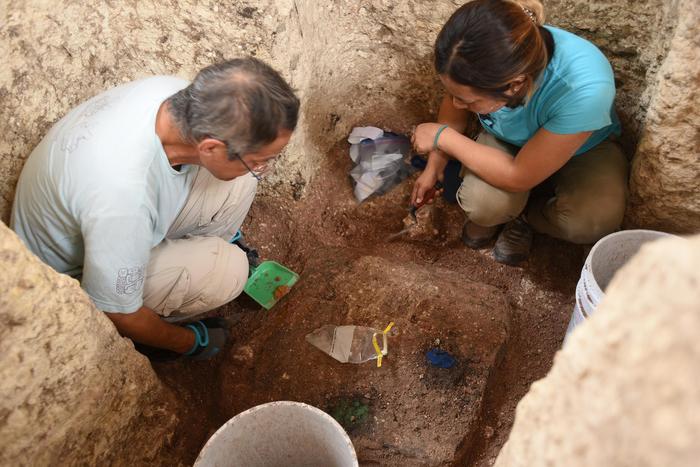
In a groundbreaking archaeological revelation, a team led by University of Arizona researchers has unearthed new evidence elucidating the function and significance of Aguada Fénix, the largest known monumental construction in the Maya region. Situated in Tabasco, Mexico, near the country’s southeastern border, this colossal site—measuring nearly a mile in length and a quarter-mile in width, with heights ranging from 30 to 50 feet—dates back over 3,000 years to approximately 1,000 B.C. Recent excavations have now provided compelling proof that Aguada Fénix served as a cosmogram, an astronomical and ceremonial representation of the cosmos, vastly enriching our understanding of early Mesoamerican civilizations.
Since the initial discovery in 2020, led by Regents Professor Takeshi Inomata and Distinguished Professor Daniela Triadan, the multidisciplinary team has delved deeper into the spatial and cultural context of Aguada Fénix and its environs. Their investigations have revealed that this monumental site was not an isolated phenomenon but part of a densely populated landscape harboring nearly 500 smaller, similar structures dispersed across southeastern Mexico. These findings suggest a sophisticated regional pattern of ceremonial centers interconnected through shared cultural and ritualistic frameworks.
The latest research published in Science Advances unveils a striking architectural feature: a cruciform-shaped pit meticulously excavated at the core of Aguada Fénix. This cross-shaped cavity contained an extraordinary cache of ceremonial artifacts, including jade axes, intricately carved ornaments depicting fauna such as crocodiles, birds, and symbolic motifs like a woman in childbirth. Such artifacts, emblematic of ritual significance, affirm the site’s role as a focal point for complex religious observances during the Middle Preclassic period.
One of the most compelling discoveries within this cruciform pit is the arrangement of mineral pigments—blue, green, and yellowish soils—deposited in alignment with the cardinal directions. This precise chromatic orientation constitutes the first concrete evidence linking specific pigment colors to their corresponding directions in a Mesoamerican ritual context, an alignment integral to various indigenous cosmologies. The pigments, alongside the artifacts, were likely offerings sealed beneath layers of sand and soil, with radiocarbon analyses dating this cache between 900 and 845 B.C.
Utilizing airborne LiDAR technology, which allows for the penetration of dense jungle canopy to reveal underlying anthropogenic structures, the research team mapped the extensive layout of Aguada Fénix and adjacent constructions. Remarkably, the site is aligned with celestial events—the main axis corresponds to the rising sun on October 17 and February 24, defining a 130-day interval congruent with half of the Mesoamerican 260-day ritual calendar. Such astronomical precision underscores the advanced observational capabilities of its builders and the cosmogrammatic intent embedded in the site’s design.
Further architectural features substantiated by excavation include a network of causeways, sunken corridors, canals, and a dam designed to channel water from a nearby lagoon. These infrastructural elements extend up to six miles from the main platform, following the site’s solar orientation and exemplifying a comprehensive landscape engineering approach. This level of integrated environmental manipulation reflects an early and profound understanding of hydraulic management paired with ceremonial architectural planning.
Contrary to traditional paradigms that emphasize centralized authority in the construction of megalithic Mesoamerican sites—where powerful rulers orchestrated enormous labor forces—the discovery at Aguada Fénix challenges this notion. The archaeological record lacks evidence of exclusive dynastic rule or coercive power. Instead, it suggests a form of communal leadership characterized by intellectual or astronomical stewardship. Leaders likely coordinated construction and ritual activities through shared cosmological beliefs, fostering collective participation without the imposition of autocratic control.
The research not only reshapes our grasp of early Maya civilization but also prompts a reevaluation of social organization models in prehistoric contexts. The monumental scale achieved without apparent hierarchical dominance implies that complex societies can realize grand construction projects through consensus-driven cooperation. This insight resonates with contemporary discussions on social equity and collective action, demonstrating that powerful social change does not inherently require substantial inequalities or coercive governance.
From a methodological standpoint, the integration of non-invasive technologies like LiDAR with meticulous stratigraphic excavation and radiocarbon dating establishes a robust multidisciplinary framework for archaeological inquiry. The findings at Aguada Fénix thus exemplify how cutting-edge technological tools, combined with cultural and astronomical expertise, can unravel the intricate relationship between ancient peoples and their cosmological understandings.
Graduate team members, including doctoral student Xanti S. Ceballos Pesina, highlight the site’s immense scale and architectural sophistication. The discovery underscores the transformative impact of advanced remote sensing techniques, which continue to revolutionize archaeological landscapes, opening windows into lost civilizations previously concealed beneath dense tropical foliage.
Overall, Aguada Fénix stands as a testament to the ingenuity and cosmological sophistication of early Mesoamerican peoples. The site’s discovery and excavation offer profound insights into prehistoric ceremonial practices, social organization, and landscape modification, thereby expanding the narrative of Maya prehistory and challenging long-held assumptions about the evolution of complex societies.
News Publication Date: June 2024
Web References:
Cite Scienmag News
Courtney Benton. (November 5, 2025). U of A-Led Team Uncovers Massive Ritual Structures Built by Early Mesoamericans. Scienmag. https://scienmag.com/u-of-a-led-team-uncovers-massive-ritual-structures-built-by-early-mesoamericans/
Courtney Benton. "U of A-Led Team Uncovers Massive Ritual Structures Built by Early Mesoamericans." Scienmag, 5 November 2025, https://scienmag.com/u-of-a-led-team-uncovers-massive-ritual-structures-built-by-early-mesoamericans/. Accessed 5 September 2026.
Courtney Benton. "U of A-Led Team Uncovers Massive Ritual Structures Built by Early Mesoamericans." Scienmag. November 5, 2025. https://scienmag.com/u-of-a-led-team-uncovers-massive-ritual-structures-built-by-early-mesoamericans/


