


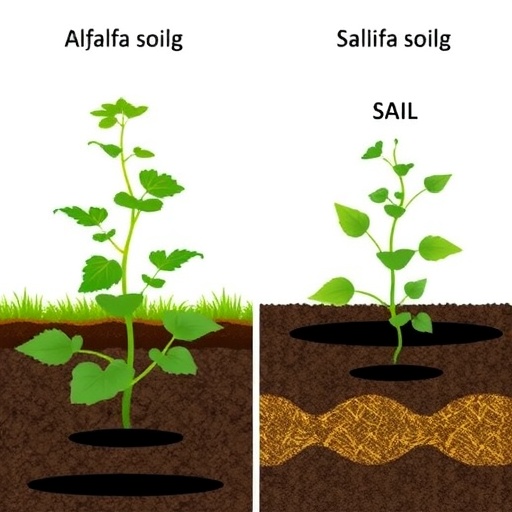
Soil salinization remains one of the most critical challenges facing global agriculture, particularly in arid and semi-arid regions where salts and alkaline conditions accumulate in the soil profile. These conditions drastically hinder root development and nutrient uptake, thereby suppressing plant productivity and jeopardizing food security. Recent pioneering research has revealed that biochar, a carbon-rich soil amendment derived from biomass pyrolysis, can transcend its traditional role of modifying soil physical and chemical properties by intricately reprogramming plant metabolic pathways and reshaping rhizosphere microbial communities to combat stress in saline-alkali soils.
Published in the journal Biochar, this groundbreaking study investigated the contrasting impacts of two distinct biochar types—acid-modified biochar with a pH of 2.3 and alkaline biochar with a pH of 8.8—on alfalfa (Medicago sativa), a vital forage legume known for its nitrogen-fixing capabilities. Conducted through controlled pot experiments, these biochars were incorporated into saline-alkali soils at dosages of 1%, 2%, and 5% by weight to dissect their individual effects on soil chemistry, plant physiology, metabolomics, and the rhizosphere’s microbial consortia.
The study’s findings underscore that biochar’s influence is not uniform but contingent on both its physicochemical properties and application rates, elucidating the necessity for precision management. Remarkably, the research pinpointed that a lower dose (1%) of acid-modified biochar and a higher dose (5%) of alkaline biochar optimally alleviated the stress imposed by saline-alkali environments, each doing so via distinct mechanistic routes. This nuanced understanding challenges the prevailing notion of biochar as a one-size-fits-all soil enhancer.
Acid-modified biochar emerged as particularly adept at ameliorating soil chemical properties. When applied at a 5% rate, it achieved a substantial reduction in soil salinity by 37.4% while simultaneously boosting soil organic carbon by an extraordinary 211%. Additionally, bioavailable phosphorus was elevated by an impressive 194.1%, collectively fostering a more nutrient-abundant and chemically stable milieu conducive to rooting and growth. These soil chemistry improvements are critical, as excessive salinity and high pH disrupt nutrient solubility and accessibility, undermining plant development.
Conversely, alkaline biochar demonstrated superior efficacy in stimulating plant biomass accumulation. With a 5% application, shoot biomass increased by 130.4%, whereas root biomass surged by a dramatic 335.6%. The alkaline amendment also modulated ion uptake by diminishing sodium accumulation—a major phytotoxic ion—and enhancing potassium absorption, pivotal for cellular osmoregulation and enzyme activation. These adjustments in ion homeostasis underpin the enhanced growth observed and enable alfalfa to better withstand salinity-induced osmotic and ionic stresses.
The research extended beyond traditional agronomic metrics, employing comprehensive root metabolomics to unravel the biochemical shifts underpinning plant adaptability. Alkaline biochar selectively activated amino acid metabolic pathways, nitrogen assimilation processes, and antioxidant defenses, including key routes involving arginine, proline, glutamate, and glutathione metabolism. These pathways are intricately linked to osmoprotection, reactive oxygen species scavenging, and nitrogen use efficiency, collectively fortifying plant resilience under salt and alkali stress.
In stark contrast, acid-modified biochar stimulated secondary metabolite biosynthesis, particularly the production of flavonoids and alkaloids. These compounds fulfill multifaceted functions ranging from modulation of root architecture to serving as signaling molecules in plant-microbe interactions and conferring enhanced defense against oxidative and pathogenic stresses. This biochemical reprogramming elucidates how acid-modified biochar fosters root development and stress resistance through specialized metabolite-mediated signaling networks.
Parallel to the metabolic insights, the study revealed that these biochar types distinctly sculpt the rhizosphere microbiome, the complex consortium of bacteria intimately associated with plant roots. Alkaline biochar enriched bacterial diversity, with notable increases in beneficial taxa such as Rhizobium and various Firmicutes members known for their roles in nitrogen fixation, phosphorus solubilization, and organic matter turnover. This microbial enrichment likely synergizes with the metabolic adaptations to improve plant nutritional status and stress tolerance.
On the other hand, acid-modified biochar favored the proliferation of Actinobacteria, a group renowned for degrading complex organic matter and producing antibiotics that suppress soil-borne pathogens. This microbial composition fosters soil health and root protection, further complementing the biochar’s enhancement of soil chemical parameters. Such microbiome restructuring underscores the multidimensional nature of biochar’s benefits in degraded saline-alkali soils.
According to co-corresponding author Jie Liu, the intricate interplay revealed among soil chemistry, plant physiology, metabolomics, and microbiome dynamics highlights that biochar amendments should be considered precision tools tailored to specific soil constraints and crop needs. The dichotomous effects of acidic and alkaline biochars present a paradigm shift, where biochar selection is guided by targeted outcomes such as biomass augmentation or soil chemistry stabilization rather than a generalized application.
Co-corresponding author Yunfeng Yang emphasized that these insights provide a foundational platform for the next generation of soil remediation strategies. Leveraging biochar’s modulatory capacity on plant metabolism and rhizosphere microbiomes could enable sustainable intensification of agriculture on salinized lands, thus addressing food security challenges aggravated by climate change and land degradation.
The implications of this research extend well beyond alfalfa, as saline-alkali soil conditions afflict vast tracts of arable land globally. Strategic residence of biochar types in degraded systems presents farmers and land managers with scalable and environmentally friendly options to restore soil functionality and improve crop resilience. By aligning biochar chemistry with specific agronomic goals, this research opens avenues for tailor-made interventions in diverse agroecosystems.
As soil salinization continues to expand under anthropogenic and climatic pressures, the integration of biochar amendments as precise modulators of soil-plant-microbe systems offers a promising, innovative pathway to rehabilitate marginal lands. This study illuminates the powerful role of biochar not merely as a soil amendment but as a dynamic agent influencing the biological network that sustains agricultural productivity amid environmental adversity.
News Publication Date: 25-Mar-2026.
Web References: http://dx.doi.org/10.1007/s42773-026-00595-y.
References: Liu, J., Shi, Z., Zhang, L. et al. Contrasting acidic and alkaline biochar reprogram alfalfa metabolism and rhizosphere microbiomes in saline-alkali soils. Biochar 8, 82 (2026).
Cite Scienmag News
Alan Morgan. (June 9, 2026). Two Varieties of Biochar Enhance Alfalfa’s Survival in Saline Soils Through Distinct Mechanisms. Scienmag. https://scienmag.com/two-varieties-of-biochar-enhance-alfalfas-survival-in-saline-soils-through-distinct-mechanisms/
Alan Morgan. "Two Varieties of Biochar Enhance Alfalfa’s Survival in Saline Soils Through Distinct Mechanisms." Scienmag, 9 June 2026, https://scienmag.com/two-varieties-of-biochar-enhance-alfalfas-survival-in-saline-soils-through-distinct-mechanisms/. Accessed 4 September 2026.
Alan Morgan. "Two Varieties of Biochar Enhance Alfalfa’s Survival in Saline Soils Through Distinct Mechanisms." Scienmag. June 9, 2026. https://scienmag.com/two-varieties-of-biochar-enhance-alfalfas-survival-in-saline-soils-through-distinct-mechanisms/


