


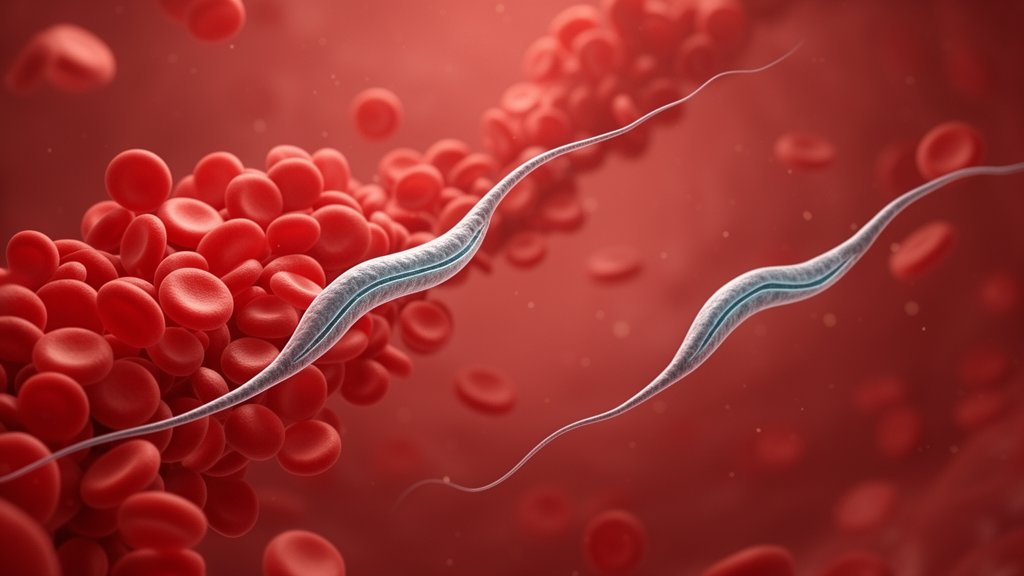
African animal trypanosomosis remains one of the most stubborn constraints on livestock production across sub-Saharan Africa, costing farmers billions of dollars each year in lost productivity, treatment expenses and animal deaths. Yet the disease presents a persistent puzzle: animals infected with different species of trypanosomes, or even with the same species delivered by different routes, can experience strikingly different disease courses. A new controlled experiment published in Acta Parasitologica has now disentangled some of these variables, showing that the identity of the parasite species and the route by which it enters the body shape the tempo of infection in ways that parasite numbers alone cannot explain.
The study, led by Deborah Buba of the University of Jos and Ahmadu Bello University in Nigeria, together with colleagues including Peter Mac Asaga of the University Medical Centre Freiburg, compared infections caused by two major African trypanosome species, Trypanosoma congolense and Trypanosoma brucei, in BALB/c mice. These two parasites are responsible for a large share of the animal trypanosomosis burden transmitted by tsetse flies across the continent. T. congolense is notorious among veterinarians for the severe anaemia it produces in cattle, while T. brucei, a close relative of the parasites that cause human sleeping sickness, is known for its ability to invade a wide range of host tissues. Despite their clinical importance, the combined influence of parasite species, inoculation route and host immune response on disease severity had rarely been examined within a single controlled experiment.
The researchers divided the animals into four infected groups of fifteen mice each, with one group receiving T. congolense and another T. brucei by intraperitoneal inoculation, and the remaining two groups receiving the respective parasites intramuscularly. A fifth group of five uninfected mice served as controls. Over the course of the experiment, the team tracked parasitaemia, body weight, rectal temperature and survival, and at defined endpoints they measured packed cell volume, a full panel of haematological indices, serum concentrations of the cytokines interferon-gamma and interleukin-10, and semi-quantitative pathology scores for the liver, spleen and kidney. The design, approved by the Ahmadu Bello University Committee on Animal Use and Care and reported according to the ARRIVE 2.0 guidelines, applied predefined humane endpoints so that no animal was permitted to reach a moribund state.
The survival data were unambiguous. Differences between the groups were highly significant, with a log-rank test yielding a p value below 0.0001. Mice infected intraperitoneally with T. congolense had the shortest median survival of any group, at just nine days. At the other extreme, mice infected intramuscularly with T. brucei survived longest among the infected groups. The two intermediate groups, intramuscular T. congolense and intraperitoneal T. brucei, fell between these poles. What makes this pattern remarkable is what the parasitaemia data did not show: the time until parasites became detectable in the blood and the peak levels they reached were broadly comparable across the infected groups. In other words, the animals that died fastest were not carrying the heaviest parasite burdens, a discordance that strikes at the heart of how virulence is conventionally assessed in laboratory models of trypanosomosis.
Haematological findings reinforced the clinical picture of acute disease. Infected animals developed anaemia, reflected in reduced packed cell volume, along with thrombocytopenia, a depletion of blood platelets. Both changes are hallmarks of African trypanosomosis in livestock and have been linked in previous work to the destruction or removal of red blood cells driven by inflammatory activation of the mononuclear phagocyte system. Earlier studies have implicated interferon-gamma produced by natural killer cells, natural killer T cells and CD8-positive T cells in driving myeloid cell activation and erythrophagocytosis, the engulfment of red blood cells by macrophages, which culminates in the acute anaemia characteristic of these infections. Other mechanisms, including the desialylation of red blood cells by parasite enzymes and cytokine-mediated haemodilution, have been proposed to contribute to the anaemia seen with different trypanosome species.
The cytokine measurements added a layer of nuance. Interferon-gamma, a pro-inflammatory signalling molecule central to the activation of macrophages during protozoal infections, was elevated in all infected animals relative to uninfected controls. However, its concentrations did not distinguish among the four infected groups, meaning this canonical inflammatory signal was similarly engaged regardless of parasite species or inoculation route. Interleukin-10, an anti-inflammatory cytokine that restrains excessive immune activation, told a different story. Its concentrations were higher in mice infected with T. congolense than in those infected with T. brucei, a species-associated pattern that suggests the two parasites elicit qualitatively different immunoregulatory environments within the same inbred host strain.
The histopathological analysis was equally revealing, both for what it showed and for what it did not. Semi-quantitative scoring of the liver, spleen and kidney confirmed that infection inflicted significant damage on all three organs: pathology scores were significantly higher in infected animals than in uninfected controls. Yet when the infected groups were compared with one another, the scores did not differ significantly. The severity of organ-level lesions, like the parasite burden, failed to track with survival. Mice that succumbed rapidly to intraperitoneal T. congolense infection did not carry measurably worse tissue damage than mice that survived longer with T. brucei. This second discordance, between lesion severity and outcome, implies that the functional consequences of infection, rather than the visible structural damage, may be what determines how quickly an animal deteriorates.
Taken together, the results paint a picture in which disease outcome in African trypanosomosis is governed by something more subtle than parasite load or tissue destruction. The authors suggest that species-associated host responses may contribute to disease outcome, although they are careful to note that further mechanistic investigation is required before the causal pathways can be pinned down. One plausible interpretation is that the balance between pro-inflammatory and anti-inflammatory signalling, exemplified here by the species-linked differences in interleukin-10, shapes the physiological toll of infection independently of how many parasites are present or how damaged the organs appear. Excessive or poorly regulated inflammation could accelerate clinical decline even when parasite numbers and histological lesions are comparable, a concept consistent with the broader literature on immunopathology in trypanosome infections.
The findings also carry practical implications for experimental design in trypanosomosis research. Laboratory models of animal African trypanosomosis have long been criticised for their reliance on syringe-passaged parasites and laboratory rodents, which can diverge from the natural tsetse-transmitted infections seen in clinically relevant livestock hosts. The demonstration that inoculation route measurably alters survival, with intramuscular delivery of T. brucei producing the most prolonged course, echoes earlier work showing that route of inoculation influences the virulence of both T. congolense and T. brucei brucei in mice. Researchers selecting a challenge model should therefore be aware that the route of infection is not a neutral variable but an active determinant of disease tempo, one that could confound comparisons between studies or mask genuine differences in parasite virulence or drug efficacy.
For the veterinary and medical communities, the study underscores a message that has been building across the trypanosomosis literature: virulence is a property of the interaction between parasite and host, not of the parasite alone. Recent work has revealed that African trypanosomes occupy unexpected tissue niches, including the skin and adipose tissue, where they may persist and adapt in ways that influence transmission and disease. The new data add a controlled, quantitative demonstration that two closely related parasite species, delivered at comparable infectious doses into the same host strain, can produce the same parasite burden and the same organ pathology while killing at different speeds and provoking different cytokine profiles. Untangling the mechanisms behind these discordances, particularly the role of interleukin-10 and other immunoregulatory pathways, may ultimately inform approaches that target the damaging host response as well as the parasite itself, an increasingly recognised strategy for diseases in which immunopathology drives the clinical picture.
Subject of Research: Comparative pathogenicity and multi-organ histopathology of Trypanosoma congolense and Trypanosoma brucei infection in mice
Article Title: Comparative Pathogenicity and Semi-quantitative Multi-organ Histopathology of Trypanosoma congolense and Trypanosoma brucei Infection in Mice
Article References: Buba, D., Adamu, S., Mohammed, B., Jatau, I. D., & Asaga, P. M. (2026). Comparative Pathogenicity and Semi-quantitative Multi-organ Histopathology of Trypanosoma congolense and Trypanosoma brucei Infection in Mice. Acta Parasitologica, 71(5), Article 232. https://doi.org/10.1007/s11686-026-01417-8
Image Credits: AI Generated
DOI: 10.1007/s11686-026-01417-8
Keywords: Trypanosoma congolense, Trypanosoma brucei, animal African trypanosomosis, pathogenicity, inoculation route, anaemia, histopathology, cytokines, IFN-gamma, IL-10, murine model, parasitaemia
Cite Scienmag News
Drew Townsend. (October 8, 2026). Two Trypanosome Species, Same Parasite Burden, Very Different Fates in Mice. Scienmag. https://scienmag.com/two-trypanosome-species-same-parasite-burden-very-different-fates-in-mice/
Drew Townsend. "Two Trypanosome Species, Same Parasite Burden, Very Different Fates in Mice." Scienmag, 8 October 2026, https://scienmag.com/two-trypanosome-species-same-parasite-burden-very-different-fates-in-mice/. Accessed 8 October 2026.
Drew Townsend. "Two Trypanosome Species, Same Parasite Burden, Very Different Fates in Mice." Scienmag. October 8, 2026. https://scienmag.com/two-trypanosome-species-same-parasite-burden-very-different-fates-in-mice/


