


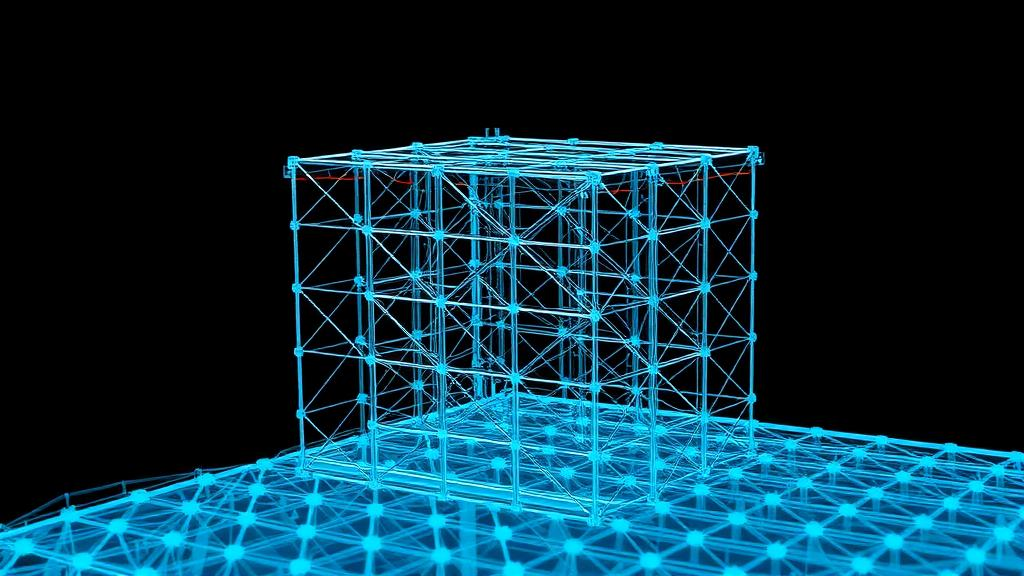
Engineers have long faced an uncomfortable truth about structural monitoring: the sensors go where they can, but the damage happens where they cannot. Critical stress concentrations tend to accumulate in riveted joints, brackets, and narrow internal passages that are difficult or impossible to instrument, while accelerometers sit comfortably on accessible outer surfaces. A new study published in the International Journal of Aeronautical and Space Sciences by researchers at Seoul National University, Pusan National University, and Kyung Hee University now demonstrates that a compact, deliberately shallow neural network can bridge that gap, reconstructing the internal strain of a vibrating structure using nothing more than acceleration measurements taken at a single accessible boundary region.
The motivation is stark. When the I-35W highway bridge in Minneapolis collapsed in 2007, killing 13 people, the subsequent National Transportation Safety Board investigation traced the failure to gusset plates whose load capacity had been compromised by a design error. Localized weakness had gone unnoticed until catastrophe. The aviation world offers similar warnings: reviews of aircraft fatigue accidents show that cracks frequently initiate at riveted joints and other stress-concentration interfaces, and the January 2024 in-flight separation of a door-plug panel on a Boeing 737-9 MAX underscored how elusive such vulnerabilities can be. In practice, sensors are rarely installed at every location of interest, so the quantities that matter most for fatigue assessment often remain unmeasured.
Existing approaches to this problem fall into two broad camps. Model-based structural health monitoring interprets measured responses through physics-based frameworks such as the eigensystem realization algorithm, subspace identification, augmented Kalman filtering, and Bayesian model updating. These methods are powerful but sensitive to modeling assumptions about material properties, connection stiffness, damping, and boundary conditions, and discrepancies between predicted and measured responses tend to be largest precisely near the local stress concentrations where failure begins. Data-driven methods, from convolutional and recurrent neural networks to sequence-to-sequence models with attention mechanisms, learn relationships directly from signals, but most still assume measurements from multiple distributed sensors or require strain-based inputs. Under truly sparse sensing, estimating internal responses becomes an underdetermined problem, because similar boundary measurements can correspond to different internal deformation states.
The new framework, developed by Jin Hyeok Seok, Ji Wan Seo, Yeong Kwan Jo, Sang Hu Park, Jae Hyuk Lim, and YunHo Kim, takes a different route. Rather than deepening the network to boost its representational capacity, the team split the prediction task into two sequential stages that mirror the physics of structural response. In the first stage, a shallow time-delay neural network converts boundary acceleration into boundary displacement. In the second stage, a second shallow network uses that estimated displacement to infer the internal strain. Each stage therefore learns only a reduced, physically consistent mapping, which keeps the model compact and trainable on limited experimental data while preserving sensitivity to the quantities that matter.
The choice of a shallow time-delay neural network, or TDNN, was deliberate. Each network consists of a single hidden layer with an input delay of eight time steps, allowing it to exploit short-term temporal dependencies in the vibration signal without the data appetite of deep sequence models. The first stage and the single-stage baseline used ten hidden neurons, while the second stage used five. Training employed the Levenberg-Marquardt backpropagation algorithm with full-batch optimization, validation-based early stopping, and a dataset of roughly 9,110 time-series samples split into training, validation, and test subsets at ratios of 70, 15, and 15 percent. A separate prediction dataset of about 121,291 samples, never seen during training, evaluated generalization.
The experimental validation was conducted on a commercial outdoor air-conditioning unit roughly 1.7 meters tall and weighing about 250 kilograms, mounted on an industrial rotary vibration system designed to reproduce transportation-type excitation conditions consistent with MIL-STD-810F guidance. Triaxial accelerometers with a 40 g range were rigidly bolted to the base structure to capture boundary acceleration, while strain gauges were attached to pipe sections inside the unit, locations that are structurally sensitive but sit in narrow spaces poorly suited to long-duration monitoring. Strain signals were initially recorded at 10 kHz and systematically downsampled; 500 Hz preserved the reference waveform with a similarity greater than 0.99 and was selected for training. Boundary displacement was obtained by numerically integrating acceleration with Simpson’s rule, with drift corrected by resetting displacement to zero at the end of each 3.5 Hz excitation cycle.
The results reveal both the promise and the subtlety of the approach. Over a 242-second prediction period, far longer than the training segments, both the one-stage and two-stage models produced stable strain estimates without divergence, adjusting smoothly when excitation intensity changed at around 125 seconds. Yet direct time-domain comparison produced negative coefficients of determination, at -0.66 for the one-stage model and -0.76 for the two-stage model, despite visually similar waveforms. The culprit was progressive phase drift: predicted peaks gradually shifted relative to measured peaks, with offsets growing from roughly 0.134 seconds early in the record to about 0.200 seconds later. After applying dynamic time warping, a post-processing alignment technique, both models achieved an R-squared of approximately 0.93, confirming that the overall waveform structure was faithfully reproduced once the timing offset was compensated.
Where the two architectures genuinely diverged was in peak reconstruction, and this is where the study carries real weight for fatigue engineering. Fatigue damage accumulation, particularly under cycle-counting methods such as Rainflow counting combined with the Palmgren-Miner rule, is dominated by peak amplitudes; if peaks are underestimated, remaining fatigue life can be significantly overestimated. The experimental mean peak strain was about 0.121 microstrain. The one-stage model captured only 68.60 percent of that value, while the two-stage model reached 80.99 percent, an improvement of roughly 12 percentage points. On the independent prediction dataset, peak accuracy fell to 68.94 percent for the one-stage network but rose to 80.67 percent for the two-stage network. The explanation lies in how mean-square-error training treats sparse events: a single-stage network forced to represent both global motion and local deformation in one mapping tends to sacrifice peak fidelity for overall waveform agreement, whereas the staged decomposition lets the second stage focus on local deformation behavior.
Fast Fourier Transform analysis added a mechanistic explanation. Acceleration and strain signals shared a dominant frequency near 6.98 Hz, while displacement was governed by a lower frequency of about 3.48 Hz. Crucially, the high-frequency components associated with rapid strain variations were preserved in the intermediate displacement prediction, meaning the first stage acted not merely as a motion estimator but as a feature-preserving transformation that passed peak-related cues to the second stage. The authors are careful to frame the limits of their work: the experiment covered a single repeated rotary excitation condition with a dominant cycle of about 3.5 Hz, the short 0.016-second input delay window may not capture longer time-varying phase relationships, and progressive loosening of the test fixture may have contributed to the observed phase drift. Real-time, phase-synchronous monitoring would require additional synchronization or phase-correction strategies.
Even within those constraints, the demonstration is striking. Once the relationship between boundary acceleration and internal strain is learned, the trained model can estimate strain at critical internal locations using only a handful of boundary sensors, without a finite element model, state-space formulation, or prescribed loading information. The researchers suggest the framework could support fatigue life evaluation, long-duration response prediction, and digital-twin-based structural state estimation, with future extensions potentially incorporating recurrent, attention-based, or physics-informed architectures while retaining the physically interpretable staged structure. For a field where the most dangerous stresses hide in the least accessible corners of a machine, the message is provocative: sometimes the boundary knows more than it lets on, and a small, well-structured network can be taught to listen.
Subject of Research: Data-driven reconstruction of internal structural strain from sparse boundary acceleration measurements using a two-stage shallow time-delay neural network
Article Title: Data-Driven Estimation of the Critical Structural Strain from Boundary Acceleration Using a 2-Stage Shallow Time-Delay Neural Network
Article References: Seok, J. H., Seo, J. W., Jo, Y. K., Park, S. H., Lim, J. H., & Kim, Y. (2026). Data-Driven Estimation of the Critical Structural Strain from Boundary Acceleration Using a 2-Stage Shallow Time-Delay Neural Network. International Journal of Aeronautical and Space Sciences. https://doi.org/10.1007/s42405-026-01244-1
Image Credits: AI Generated
DOI: 10.1007/s42405-026-01244-1
Keywords: structural health monitoring, time-delay neural network, virtual sensing, strain reconstruction, fatigue assessment, boundary acceleration, machine learning, vibration testing, digital twin, aerospace structures, peak strain prediction, dynamic time warping
Cite Scienmag News
Blake Davidson. (October 4, 2026). Two-Stage Neural Network Reads Hidden Structural Strain From Boundary Sensors Alone. Scienmag. https://scienmag.com/two-stage-neural-network-reads-hidden-structural-strain-from-boundary-sensors-alone/
Blake Davidson. "Two-Stage Neural Network Reads Hidden Structural Strain From Boundary Sensors Alone." Scienmag, 4 October 2026, https://scienmag.com/two-stage-neural-network-reads-hidden-structural-strain-from-boundary-sensors-alone/. Accessed 4 October 2026.
Blake Davidson. "Two-Stage Neural Network Reads Hidden Structural Strain From Boundary Sensors Alone." Scienmag. October 4, 2026. https://scienmag.com/two-stage-neural-network-reads-hidden-structural-strain-from-boundary-sensors-alone/


