


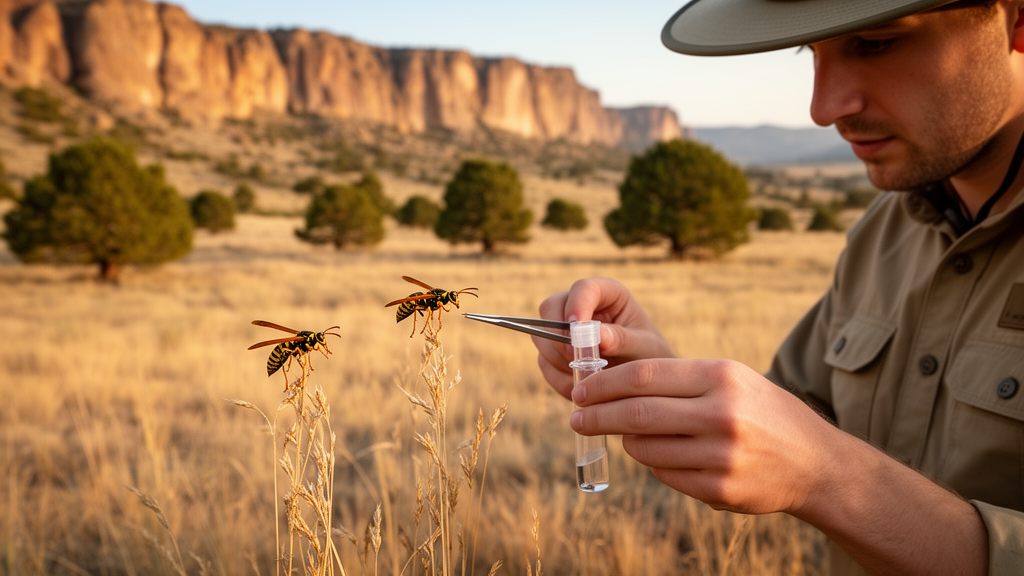
Deep in the far southeastern corner of Georgia, where the arid hills of Kakheti press against the border with Azerbaijan, scientists have quietly rewritten part of the country’s insect map. A new study published in the journal Caucasiana documents the first national records of two paper wasp species of the genus Polistes — Polistes bucharensis and Polistes mongolicus — captured in Vashlovani National Park and confirmed not only under the microscope but also by DNA barcodes. The discovery lifts the number of Polistes species known from Georgia to ten and marks a milestone of another kind: the sequences represent the first DNA barcodes ever generated for this iconic wasp genus anywhere in the Caucasus region.
Vashlovani National Park is one of the most distinctive landscapes in a country that sits at the heart of one of the world’s recognized biodiversity hotspots. The park encompasses a striking mosaic of steppe, forest-steppe, semi-desert, and deciduous forest, with elevations ranging from 95 to 900 meters above sea level. Summers are hot and dry, while winters are cooler but rarely push temperatures below freezing. That combination of dry climate and varied habitats favors a rich community of Hymenoptera — the vast insect order that includes bees, ants, and wasps — and new finds are being made there on a near-constant basis as sampling campaigns continue.
Hymenoptera are currently considered by many entomologists to be the most species-rich of all insect orders. Within the order, parasitoid wasps dominate in sheer numbers of species, but the generally larger members of the family Vespidae are more iconic and, historically, better studied. Georgia’s known vespid fauna stood at 104 species before the new work. Within the family, the genus Polistes — the cosmopolitan umbrella paper wasps — comprises roughly 200 species worldwide and plays a valuable ecological role: the wasps are largely predatory, consuming large numbers of other insects, which is why they are often considered beneficial. Some species, such as Polistes dominula and Polistes gallicus, also collect nectar to meet their energetic demands and to provision their brood.
Despite that ecological importance, the Polistes of Georgia had received surprisingly little scientific attention. The first report came from the nineteenth-century explorer Alfred Radde, who recorded Polistes gallicus from Borjomi in 1899. In the 1950s and 1960s, the Georgian entomologist Kobakhidze added six further species to the national list: Polistes atrimandibularis, Polistes biglumis, Polistes foederatus, Polistes nimpha, Polistes sulcifer, and Polistes semenowi. Two of those, P. foederatus and P. nimpha, had already been recorded from Vashlovani itself. A later study added Polistes dominula, bringing the national tally to eight species before the current survey began.
The new records emerged from a larger project on the hymenopteran biodiversity of Vashlovani National Park, run by a team from the Invertebrate Research Center. The sampling design was simple but systematic: every 20 days from early April to the end of August, the researchers deployed four colored pan traps of similar diameter — yellow, white, blue, and pink — at two locations within the park. The traps were set on the ground and filled with 100 to 150 milliliters of water plus a drop of unscented detergent to break the surface tension. After 24 hours, the trapped insects were collected with tweezers and preserved in vials of 96% ethanol for later analysis.
The two trapping sites capture the ecological range of the park. The first, at Mijniskure near coordinates 41.11 N, 46.65 E, sits at just 95 meters above sea level and is shaped by the Alazani River and its tributaries, which have carved deep valleys and deposited fertile alluvial soils over millennia. The site mixes forests, grasslands, and wetlands, with vegetation dominated by oaks, pistachio, hornbeam, poplar, pomegranate, rose, and other genera, and a geologically diverse mountain setting of sedimentary, volcanic, and metamorphic rocks. The second site, at the park’s central bungalows at 275 meters elevation, is a cluster of 11 stone buildings surrounded by pistachio and juniper trees — including all four juniper species characteristic of the park, Juniperus foetidissima, J. rufescens, J. oblonga, and J. polycarpos — growing together in one place.
Identifying paper wasps is notoriously tricky, so the team took a two-pronged approach. Specimens were first identified morphologically using a modern identification key for the region, and representative specimens were then imaged with a camera mounted on a stereomicroscope. For the genetic work, genomic DNA was extracted from the middle legs of four Polistes specimens using a commercial purification kit, and partial sequences of the mitochondrial cytochrome c oxidase subunit I gene — the standard DNA barcode region for the animal kingdom — were amplified by polymerase chain reaction using the classic Folmer primer pair LCO1490 and HCO2198. The researchers also generated additional new reference sequences from Georgia, Bulgaria, Armenia, and Iran using the JJ primer variant, with extended overnight lysis incubations and Sanger sequencing of both the sense and antisense strands to guarantee unequivocal reads.
The resulting 648-base-pair barcodes were compared against the Barcode of Life Data System (BOLD) and then woven into a Bayesian phylogenetic analysis together with 21 additional ingroup sequences of related species retrieved from public databases. The analyses, run in MrBayes with a reversible jump model across one million generations, used the European hornet Vespa crabro as an outgroup, and convergence was confirmed by average split frequencies below 0.05. The results were unambiguous for the headline species: the Georgian Polistes bucharensis barcodes matched database entries with greater than 99.5% sequence identity, while P. foederatus and P. mongolicus both matched at a perfect 100%. The new sequences have been deposited in GenBank under accession numbers PX502332 through PX502343, and the remaining DNA extracts are archived in the scientific collection of the Institute of Entomology at the Agricultural University of Georgia in Tbilisi.
The phylogenetic tree broadly mirrored morphology, with all Polistes forming a single highly supported cluster and most species appearing as monophyletic groups whose genetic and morphological assignments agreed. Two intriguing exceptions stood out: one specimen identified as P. dominula grouped instead with P. bucharensis, and one specimen of P. associus fell within P. nimpha. The authors suggest these anomalies most likely reflect misidentifications of morphologically very similar close relatives in public databases rather than genuine biological surprises — a cautionary reminder of how integrative methods, combining traditional taxonomy with barcoding, can catch errors that either approach alone would miss. In the tree, P. biglumis together with two P. cf. gallicus specimens, along with P. gallicus and P. mongolicus, occupied basal positions, while deeper branches split into clusters containing P. foederatus, P. nimpha, and a group uniting P. dominula and P. bucharensis with P. atrimandibularis, P. sulcifer, and P. semenowi.
The faunistic payoff is a richer picture of Georgia’s paper wasp diversity and a distributional puzzle worth watching. Polistes bucharensis was previously known from western and central Asia, Cyprus, Egypt, and Crete, while P. mongolicus ranges from Croatia and southeastern Europe through Turkey and Cyprus to Central Asia and Egypt — Georgia now sits plausibly within the overlap of these ranges, with Vashlovani’s dry, semi-arid habitats offering a natural corridor for Central Asian faunal elements. Three of the four barcoded species came from specimens caught in the simple colored water traps, with P. bucharensis recorded at both Mijniskure and the central bungalows in June and July 2023. As the authors note, the work represents a significant first step toward an integrative assessment of Polistes diversity across the Caucasus, a hotspot region that continues to yield new distributional records — and will likely provide further faunistic surprises for anyone patient enough to set out pans of soapy water in its steppes.
Subject of Research: New country records and first DNA barcodes of Polistes paper wasps in Georgia
Article Title: New records of Polistes paper wasps ( Hymenoptera : Vespidae ) for Georgia with first DNA barcodes from Vashlovani National Park
Article References: Japoshvili, G., Ljubomirov, T., Kulanek, D., & Husemann, M. (2026). New records of Polistes paper wasps (Hymenoptera: Vespidae) for Georgia with first DNA barcodes from Vashlovani National Park. Caucasiana, 5, 15-24. https://doi.org/10.3897/caucasiana.5.e177177
Image Credits: AI Generated
DOI: 10.3897/caucasiana.5.e177177
Keywords: Polistes, paper wasps, Vespidae, Georgia, Vashlovani National Park, DNA barcoding, COI barcode, biodiversity, Caucasus, faunistics, Hymenoptera, phylogenetics
Cite Scienmag News
Margaret Porter. (October 15, 2026). Two Paper Wasp Species New to Georgia Found with DNA Barcodes in Vashlovani National Park. Scienmag. https://scienmag.com/two-paper-wasp-species-new-to-georgia-found-with-dna-barcodes-in-vashlovani-national-park/
Margaret Porter. "Two Paper Wasp Species New to Georgia Found with DNA Barcodes in Vashlovani National Park." Scienmag, 15 October 2026, https://scienmag.com/two-paper-wasp-species-new-to-georgia-found-with-dna-barcodes-in-vashlovani-national-park/. Accessed 15 October 2026.
Margaret Porter. "Two Paper Wasp Species New to Georgia Found with DNA Barcodes in Vashlovani National Park." Scienmag. October 15, 2026. https://scienmag.com/two-paper-wasp-species-new-to-georgia-found-with-dna-barcodes-in-vashlovani-national-park/


