


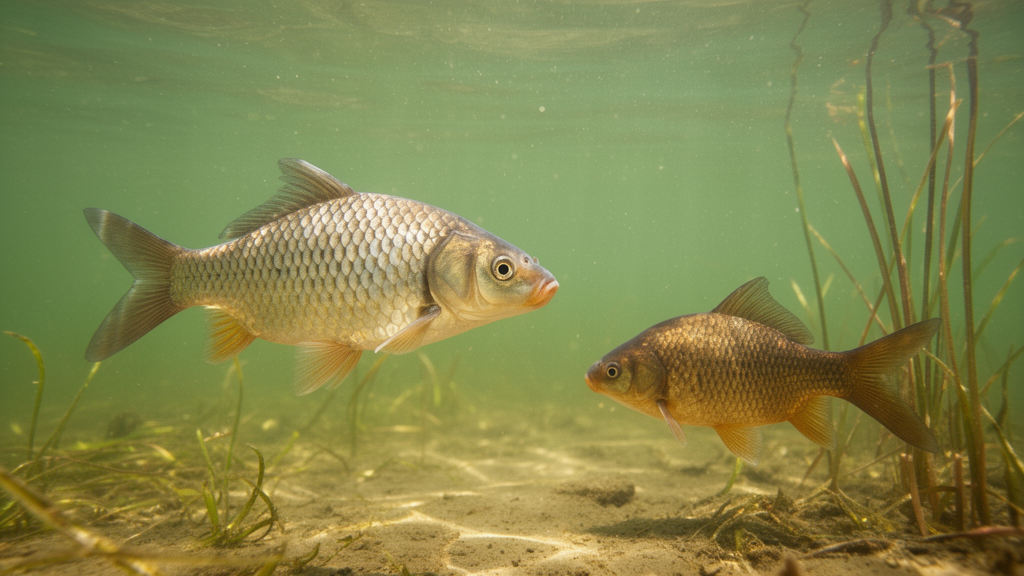
A quiet but dramatic replacement has been unfolding in the rivers, oxbows and ponds of Croatia over the past century. The crucian carp (Carassius carassius), once a widespread native fish of the country’s lowland waters, has been pushed into a handful of fragmented refuges, while the invasive gibel carp (Carassius gibelio) has spread to nearly every freshwater system in the country. A new long-term study, published in the journal Nature Conservation, has reconstructed this ecological changing of the guard using more than 140 years of occurrence records, and its findings read like a case study in how habitat destruction and biological invasion can combine to erode native biodiversity.
The research team compiled validated presence and absence data covering the period from 1883 to 2025, drawing on historical literature, national monitoring programmes, citizen science platforms such as iNaturalist, and verified records submitted by recreational anglers. Rigorous validation was central to the effort. Records were accepted only when the locality and year of observation were clearly defined, and photographs accompanying angler submissions had to show diagnostic morphological features, including the shape of the dorsal fin margin, the form of the caudal fin, the presence of a dark spot on the caudal peduncle in juveniles, and overall head shape. The authors also had to navigate a thicket of vernacular confusion, since the name karas, which formally refers to the crucian carp, is in parts of the Sava basin colloquially applied to the unrelated pumpkinseed sunfish.
Croatia spans two major freshwater ecoregions under the European Union Water Framework Directive: the Pannonian Ecoregion of the continental lowlands, drained by the Sava, Drava and Danube Rivers, and the largely karstic Dinaric Ecoregion, which is subdivided into continental and Mediterranean subecoregions. The researchers divided their 142-year record into three analytical windows: the period before 1967, prior to major river regulation and gibel carp expansion; the interval from 1967 to 2013, characterised by intensive hydromorphological alteration and introductions of Asian cyprinids; and the most recent, data-rich period from 2014 to 2025, shaped by systematic monitoring linked to Natura 2000 implementation. Trends in relative occurrence were visualised with a five-year moving average of proportional presence.
The picture that emerges is stark. Between 1883 and 1966, the crucian carp was the only Carassius species recorded in Croatia, distributed widely across the shallow lentic habitats of the Pannonian lowlands, with 23 precisely georeferenced observations plus two early translocations in the Lika River and Lake Vrana. This broad distribution reflected well-connected river-floodplain systems, in which oxbows, backwaters and seasonally flooded ponds provided abundant habitat for a species specially adapted to stagnant, often oxygen-poor waters, where it plays a valuable ecological role as prey for predatory fish and a conduit for energy transfer.
Everything changed after the mid-twentieth century. The gibel carp entered the region largely by accident, as an unintentional associate of Asian cyprinids imported from the Amur Basin for aquaculture, with the first confirmed records in the Drava and Danube Rivers of the former Yugoslavia dating to the 1960s. Between 1967 and 2013, the invader expanded across the Pannonian Ecoregion, generating more than 1,600 records, while crucian carp were documented 87 times within their native range and 18 times in translocated localities, notably in the wetlands of Lonjsko Polje and the oxbows of the Mura River. From 2014 onward, the gibel carp dominates nearly all water bodies in both ecoregions, and the native species persists only in 49 Pannonian and 15 Dinaric localities, almost always at low density and in coexistence with its invasive relative.
The study attributes this shift to the interplay of two pressures. Large-scale hydromorphological modification of Croatian rivers, which began along the Sava and Drava as early as the eighteenth century through the disconnection of side arms and meanders and intensified after major floods in the second half of the twentieth century, eliminated much of the floodplain habitat on which limnophilic species depend. Into this degraded landscape came a competitor exceptionally well equipped to exploit it. The gibel carp reproduces gynogenetically, a remarkable mode of reproduction in which females use the sperm of other fish species to trigger development of eggs that carry only maternal genes, allowing populations to grow rapidly from small numbers of founders. Combined with broad ecological tolerance and strong competitive ability, this trait has made it one of Europe’s most successful freshwater invaders.
Dispersal pathways for the invader have been multiple. Flood events apparently carried the gibel carp naturally along the Sava and Drava systems into side channels, oxbows, gravel pits and ponds, while aquaculture operations may have unintentionally released it during fish pond management. Recreational angling, particularly the use of live bait, appears to be a major mechanism of spread into the Dinaric Ecoregion, despite legislation prohibiting the use of invasive species as bait. Even without human help, the fish can travel: recent research has shown that developing eggs with soft membranes can survive passage through the gut of waterbirds such as mallards, providing a natural dispersal route that no border control can close.
Abundance-based analysis at sites with multi-year data revealed three recurring scenarios. In some habitats, such as the Zlatna Greda Channel, the crucian carp coexists with the gibel carp at extremely low densities and is frequently missed by standard monitoring, raising the likelihood of undetected local extinctions. In others, such as Odra and Čička Poljana, both species persist with the native fish at moderately higher numbers. In historical habitats, including sections of the Sava at Medsave and various rivers and gravel pits, the crucian carp has disappeared entirely. The authors caution that trends derived from heterogeneous historical sources should be interpreted carefully, since uneven sampling effort and changing observer intensity can influence apparent patterns, but the overall direction of change is unmistakable.
There is nonetheless reason for hope. Conservation projects in England and the Czech Republic have demonstrated that crucian carp can persist and even thrive in small, shallow ponds free of predatory fish, otters and gibel carp, and similar small-scale initiatives appear realistic in Croatia, particularly through cooperation with recreational anglers who have shown genuine interest in saving the species. Isolated ponds managed by the Trakošćan sports fishing society already support stable populations of crucian carp and tench, hinting at what targeted action can achieve. The authors stress, however, that the first step must be genetic screening to determine the true status of Croatian crucian carp populations, assess the extent of hybridisation with non-native Carassius taxa, and detect cryptic lineages, including the possibility that the Amur crucian carp Carassius langsdorfii, already documented in the Neretva basin of Bosnia and Herzegovina, extends into Croatian waters. With habitat protection and restoration, stricter control of invasive species pathways, and ex situ conservation informed by genetics, the study argues, Croatia may still be able to safeguard a species that has survived there since at least 1883, but only if action comes before the last isolated populations vanish.
Subject of Research: Long-term distribution changes of native crucian carp and invasive gibel carp in Croatian freshwaters
Article Title: Temporal changes in the distribution of Carassius carassius and the invasive Carassius gibelio in Croatian freshwaters
Article References: Temporal changes in the distribution of Carassius carassius and the invasive Carassius gibelio in Croatian freshwaters. (n.d.). https://doi.org/10.3897/natureconservation.65.186939
Image Credits: AI Generated
DOI: 10.3897/natureconservation.65.186939
Keywords: crucian carp, gibel carp, Carassius, invasive species, Croatia, freshwater biodiversity, river regulation, floodplain loss, gynogenesis, conservation, Pannonian Ecoregion, citizen science
Cite Scienmag News
Patricia Pace. (October 15, 2026). Invasive gibel carp pushes native crucian carp to the brink in Croatian freshwaters. Scienmag. https://scienmag.com/invasive-gibel-carp-pushes-native-crucian-carp-to-the-brink-in-croatian-freshwaters/
Patricia Pace. "Invasive gibel carp pushes native crucian carp to the brink in Croatian freshwaters." Scienmag, 15 October 2026, https://scienmag.com/invasive-gibel-carp-pushes-native-crucian-carp-to-the-brink-in-croatian-freshwaters/. Accessed 15 October 2026.
Patricia Pace. "Invasive gibel carp pushes native crucian carp to the brink in Croatian freshwaters." Scienmag. October 15, 2026. https://scienmag.com/invasive-gibel-carp-pushes-native-crucian-carp-to-the-brink-in-croatian-freshwaters/


