


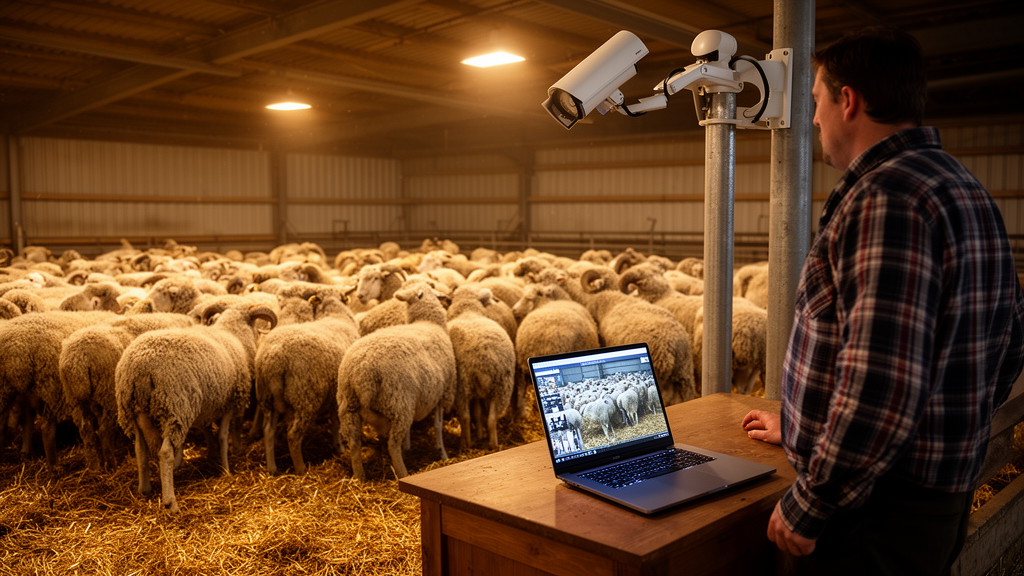
On commercial sheep farms, the difference between a profitable breeding season and a disappointing one often comes down to a matter of seconds. When a ewe enters estrus, she actively seeks to be mounted by other sheep, and this mounting behavior is considered one of the most direct and reliable behavioral indicators of fertility. The problem is that sheep mating typically lasts only two to four seconds, an interval so brief that even the most attentive farmhand can easily miss it, let alone record it systematically across a barn holding hundreds of animals. A research team in China has now developed an artificial intelligence system that watches for these fleeting events automatically, distinguishing genuine reproductive mounting from lookalike social behavior and pinpointing exactly which ewe is being mounted.
The study, led by Yanchao Wang and Kaiying Wang with colleagues at institutions in Zhejiang Province, was published in the journal Smart Agricultural Technology. The team built their system around a modified deep learning architecture they call HSM-YOLO, short for Hu Sheep Mounting-YOLO, named after the Hu sheep breed they studied, which is recognized in China as a national-level protected livestock genetic resource. Their approach addresses a persistent gap in precision livestock farming: while computer vision systems for detecting mounting behavior in cattle and pigs have advanced rapidly, sheep have received comparatively little attention, and existing sheep models tend to be bulky, computationally expensive, and tested only in single, fixed farming environments.
The challenge the researchers set out to solve is harder than it might appear. In dense group-housed environments, sheep exhibit complex social interactions that include not only sexual mounting related to estrus but also non-sexual mounting triggered by food competition, social play, and stress responses. Both behavioral patterns look strikingly similar on camera: one animal places its forelimbs on the back of another, stands on its hind limbs for support, and maintains a forward-leaning posture. The crucial distinction lies in the details. Non-sexual mounting typically lacks the rhythmic pelvic thrusting movements of reproductive mounting and shows arbitrary forelimb positioning, manifesting primarily as simple dorsal pressure. These subtle postural differences are exactly what the new model was designed to learn.
To train and test the system, the researchers collected video from two commercial sheep farms in Huzhou City between April 2024 and February 2025, using healthy Hu sheep aged six to twelve months. Rather than relying on a single camera setup, they deliberately engineered four distinct imaging scenarios to push the model’s adaptability. Five dome cameras installed three meters above ground captured footage of side pens near windows, where fluctuating light, fence bars, and sheep clustering created interference. Nine cameras at 2.75 meters monitored the central pens, which suffered from insufficient illumination, close-range occlusions, and animals temporarily exiting the field of view. Three cameras of a different model provided supplementary imaging, and an inspection robot circling the entire barn at 0.3 meters per second added motion blur to the mix of challenges.
From this footage, the team manually selected 867 video clips ranging from roughly three to twenty seconds, then extracted frames and applied a perceptual hashing algorithm to eliminate redundant near-identical images. The result was a curated dataset of 6,655 images divided into training, validation, and test sets at an approximate six-to-two-to-two ratio. Crucially, the annotation scheme was innovative: rather than treating all mounting as a single category, veterinary-supervised labeling divided the interactions into three classes: sexual mounting, non-sexual mounting, and the mounted ewe herself. Non-sexual mounting was introduced primarily to absorb interference, so labels for mounted individuals were not required for that category. This three-class structure allows the model to simultaneously recognize the behavior and localize the fertile animal.
The technical heart of HSM-YOLO lies in four coordinated modifications to the YOLOv11n architecture, one of the most computationally efficient models in the YOLO family. First, the researchers replaced most standard convolutional layers in the backbone network with depthwise separable convolutions, a design that splits feature extraction into a depthwise operation applying a single filter per input channel and a pointwise operation working across channels. The mathematics is compelling: where a standard convolution requires k²×n×m parameters, the separable version needs only k²×n plus n×m, a compression ratio of one over m plus one over k². This dramatically cuts parameters and computation while preserving feature representation, reserving computational overhead for the more demanding modules that follow.
Second, the team upgraded the C3k2 blocks in the backbone to a novel dual-path module called C3k2_BiRep, which flexibly switches between two sub-architectures depending on configuration. One path employs a RepViTBlock with Vision Transformer characteristics, using depthwise convolution as a token mixer to capture long-range dependencies and positional associations between interacting sheep in overlap scenarios. The other path uses a RepBottleneck with multi-branch RepConv structures that fuse three-by-three convolutions, one-by-one convolutions, and identity branches during training, then collapse them into equivalent single convolutions at inference, enhancing fine-grained posture recognition without added cost. A squeeze-and-excitation module within the block adaptively amplifies key channel responses while suppressing background noise from overlapping animals.
Third, an efficient multi-scale attention module in the network’s neck divides feature maps into groups along the channel dimension without reduction, establishing collaborative attention mappings along both horizontal and vertical directions through parallel branches. Two channel attention maps are aggregated through multiplication to achieve cross-channel feature enhancement, while spatial attention weights derived through global average pooling and Softmax operations help the model focus on the key regions associated with mounting behavior. Fourth, the bounding-box regression loss was replaced with a hybrid Inner-SIoU function that combines the angular cost term of SIoU, which guides optimization for low-quality anchors by minimizing angular deviation between predicted and ground-truth boxes, with auxiliary bounding boxes from the Inner-IoU concept that enhance robustness against the drastic scale variations common in crowded pens.
The performance results demonstrate that these four components work synergistically. Trained from scratch on identical hardware, HSM-YOLO achieved a mean Average Precision of 90.2 percent with an F1 score of 88.1 percent, compared to 84.5 percent mAP for the unmodified YOLOv11n baseline. That 5.7 percentage point improvement came alongside a 15.6 percent reduction in computational complexity, down to 5.4 billion floating-point operations, and a model containing just 2.2 million parameters in a 4.5 megabyte package. The system processed 135.9 frames per second on an RTX 4090 graphics card, outpacing every competing model tested, including RT-DETR-l, YOLOv8n, YOLOv10n, and YOLOv12n. Ablation experiments confirmed each module’s contribution: the dual-path C3k2_BiRep added 3.0 points of mAP, the attention mechanism 2.7 points, and the new loss function 2.2 points, while the separable convolutions cut computation by 18.8 percent.
Perhaps most tellingly, the labeling strategy itself proved decisive. When the team compared their three-class annotation against a simpler two-class approach that treated non-sexual mounting as background, the three-class version improved mAP by 2.9 percentage points. The difference was most dramatic for false positives on the mounted class, which plummeted from 954 to 222, a reduction of 76.7 percent, showing that explicitly teaching the model about non-reproductive mounting prevents it from misclassifying irrelevant sheep instances as fertile animals. Across the four imaging scenarios, HSM-YOLO consistently outperformed competitors, achieving 94.6 percent mAP in the favorable side-pen conditions and maintaining 77.3 percent even under the robot’s dynamic viewpoints and motion blur, where rival models degraded severely.
The practical implications extend beyond benchmark numbers. The researchers built a complete monitoring system with a graphical interface supporting real-time detection from single images, local video files, and RTSP IP camera streams, triggering alerts whenever sexual mounting is detected. Testing with 2560-by-1440 resolution video at 25 frames per second showed an average end-to-end detection speed of 47.9 frames per second, comfortably exceeding the playback rate of the source footage. The team also deployed the model on an NVIDIA Jetson Orin NX edge device, where its TensorRT engine ran 7.4 percent smaller and 12.7 percent faster in latency than the baseline YOLOv11, reaching 15.5 end-to-end frames per second.
Generalization testing on 850 images from an entirely different commercial farm in Xiaoshan District, Hangzhou, with distinct lighting, pen layouts, and camera viewpoints, showed HSM-YOLO maintaining 78.8 percent mAP versus 72.6 percent for the baseline, with smaller performance degradation. The researchers acknowledge limitations: the model was trained exclusively on Hu sheep in Zhejiang Province, cannot identify the individual identity of the mounted ewe, lacks distant small-scale samples, and struggles with continuous real-time analysis on memory-constrained edge hardware. Future work will collect video from multiple breeds including Small-tailed Han and Dorper sheep, introduce infrared imaging for all-weather monitoring, integrate tracking and animal re-identification to build a unified detection-tracking-identification framework, and pursue further lightweighting through channel pruning and knowledge distillation. If successful, these advances could transform estrus detection from a labor-intensive guessing game into an automated, round-the-clock precision operation for the sheep farming industry.
Subject of Research: AI Camera System Spots Fertile Ewes in Seconds During Crowded Barn Mounting Events
Article Title: Detection of mounting behavior and mounted ewes in group-housed environments using HSM-YOLO algorithm
Article References: Wang, Y., Gao, M., Hua, Z., Shakeel, A., Ren, C., & Wang, K. (2026). Detection of mounting behavior and mounted ewes in group-housed environments using HSM-YOLO algorithm. Smart Agricultural Technology, 15, Article 102639. https://doi.org/10.1016/j.atech.2026.102639
Image Credits: AI Generated
DOI: Not provided
Keywords: HSM-YOLO, estrus detection, sheep farming, computer vision, deep learning, YOLOv11n, precision livestock farming, mounting behavior, Hu sheep, agricultural AI, Detection, mounting
Cite Scienmag News
Blake Davidson. (October 15, 2026). AI Camera System Spots Fertile Ewes in Seconds During Crowded Barn Mounting Events. Scienmag. https://scienmag.com/ai-camera-system-spots-fertile-ewes-in-seconds-during-crowded-barn-mounting-events/
Blake Davidson. "AI Camera System Spots Fertile Ewes in Seconds During Crowded Barn Mounting Events." Scienmag, 15 October 2026, https://scienmag.com/ai-camera-system-spots-fertile-ewes-in-seconds-during-crowded-barn-mounting-events/. Accessed 15 October 2026.
Blake Davidson. "AI Camera System Spots Fertile Ewes in Seconds During Crowded Barn Mounting Events." Scienmag. October 15, 2026. https://scienmag.com/ai-camera-system-spots-fertile-ewes-in-seconds-during-crowded-barn-mounting-events/


