


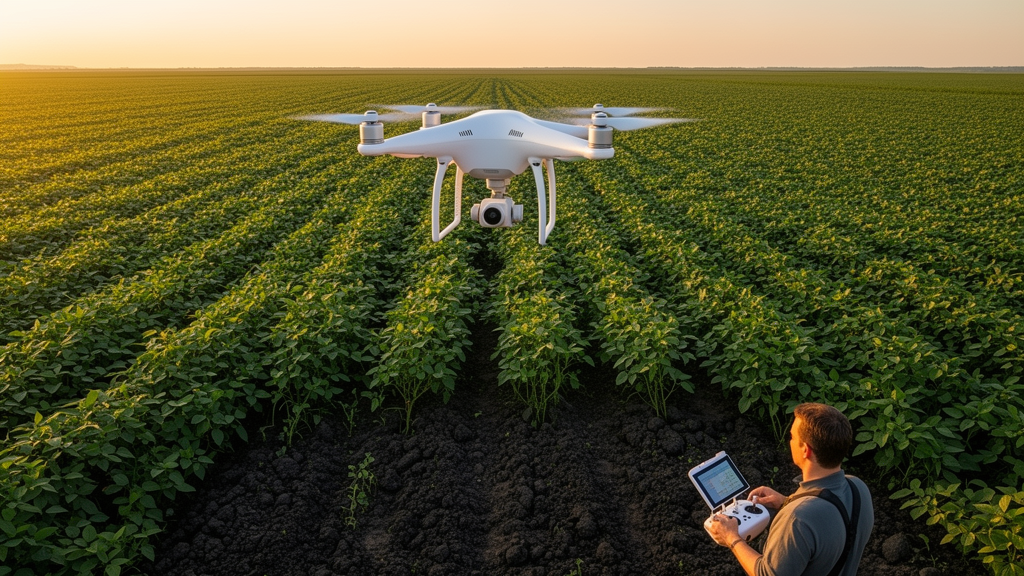
A pair of well-timed drone flights may capture more of what determines a soybean harvest than either flight alone. In a new field-scale study conducted across two sites in Northeast China, researchers combined pre-season bare-soil multispectral imagery from unmanned aerial vehicles with a single pod-filling canopy acquisition to predict soybean yield at the level of individual sample points. Their central result was nuanced but useful: vegetation indices measured from the late-season canopy remained the strongest stand-alone predictor of yield, yet adding spectral indices computed from bare soil captured before crop emergence delivered a modest, statistically supported improvement in prediction accuracy on data the models had never seen.
The study, framed explicitly as a proof of concept, drew on 101 observations from four slope units at two sites, Hailun and Beian, during a single growing season. Across those observations, soybean yield averaged 3438.23 kilograms per hectare with a standard deviation of 842.29, ranging from 1305.82 to 5184.32 kilograms per hectare. Mean soil organic carbon was 25.50 grams per kilogram, and mean sand, silt, and clay contents were 12.24, 53.48, and 34.28 percent, respectively. The team flew one mission over bare soil before the crop emerged and a second in late August 2024, during the field-identified pod-filling period, when the canopy was fully developed and agronomically most informative.
The rationale for the two-flight design rests on a simple limitation of canopy remote sensing. Vegetation indices derived from pod-filling imagery describe crop condition at the moment of acquisition, but once the canopy closes, the soil surface beneath it becomes nearly invisible from above. Soil texture, moisture, and topographic position can shape soybean development throughout the season, and those persistent spatial gradients may not be fully expressed in a single late-season canopy snapshot. A bare-soil flight before emergence offers a window to record the exposed soil surface, although visible and near-infrared soil reflectance is jointly influenced by organic matter, mineral composition, iron oxides, texture, moisture, roughness, residues, and illumination geometry, so bare-soil indices must be treated as soil-associated spectral proxies rather than direct measurements of any single soil property.
Methodological rigor was a defining feature of the analysis. The researchers used random forest regression, an ensemble of randomized regression trees capable of capturing nonlinear relationships and interactions, and applied SHapley additive explanations, or SHAP, to quantify each predictor’s contribution to fitted predictions. Crucially, they guarded against information leakage with a nested validation design: predictor selection and hyperparameter tuning were confined entirely to training data, and performance was assessed only on outer-test samples excluded from all model-development steps. Five predictor scenarios were compared under identical outer splits: pod-filling vegetation spectral indices alone, bare-soil spectral indices alone, and three combinations pairing the canopy indices with bare-soil proxy pools constructed around soil organic carbon, soil texture, or the full bare-soil index set.
The outer-test results told a clear story about relative signal strength. The vegetation-index-only scenario achieved a mean predictive R2 of 0.240 with a root-mean-square error of 695.92 kilograms per hectare, whereas the bare-soil indices alone performed poorly, with a mean predictive R2 of just 0.071 and the highest error of any scenario. All three combined scenarios outperformed the canopy-only baseline at the level of across-repeat means: predictive R2 reached 0.302 with measured soil organic carbon proxies, 0.321 with texture proxies, and 0.325 with the full bare-soil index set, with corresponding root-mean-square errors of 665.10, 658.50, and 656.15 kilograms per hectare. The texture and full-proxy combinations performed nearly identically.
Paired comparisons across the ten identical outer splits confirmed that the gains were genuine, if modest. Adding the complete bare-soil proxy pool increased predictive R2 by an average of 0.0857, improving in eight of ten repeats with a 95 percent bootstrap confidence interval of 0.0185 to 0.1488 and a permutation-test p value of 0.037. Root-mean-square error fell by an average of 39.77 kilograms per hectare, improving in eight repeats, and mean absolute error fell by 54.29 kilograms per hectare, improving in all ten repeats, the most consistent benefit of all. Relative root-mean-square error declined by 1.134 percentage points. The pattern indicates that bare-soil spectral proxies complemented, rather than replaced, the yield information already carried by the pod-filling canopy signal.
The SHAP attribution revealed how the two acquisition periods contributed different components of the predictive signal. Within the best combined scenario, pod-filling LCI and pod-filling NDRE, indices sensitive to canopy chlorophyll, nitrogen status, green leaf area, and structure, recorded the two highest selection-weighted mean absolute SHAP values at 195.4 and 167.5 kilograms per hectare, each retained in seven of ten repeats. Bare-soil NCMI, a normalized contrast between near-infrared and combined red and green reflectance originally developed for crop monitoring, ranked third at 126.4 kilograms per hectare and was retained in nine of ten repeats. Higher canopy index values tended to push predictions upward, while higher bare-soil NCMI values were more often associated with negative contributions. The authors stressed that these are model attributions describing fitted predictions, not causal effects on observed yield, and that the confidence intervals for the leading predictors overlapped.
An important calibration exercise clarified what the bare-soil indices could and could not measure. Proxy models trained to estimate laboratory-measured soil organic carbon achieved a positive mean predictive R2 of 0.543, but the sand-, silt-, and clay-associated proxy models all failed, with negative mean predictive R2 values. Yet texture-associated proxy pools still improved yield prediction when added to the canopy baseline. The researchers explain this apparent paradox by distinguishing two different prediction tasks: estimating a specific laboratory soil property is not the same as detecting a composite soil-surface spectral pattern associated with yield. A multispectral index such as bare-soil NCMI can summarize a reproducible soil-surface state that carries yield-relevant information without acting as a selective measurement of organic carbon, texture, or moisture alone.
The study was equally candid about its limitations. Predictions regressed toward the mean: low-yield locations were systematically overpredicted and high-yield locations underpredicted, a pattern the authors attribute to limited representation of extreme yields and the averaging behavior of regression forests. Adding bare-soil information softened but did not eliminate this compression, reducing low-yield overprediction from 527.86 to 460.76 kilograms per hectare and high-yield underprediction from 630.73 to 571.88. More strikingly, when entire slope units were held out in leave-one-slope-unit-out validation, predictive R2 for the best combined scenario dropped from 0.325 to a pooled 0.161, and performance varied wildly among the four held-out slopes, from a predictive R2 of 0.238 at one unit to negative values at another. Selected predictors also showed large distribution shifts between training and test folds under this stricter design, showing that within-study performance did not transfer uniformly to unseen terrain.
The practical takeaway is a compact, leakage-free two-flight framework whose value has been demonstrated within one season, two sites, and 101 observations, but not yet beyond them. The authors argue that independent multi-year, multi-site replication, additional spatial units, varied cultivars and management conditions, and broader weather and soil-moisture environments are needed before operational use, and that predictions should be restricted to conditions adequately represented by the training data. Even so, the demonstration that pre-season bare-soil multispectral imagery contains predictive information useful beyond a single pod-filling canopy acquisition, under validation designs designed to prevent optimistic bias, gives precision agriculture a notably cheap addition to its toolkit: one extra flight before the crop ever breaks the soil.
Subject of Research: UAV-based soybean yield prediction combining bare-soil and pod-filling canopy spectral indices
Article Title: Pre-season bare-soil spectral proxies complement pod-filling canopy indices for field-scale soybean-yield prediction from UAV imagery
Article References: Zhao, Y., Tian, Z., Ma, R., & Liang, Y. (2026). Pre-season bare-soil spectral proxies complement pod-filling canopy indices for field-scale soybean-yield prediction from UAV imagery. iScience, 29(11), Article 118045. https://doi.org/10.1016/j.isci.2026.118045
Image Credits: AI Generated
DOI: 10.1016/j.isci.2026.118045
Keywords: soybean, yield prediction, UAV remote sensing, bare-soil spectral proxies, random forest, SHAP, multispectral imagery, Northeast China, pod-filling stage, nested validation, spatial transfer, precision agriculture
Cite Scienmag News
Alan Morgan. (October 26, 2026). Two Drone Flights, One Better Forecast: Bare-Soil Imagery Boosts Soybean Yield Prediction. Scienmag. https://scienmag.com/two-drone-flights-one-better-forecast-bare-soil-imagery-boosts-soybean-yield-prediction/
Alan Morgan. "Two Drone Flights, One Better Forecast: Bare-Soil Imagery Boosts Soybean Yield Prediction." Scienmag, 26 October 2026, https://scienmag.com/two-drone-flights-one-better-forecast-bare-soil-imagery-boosts-soybean-yield-prediction/. Accessed 26 October 2026.
Alan Morgan. "Two Drone Flights, One Better Forecast: Bare-Soil Imagery Boosts Soybean Yield Prediction." Scienmag. October 26, 2026. https://scienmag.com/two-drone-flights-one-better-forecast-bare-soil-imagery-boosts-soybean-yield-prediction/


