


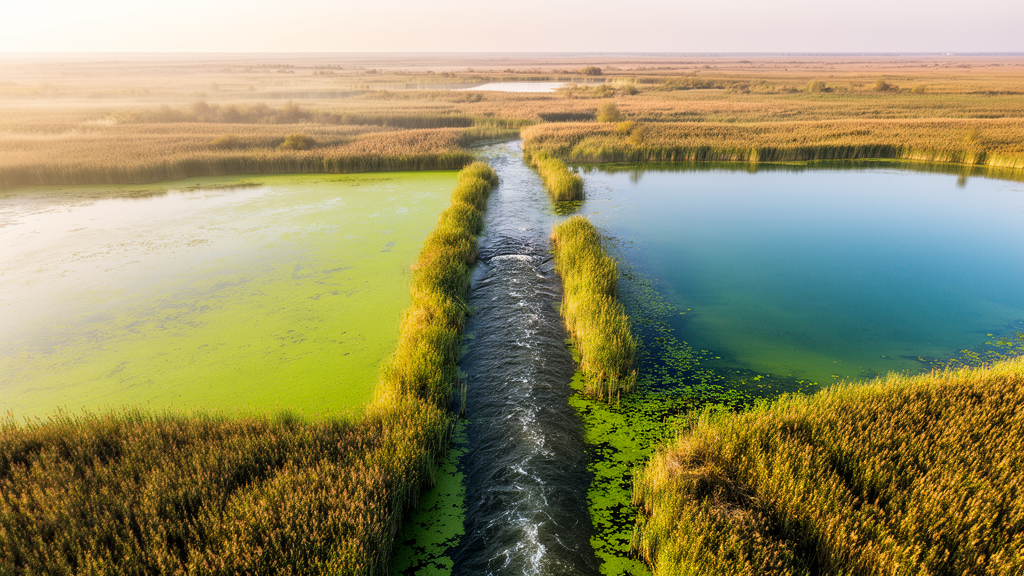
Deep in the Danube Delta, where Europe’s second-longest river fans out into a labyrinth of channels before reaching the Black Sea, two shallow lakes are quietly telling scientists how water moves nutrients through one of the continent’s most valuable wetland ecosystems. A new five-year study has compared nutrient concentrations in Lake Parcheș, sitting in the pre-deltaic zone near the city of Tulcea, and Lake Fortuna, embedded deep within the delta’s fluvial network. The findings, published in Scientific Annals of the Danube Delta Institute, show that the way a lake is connected to the river system can matter as much as the pollution entering it, shaping everything from algal bloom risk to the water’s capacity to clean itself.
The research team analysed eight chemical indicators in surface water samples collected seasonally between 2019 and 2023, following standardised protocols under SR ISO 5667-4/2020 for lake sampling. Each spring, summer and autumn campaign yielded one sample and a suite of in-situ measurements per lake, producing fifteen samples per lake over the monitoring period. Winter campaigns were deliberately excluded because ice cover limits access and biological activity slows dramatically. Concentrations of ammonium, nitrite, nitrate, total nitrogen, phosphate and total phosphorus were determined by molecular absorption spectrophotometry, a wet-chemical technique that converts target nutrients into intensely coloured compounds before measurement on a UV-VIS PerkinElmer Lambda 650 S spectrophotometer across wavelengths from 190 to 900 nanometres. Organic fractions of nitrogen and phosphorus were then calculated as the difference between measured total forms and their inorganic counterparts.
The two lakes could hardly be more different in character. Lake Parcheș belongs to the Somova-Parcheș complex, roughly 9,000 hectares of interconnected lakes and channels in the western sector of the Danube Delta Biosphere Reserve, bordered by the Danube River, the Tulcea branch and the Northern Dobrogea Plateau. Its hydrological regime is regulated by fixed intake and discharge structures tied to the Danube, ensuring regular, largely one-way water renewal. Lake Fortuna, by contrast, covers about 900 hectares in the Șontea-Fortuna complex of the fluvial-deltaic zone, lying between zero and half a metre below sea level. The Șontea Channel flows through it as its primary hydrological artery, while connections to the Sulina branch and the Great M channel create a dynamic, naturally regulated exchange of water and everything it carries.
Physical measurements revealed how these contrasting regimes play out on the ground. Lake Parcheș ranged from a minimum average depth of 60 centimetres in 2022, suggesting drier conditions, to a maximum of 186 centimetres in 2023, likely reflecting increased inflow. Transparency fluctuated considerably, from as low as 20 percent between 2019 and 2021, possibly driven by algal blooms and organic-rich inflows, to above 50 percent in 2021 and 2022. Fortuna’s average depth varied more narrowly, between 116 and 153 centimetres, but its transparency showed striking swings, dipping to 30 to 51 percent in some years and climbing to 67 to 74 percent in 2020 and 2022, probably thanks to efficient water exchange that allowed sediments to settle.
Dissolved oxygen told an equally revealing story. Every recorded value in both lakes exceeded the 7 milligrams per litre threshold of the second water quality class, but Parcheș consistently outperformed its deltaic counterpart. Parcheș annual averages ranged from 10.27 to 11.41 milligrams per litre, indicating stable and favourable oxygenation throughout the period, while Fortuna’s values were lower and more variable, from 7.86 milligrams per litre in 2019 to 10.76 in 2023. Water temperature also diverged, with Parcheș averaging between 14.7 and 18 degrees Celsius and Fortuna between 9.3 and 17.6 degrees, reflecting the distinct climatic and hydrological influences acting on each system.
The nitrogen results exposed the sharpest contrast between the two lakes. Ammoniacal nitrogen in Parcheș showed a declining trend across the monitoring period, staying well below the 0.4 milligrams per litre Class I threshold established by Romanian Order 161/2006, suggesting reduced nutrient inputs or improved internal nitrogen cycling. Fortuna, by contrast, oscillated between 0.058 and 0.14 milligrams per litre, likely responding to seasonal nutrient influxes and shifting hydrological connectivity. More dramatically, the intermediate and final products of nitrogen oxidation, nitrites and nitrates, were consistently higher in Fortuna than in Parcheș. The researchers attribute this to Fortuna’s position within the deltaic network, where sinuous channels accumulate and remobilise nutrient-rich suspended matter and fine sediments before delivering them to the lake, whereas Parcheș receives more directly diluted Danube water with lower external nutrient loads.
Phosphorus patterns reinforced the divide. Phosphate concentrations generally complied with Class I standards in both lakes, with a single anomaly in 2019 when Parcheș recorded 0.048 and Fortuna 0.047 milligrams per litre. Parcheș showed a slight decreasing trend over the five years, hinting that its Danube-controlled regime effectively limits nutrient accumulation. Fortuna instead experienced a sharp drop in 2020, possibly reflecting high water exchange and flushing efficiency, followed by a gradual rise through 2023 as reduced connectivity allowed greater phosphorus retention from upstream channels. Total nitrogen ranged from 2.77 to 4.95 milligrams per litre, with both extremes in Parcheș, while total phosphorus peaked at 0.160 milligrams per litre in Parcheș in 2020 and 0.091 in Fortuna in 2019. The nitrogen-to-phosphorus ratio oscillated between 18 and 79 in Parcheș and 36 and 84 in Fortuna, pointing to seasonal and hydrological control over nutrient availability.
Perhaps the most striking finding lay in the organic fractions. In Parcheș, organic nitrogen averaged roughly 97 percent of total nitrogen between 2019 and 2022, falling to 73 percent in 2023, while Fortuna hovered around 75 percent with deviations reaching 85 percent in 2022 and 65 percent in 2023. For phosphorus, the organic share averaged 87 percent of the total in the pre-deltaic lake compared with about 56 percent in the fluvial delta zone. This suggests Parcheș maintains a more stable nutrient cycle dominated by organic forms with lower external inputs, whereas Fortuna experiences more dynamic cycling influenced by sediment resuspension, channel-borne nutrients and anthropogenic pressures. The team also notes that large colonies of waterbirds may contribute significant nutrient loads through guano deposition, a phenomenon documented in comparable ecosystems.
Taken together, the results classify both lakes as Class II water quality under Order 161/2006, indicating good ecological status, with one exception: Fortuna’s nitrite concentration in 2021 slipped into Class III. The researchers conclude that Fortuna is more susceptible to nutrient accumulation because of its complex channel network and relatively lower freshwater inflow, while Parcheș demonstrates greater self-purification capacity, evidenced by higher dissolved oxygen and a larger proportion of organic nutrient forms. Variations in both lakes were driven primarily by floods, snowmelt and rainfall, compounded by agricultural and urban pressures that hit the deltaic setting harder. The authors stress that continuous monitoring and careful management of nutrient inputs, particularly during flood events and snowmelt periods when loading peaks, will be essential to preserve the ecological health of these water bodies. As nutrient pollution intensifies across Europe’s river deltas, the message from these two lakes is clear: connectivity is destiny, and understanding how water moves through a landscape may be the key to predicting where eutrophication strikes next.
Subject of Research: Comparative nutrient analysis of two freshwater lakes in the pre-deltaic and deltaic areas of the Danube Delta with natural hydrological regimes
Article Title: Comparative nutrient analysis of two freshwater lakes located in the pre-deltaic and deltaic areas with natural hydrological regimes
Article References: Gheorghe, P. B., Țigănuș, M., Seceleanu-Odor, D., Suliman, I., Ibram, O., Matei, N., Burada, A., & Despina, C. (2025). Comparative nutrient analysis of two freshwater lakes located in the pre-deltaic and deltaic areas with natural hydrological regimes. Scientific Annals of the Danube Delta Institute, 30, 107-122. https://doi.org/10.3897/saddi.30.160992
Image Credits: AI Generated
Keywords: Danube Delta, eutrophication, nutrient dynamics, water quality, hydrology, Lake Fortuna, Lake Parcheș, freshwater ecology, Comparative, nutrient, analysis, freshwater
Cite Scienmag News
Gavin Prescott. (October 15, 2026). Two Danube Delta lakes reveal how water flow shapes nutrient pollution risk. Scienmag. https://scienmag.com/two-danube-delta-lakes-reveal-how-water-flow-shapes-nutrient-pollution-risk/
Gavin Prescott. "Two Danube Delta lakes reveal how water flow shapes nutrient pollution risk." Scienmag, 15 October 2026, https://scienmag.com/two-danube-delta-lakes-reveal-how-water-flow-shapes-nutrient-pollution-risk/. Accessed 15 October 2026.
Gavin Prescott. "Two Danube Delta lakes reveal how water flow shapes nutrient pollution risk." Scienmag. October 15, 2026. https://scienmag.com/two-danube-delta-lakes-reveal-how-water-flow-shapes-nutrient-pollution-risk/


