


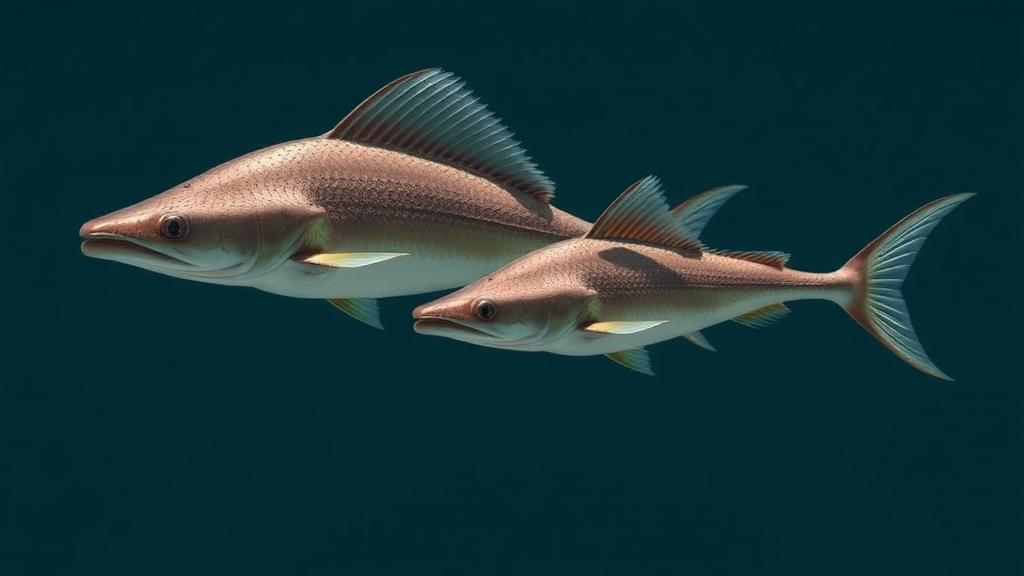
For nearly two centuries, a pair of bizarre ray-finned fishes from the age of dinosaurs have been shuffled back and forth between one genus and two, their identities tangled by lost specimens, wartime destruction, and a case of mistaken fossil fish that fooled some of the greatest palaeontologists of the nineteenth and twentieth centuries. Now a comprehensive new revision, published in the Swiss Journal of Palaeontology, has finally untangled the story of Macromesodon and Apomesodon, two pycnodontiform fishes from the Upper Jurassic and lowermost Cretaceous of England, France, and Germany. The verdict: they are definitively two separate genera, and the differences between them are far stranger and more spectacular than anyone realized, thanks in part to ultraviolet photography that revealed hidden anatomical details invisible under normal light.
Pycnodontiformes were a successful group of neopterygian fishes known for their deep, disc-shaped bodies and specialized crushing dentitions, which they used to feed on hard-shelled prey such as snails, clams, and sea urchins. The basal members of this order have long frustrated researchers because their phylogenetic relationships remain only partially understood. The new study, authored by Martin Ebert, focuses on two little-known genera: Macromesodon Blake, 1905, with its type species Macromesodon macropterus, and Apomesodon Poyato-Ariza & Wenz, 2002, with its type species Apomesodon gibbosus. Both were originally named by Louis Agassiz in the 1830s and 1840s as species of the genus Gyrodus, based on holotypes from the Graf Münster collection.
The nomenclatural saga behind these fishes reads like a detective story. In 1851, Johannes Wagner described and figured both species under the genus name Mesodon, separating them from Gyrodus mainly on the basis of dentition differences. But Mesodon Wagner, 1851 turned out to be preoccupied by Mesodon Rafinesque, 1831, a gastropod, so Blake replaced it with Macromesodon in 1905. Woodward then separated the two taxa into different genera in 1918, placing gibbosus in his new genus Eomesodon and leaving macropterus in Mesodon, probably unaware of Blake’s name change. Worse, Woodward confused the holotype of macropterus, which had been moved to Munich, with entirely different specimens from the Solnhofen Archipelago held in the Natural History Museum in London. Those misidentified specimens actually belong to Turbomesodon relegans, a member of the family Pycnodontidae, meaning that nearly every figure published under the name Macromesodon macropterus before 2004 depicted the wrong fish.
The confusion did not end there. Poyato-Ariza and Wenz created the genus Apomesodon for gibbosus in 2002, only to unite it again with Macromesodon in 2004, treating Apomesodon as a junior synonym. Ebert and colleagues disagreed in 2017, and the present revision now firmly rejects the union of the two genera. The main differences between Macromesodon and Apomesodon lie in the dentition, the prominence of the dorsal apex, the scale pattern, the shape and ornamentation of the body scales, and the articulation of the neural arches and spines. Macromesodon macropterus is a small fish, with all twenty known specimens measuring between 42 and 165 millimeters in total length. Apomesodon gibbosus, by contrast, is a giant among pycnodontiformes, reaching up to 65 centimeters in total length, making it one of the largest known members of the entire order.
The scale patterns alone are enough to separate the two genera. Macromesodon displays a loricate scale pattern with 12 to 13 transverse scale rows of fully developed scales in the anterior part of the body, while the posterior part of the body is completely naked, bearing only irregularly scattered sclerites. Apomesodon, on the other hand, has 17 to 22 transverse scale rows of complete scales in the anterior body, combined with rows of reduced scales, called scale bars, in the posterior part. The ornamentation differs just as dramatically: in Macromesodon, the scales and some head bones carry a pattern of honeycomb-shaped depressions, whereas in Apomesodon the scales and most head bones are covered with fine granulations, small spines, or knobs. These differences in scale architecture and surface texture are consistent across specimens of all sizes and from all localities, providing robust evidence that the two genera are genuinely distinct rather than merely ontogenetic variants of a single taxon.
The dentition provides equally compelling technical distinctions. Macromesodon has five rows of teeth on the vomer, with the teeth of the characteristic median row being curved, bean-shaped, and clearly reniform, approximately three times longer than deep, each bearing an elongated depression along almost its entire length with slightly granulated sides. The inner teeth of the paired prearticulars are elongated as well, and all teeth carry a slight central depression with slightly serrated edges. Apomesodon also has five vomerine tooth rows, but the middle row carries large, oval teeth while the outer rows carry much smaller, nearly circular teeth. The prearticulars of Apomesodon have five to six rows of teeth, with the second or third row carrying comparably very large, oval teeth surrounded by rows of small, circular teeth. Unworn teeth in Apomesodon show a slight granulation and a median elevation, a texture quite different from the finely furrowed surfaces described by Wagner himself in 1851 for Macromesodon.
The ultraviolet photography deployed in the study produced some of the most striking results. Under UV light, previously unknown characters became visible, including tiny sclerites and spines of the skin. In Macromesodon, star-shaped sclerites with four to eight radii and a hole in the center cover the anterior part of the cranium, the gular region, and the posterior body up to between the bases of the dorsal and anal fins. In many specimens, a thin spine rises from the center of each sclerite, sometimes reaching twice the length of the sclerite itself. Similar hidden details emerged in Apomesodon, where UV photos revealed the reduced squamation of the posterior body part in the holotype, showing scale rows with reduced scales where normal light shows only a featureless surface. The UV images also exposed the sensory canal systems of the cranium in unprecedented detail, including infraorbital sensory tesserae, the ethmoid commissure, and even a small oval bone of unknown origin ornamented by six round indentations in one specimen from the Blumenberg locality.
The revision also assigns further taxa to these two genera for the first time. Macromesodon arcuatus, from the lowermost Cretaceous Purbeck Formation of Swanage, Dorset, England, is newly combined with Macromesodon, its dentition closely resembling that of Coelodus jourdani from Cerin, France, which is now recognized as a junior synonym of Macromesodon macropterus. Apomesodon gains two additional species: Apomesodon damoni from the Purbeck and Portland of Dorset, England, and Apomesodon granulatus from the Upper Jurassic near Hanover, Germany, known from over 220 isolated jaws in the Göttingen collection alone. Remarkably, most of these Hanover jaws show pathological inhomogeneities in the tooth pattern, hinting at some environmental or biological stress affecting these populations. Even Tibetodus gyrodoides from distant localities is provisionally assigned to Apomesodon based on striking similarities in dentition and tooth ornamentation.
The study culminates in a new phylogeny of the Pycnodontomorpha, built from a data matrix of 105 characters and 44 taxa analyzed with PAUP. The cladistic analysis yielded three most parsimonious trees of 663 steps, with a consistency index of 0.3967 and a retention index of 0.6552. In the resulting strict consensus tree, Macromesodon is identified for the first time as a monogeneric family, the Macromesodontidae, restricted to a single genus. Apomesodon and Piranhamesodon, the famous fin-eating pycnodont from Ettling, emerge as sister taxa, though the family for this group remains unnamed pending revision of the Brembodontidae and the genus Arduafrons. Intriguingly, the new phylogeny shows that Macromesodontidae, Apomesodon, and Piranhamesodon, all from the Upper Jurassic, are more basal than the Brembodontidae from the Triassic and Lower Jurassic, overturning expectations that Triassic lineages must precede Jurassic ones.
For a group of fishes that once seemed like footnote taxa in the grand pageant of Mesozoic life, Macromesodon and Apomesodon have turned out to be keys to understanding the early evolution of one of the most successful orders of ray-finned fishes. The basal Pycnodontiformes still need more detailed descriptions to clarify their relationships, as the author agrees with Poyato-Ariza that additional basal forms must be described. Separate articles on the Gyrodontidae, Mesturidae, and other basal pycnodontiformes are already in preparation, promising that the Solnhofen Archipelago and its sister localities will continue yielding secrets. With spectacular UV photography now revealing skin spines, sclerites, and sensory canals in dazzling detail, these disc-shaped denizens of the late Jurassic seas are finally getting the recognition they deserve, nearly two hundred years after Agassiz first sketched their teeth in the margins of his monumental Recherches sur les Poissons Fossiles.
Subject of Research: Macromesodon Blake, 1905 and Apomesodon Poyato-Ariza & Wenz, 2002 (Actinopterygii, Pycnodontiformes) from the Jurassic and lowermost Cretaceous of England, France, and Germany
Article Title: Macromesodon Blake, 1905 and Apomesodon Poyato-Ariza & Wenz, 2002 ( Actinopterygii , Pycnodontiformes ) from the Jurassic and lowermost Cretaceous of England, France, and Germany
Article References: Ebert, M. (2026). Macromesodon Blake, 1905 and Apomesodon Poyato-Ariza & Wenz, 2002 (Actinopterygii, Pycnodontiformes) from the Jurassic and lowermost Cretaceous of England, France, and Germany. Swiss Journal of Palaeontology, 145, 97-129. https://doi.org/10.3897/sjp.145.177263
Image Credits: AI Generated
Keywords: Macromesodon, Blake, Apomesodon, Poyato-Ariza, Wenz, Actinopterygii, Pycnodontiformes, Jurassic, lowermost, Cretaceous, England, France
Cite Scienmag News
Gavin Prescott. (October 18, 2026). Two Ancient Ray-Finned Fish Genera Are Not the Same After All. Scienmag. https://scienmag.com/two-ancient-ray-finned-fish-genera-are-not-the-same-after-all/
Gavin Prescott. "Two Ancient Ray-Finned Fish Genera Are Not the Same After All." Scienmag, 18 October 2026, https://scienmag.com/two-ancient-ray-finned-fish-genera-are-not-the-same-after-all/. Accessed 18 October 2026.
Gavin Prescott. "Two Ancient Ray-Finned Fish Genera Are Not the Same After All." Scienmag. October 18, 2026. https://scienmag.com/two-ancient-ray-finned-fish-genera-are-not-the-same-after-all/


