


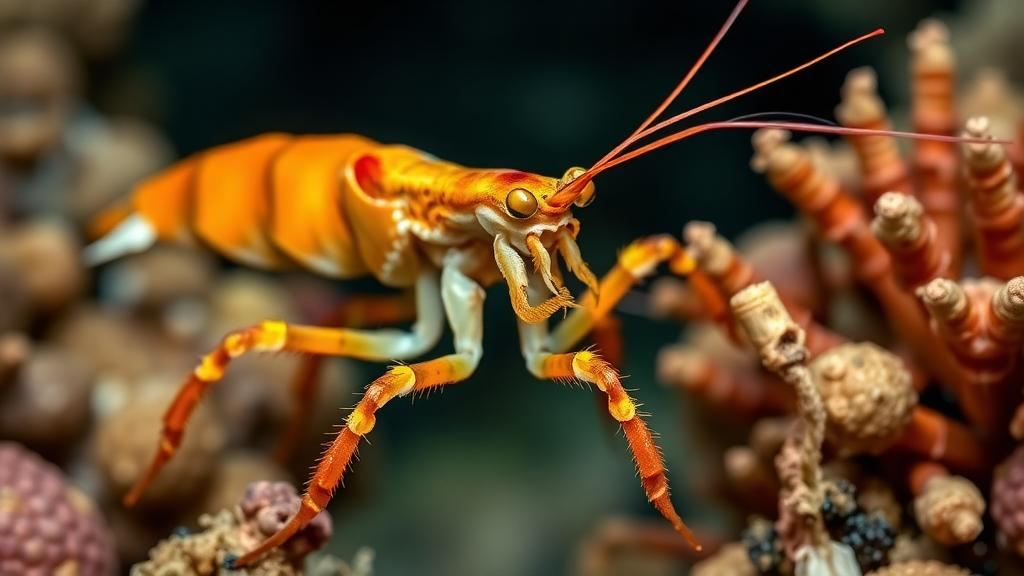
Beneath the rubble of South China Sea reefs lives a group of small, violent predators that scientists have largely overlooked. A new integrative taxonomic study of gonodactylid mantis shrimps has now uncovered substantially underestimated diversity in this biodiversity hotspot, formally describing one striking purplish-red new species, reporting another region first, and delivering fresh molecular evidence that the genus Gonodactylellus is not a natural group at all.
The research, published in the journal Zoosystematics and Evolution, combined detailed morphological examination of 53 specimens collected by SCUBA diving with DNA barcoding of the mitochondrial COI gene and multi-gene phylogenetic reconstruction using mitochondrial genomes and nuclear markers. The team, working from the Marine Biodiversity Museum of the Chinese Academy of Sciences in Qingdao, gathered animals from reef slopes and lagoons by carefully fracturing coral rubble, the cryptic cavities where these small stomatopods shelter.
Mantis shrimps of the order Stomatopoda are among the most celebrated crustaceans in biology, famous for raptorial appendages that smash prey with high-velocity strikes and for compound eyes containing six rows of rectangular mid-band ommatidia that enable hyperspectral vision. Within this order, the family Gonodactylidae functions as a critical predatory component of coral reef ecosystems, yet its phylogenetic relationships remain poorly resolved, particularly in the most species-rich genus, Gonodactylellus.
Gonodactylellus was originally separated from the genus Gonodactylus on morphological grounds, chiefly a significantly smaller body size of less than 55 millimeters total length and narrow ocular scales. Concurrently, Gonodactylus was restricted to five large-sized species, excluding several previously classified small to medium-sized forms. This morphology-based classification, however, has long been challenged by molecular evidence. As early as 2000, analyses of mitochondrial COI sequences revealed significant polyphyly within Gonodactylellus, with several species nesting inside a clade containing Gonodactylus and Gonodactylinus, suggesting that body size variation may reflect ecological niche partitioning rather than phylogenetic divergence.
The South China Sea hosts exceptionally diverse coral reefs, mangroves, and seagrass meadows, yet its stomatopod fauna remains poorly documented. Only ten gonodactylid species had been recorded from coral reef systems of the Nansha Islands, a sharp contrast to more than 40 species known across the tropical Indo-West Pacific. DNA barcoding surveys of the family had previously been limited to Hong Kong coastal waters, leaving most of the South China Sea genetically unexplored. Sampling is compounded by the animals’ small body size and cryptic reef-dwelling behavior, which complicate detection and collection.
To test whether undocumented diversity lurked in the region, the researchers examined 53 specimens representing three gonodactylid genera, fixed in 85 percent ethanol and deposited in the Marine Biodiversity Museum of the Chinese Academy of Sciences. Morphological observation focused on key sclerotized structures, including cephalothoracic morphology and rostral plate configuration, the lateral processes of thoracic segments 5 through 8, and the armature of the telson and uropod. Specimens were grouped into morphotypes based on these characters before molecular work began.
On the molecular side, the team amplified partial COI sequences using universal primers, verified products by agarose gel electrophoresis, and sequenced them bidirectionally on an ABI 3730xl platform. Quality control with a Phred score threshold of 30 or higher, followed by alignment with the MUSCLE algorithm and automated trimming with trimAl, yielded a final 550 base pair COI alignment. For mitochondrial genome sequencing, libraries with 350 base pair inserts were sequenced on the Illumina NovaSeq platform, and mitogenomes were assembled using a COI seed sequence from Gonodactylus platysoma. The concatenated multi-gene dataset, combining 13 protein-coding genes, ribosomal RNAs, and histone H3, reached 17,024 base pairs.
Species delimitation relied on three complementary methods applied to 122 COI sequences: Automated Species Assignment and Partitioning, Automatic Barcode Gap Discovery, and Bayesian Poisson Tree Processes. The results diverged notably, with ABGD identifying 44 molecular operational taxonomic units, ASAP delineating 27, and bPTP supporting 34, figures that exceed the total number of currently described species of Gonodactylus, six, and Gonodactylellus, 25. While such methods may overestimate species diversity, the observed patterns reveal substantial genetic heterogeneity and may indicate additional unrecognized lineages awaiting discovery.
The morphological examination identified seven morphospecies among the 53 specimens. Four matched known taxa: Gonodactylellus caldwelli, Gonodactylellus espinosus, Gonodactylellus erdmanni, and Gonodactylus smithii. Notably, G. caldwelli represents its first recorded occurrence in the South China Sea, extending its known range westward within the tropical western Pacific from Indonesia and Australia. Of the remaining morphospecies, one belonged to the morphologically distinct genus Gonodactylaceus and was excluded from further discussion, while two others, though clearly Gonodactylellus, could not be assigned to any described species and were designated Morphogroup A and Morphogroup B.
All three delimitation methods consistently recognized Morphogroups A and B as distinct species, with phylogenetic positions significantly divergent from known gonodactylids in both maximum likelihood and Bayesian inference trees, supported at 100 bootstrap and 1.00 posterior probability. Integrating morphological and molecular evidence, the team provisionally designated Morphogroup A as Gonodactylellus sp., represented by a single severely damaged specimen from North Island in the Xisha Islands, and formally described Morphogroup B as Gonodactylellus xishaensis sp. nov., collected from the Xisha Islands and named after its type locality.
Gonodactylellus xishaensis sp. nov. is diagnosed by separate rounded ocular scales, a rostral plate with rounded anterolateral angles and divergent anterior lateral margins, an adult raptorial claw dactylus without a proximal notch, and a telson bearing spiniform submedian denticles with intermediate teeth whose apices do not reach the apices of the intermediate denticles. In life, the entire body is purplish-red with unevenly distributed pale yellow spots, and the swollen portion of the telson median carina is orange-red with a light-yellow round spot at its center. The holotype, a 23 millimeter female from Ximen Reef at 35 meters depth, was collected in May 2024, with paratypes from Robert Island, Antelope Reef, Quanfu Reef, and Zhaoshu Dao.
The new species is morphologically similar to Gonodactylellus kume, Gonodactylellus rubriguttatus, and Gonodactylellus micronesicus in sharing a tumid median carina on the telson, short accessory median carinae not extending one-third of the median carina anteriorly, and a telson lacking dorsal ornamentation. It can be distinguished from these relatives by the intermediate denticles of the telson, which do not extend beyond the posterior margin of the intermediate teeth, and by the short intermediate carina of the telson. It further differs from G. kume in the indistinct, small, and irregular lateral lobe on the pleopod 1 endopod, from G. rubriguttatus in the absence of a marginal carina on abdominal somite 6, and from G. micronesicus in its more elevated telson median carina.
The second undescribed taxon, Gonodactylellus sp., exhibits a combination of characters not seen in any described species, including a short accessory median carina of the telson fused posteriorly with the median carina and an anterior submedian carina with a submedian expansion longer than half the median carina. Although its general telson shape is somewhat reminiscent of G. affinis, it differs in that the median and anterior submedian carinae lack acute posterior spines. Due to the absence of key diagnostic structures such as the complete carapace and thoracic somites, the researchers conservatively identified it as Gonodactylellus sp., pending the discovery of additional material.
For phylogenetic reconstruction, the team employed maximum likelihood with IQ-TREE 2.4.0, assessing branch support through 100,000 ultrafast bootstrap replicates, and Bayesian inference with MrBayes 3.2.7a, running two independent Markov Chain Monte Carlo analyses for 10 million generations. Analyses of 122 mitochondrial COI sequences demonstrated that Gonodactylellus is non-monophyletic, with species of Gonodactylus nested within it. All species from the two genera clustered together, subdivided into two subclades: Clade I consisted exclusively of Gonodactylellus snidsvongi and Gonodactylellus barberi with full support, while Clade II encompassed all remaining Gonodactylellus species, notably including all analyzed Gonodactylus species.
Multi-gene analyses using the genus Odontodactylus as outgroup yielded largely congruent topologies, revealing that species of Gonodactylellus and Gonodactylus formed a strongly supported clade within which Gonodactylellus was recovered as paraphyletic. Gonodactylus species formed a distinct subclade nested within the assemblage of Gonodactylellus lineages, indicating a close affinity between the two genera. This combined clade was recovered as sister to representatives of Neogonodactylus, whereas members of Gonodactylaceus represented an earlier-diverging lineage, despite low statistical support for these deeper relationships in the maximum likelihood analysis.
The persistent non-monophyly of Gonodactylellus across datasets of differing taxon coverage and gene marker composition indicates that the current taxonomic framework does not reflect evolutionary history and may require revision. Alternatively, the pattern could reflect a complex evolutionary history potentially involving incomplete lineage sorting, historical hybridization, or morphological convergence. Manning’s 1995 subdivision of the genus Gonodactylus sensu lato into five genera explicitly acknowledged that the classification lacked phylogenetic support, and the new results corroborate earlier molecular evidence that generic boundaries in the family remain substantially unresolved.
Interestingly, Gonodactylus smithii, despite its well-defined diagnostic characters, was split into two molecular operational taxonomic units across all analyses, possibly suggesting cryptic diversity within this taxon. Given limited sample size and insufficient morphological or molecular evidence, the researchers did not pursue detailed discussion, but the observed genetic divergence warrants further investigation with expanded sampling.
The findings underscore the South China Sea as a reservoir of previously underestimated gonodactylid diversity, echoing earlier barcoding surveys in which even a reference database covering 91 percent of known stomatopod species still returned multiple unknown units suspected to be undiscovered new species. The study adds to recently described gonodactylids from the region, following Gonodactylopsis maqqaba from Macclesfield Bank in 2022, suggesting that stomatopod species richness in the South China Sea may be higher than previously recognized.
Future work should prioritize comprehensive sampling in understudied areas of the South China Sea and employ non-invasive techniques such as environmental DNA metabarcoding to minimize ecological disturbance. Inclusion of richer genomic data, such as ultraconserved elements or transcriptomes, integrated with detailed morphological examination, will be necessary to clarify generic-level phylogenetic relationships and the evolutionary history of this remarkable predatory lineage, and to establish the foundational knowledge critical for future conservation planning in one of the ocean’s most threatened biodiversity hotspots.
Subject of Research: Integrative taxonomy and phylogenetics of gonodactylid mantis shrimps in the South China Sea
Article Title: Unveiling hidden gonodactylid diversity in the South China Sea provides insights into non-monophyly of Gonodactylellus ( Crustacea , Stomatopoda , Gonodactylidae )
Article References: Zheng, S., Wang, Y., Zhang, L., Sha, Z., & Cheng, J. (2026). Unveiling hidden gonodactylid diversity in the South China Sea provides insights into non-monophyly of Gonodactylellus (Crustacea, Stomatopoda, Gonodactylidae). Zoosystematics and Evolution, 102(2), 457-469. https://doi.org/10.3897/zse.102.172564
Image Credits: AI Generated
Keywords: mantis shrimp, South China Sea, taxonomy, phylogenetics, Gonodactylellus, marine biodiversity, coral reefs, new species, Unveiling, hidden, gonodactylid, diversity
Cite Scienmag News
Gavin Prescott. (October 18, 2026). Hidden mantis shrimp species in the South China Sea upend mantis shrimp family tree. Scienmag. https://scienmag.com/hidden-mantis-shrimp-species-in-the-south-china-sea-upend-mantis-shrimp-family-tree/
Gavin Prescott. "Hidden mantis shrimp species in the South China Sea upend mantis shrimp family tree." Scienmag, 18 October 2026, https://scienmag.com/hidden-mantis-shrimp-species-in-the-south-china-sea-upend-mantis-shrimp-family-tree/. Accessed 18 October 2026.
Gavin Prescott. "Hidden mantis shrimp species in the South China Sea upend mantis shrimp family tree." Scienmag. October 18, 2026. https://scienmag.com/hidden-mantis-shrimp-species-in-the-south-china-sea-upend-mantis-shrimp-family-tree/


