


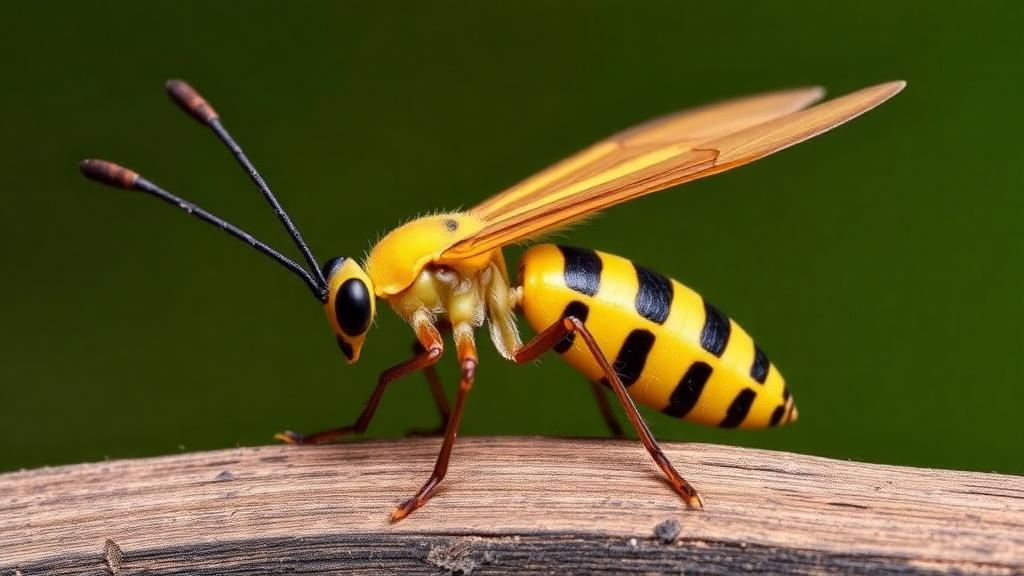
Somewhere in a suburban Auckland garden, a large, pale, winged insect is stalking moths in the dark. It looks like a wētā that somehow grew wings — an impossibility in New Zealand, where no native raspy cricket has ever existed. Yet for more than three decades, this Australian impostor has been living, breeding and spreading across the northern half of the country without so much as a proper scientific name. A new study in the Journal of Orthoptera Research has finally put a label on the mystery invader: Pterapotrechus salomonoides, a raspy cricket from southern Queensland that is now firmly established in New Zealand and advancing at a remarkable pace.
The story begins in 1990, when one of these striking insects turned up inside a house in Pukekohe, South Auckland. Entomologists recognized it as a member of the genus Pterapotrechus, a small and poorly known group of winged raspy crickets native to Australia, but they could not pin down the species. There was a good reason for that: all three species then known in the genus had been described from a single adult female each, the males were completely unknown, and none had been revised since their original descriptions more than a century ago. One species, P. salomonoides, was even described only in German, tucked away in print where few modern researchers could easily consult it. Even professional entomologists, the new paper notes, struggle to identify these animals.
The author of the new study, D. Hegg of Massey University, took a multi-pronged approach to crack the case. Fresh specimens were collected between 2021 and 2023, both in northern New Zealand and at the species’ type locality on Tamborine Mountain in Queensland, using night spotlighting in forest foliage and an insect net. Nineteen specimens were examined under a stereo microscope, measured with digital calipers, and photographed using focus-stacking equipment. Crucially, the study also involved comparing the New Zealand insects against the original holotypes — the name-bearing museum specimens — held in Adelaide, Oxford and Stockholm.
Two diagnostic features immediately pointed toward P. salomonoides. The female’s subgenital plate is bilobed, shaped like a capital letter M, and her ovipositor is short and heavily recurved upward. The two rival species from Australia’s Northern Territory, by contrast, have a trapezoidal subgenital plate with a double keel and a long, nearly straight ovipositor. Body measurements of the New Zealand specimens matched the P. salomonoides holotype collected on Tamborine Mountain between 1910 and 1913.
The clincher came from genetics. The researcher extracted DNA from leg tissue of six specimens using a Chelex protocol, amplified a 1,040-base-pair fragment of the mitochondrial cytochrome c oxidase I gene, and built a maximum-likelihood gene tree. The sequences from New Zealand crickets fell squarely within the variation of P. salomonoides from Tamborine Mountain and its surroundings. The male terminalia of insects from both countries were identical as well. Together, the morphological and molecular evidence settled it: the insect spreading through New Zealand is Pterapotrechus salomonoides, described originally by Karny in 1929.
In the process, the study achieved another first: the male of the species was formally described for the first time. Males turn out to have a triangular subgenital plate bearing dense, stout spinules along a median keel underneath, and a suranal plate with two darkened, cat’s-ear-shaped lobes. The new description is based on ten males and nine females, with males averaging about 25.9 millimeters in body length and females slightly larger at 27.6 millimeters. Both sexes carry well-developed wings, with the hindwings on average about six percent longer than the forewings — though these are not really wings built for distance. The insect uses them for steering and stabilization while jumping, and even when threatened it prefers to stand its ground or leap rather than take flight.
So how did a poor flier cross the Tasman Sea? The study argues that it almost certainly did not fly. While winged insects such as butterflies occasionally blow across from Australia on westerly winds, a heavy, short-winged cricket jumping rather than flying is a different proposition. The far more likely explanation is that the species traveled as a stowaway in equipment or cargo shipped from Australia — a route consistent with reported interceptions of Australian raspy crickets at the New Zealand border. Its spread pattern within New Zealand supports this human-assisted picture: the insect has reached Waiheke Island, connected to the mainland by up to 37 ferry sailings a day, but has not been recorded on Rangitoto or Tiritiri Matangi, both just three kilometers from Auckland but without the same traffic.
Once established, however, the cricket has needed no help expanding. Drawing on twelve years of citizen-science records from iNaturalist, the study mapped 426 confirmed observations across northern New Zealand. The longest diagonal of the species’ range has been growing at a steady 36.96 kilometers per year — meaning the insect is advancing about 18.5 kilometers per year in every direction. Its distribution now stretches from Cable Bay in Northland down to a line joining Raglan, Hamilton and Tauranga. In Auckland itself, the picture is even more striking. Because the platform’s popularity has exploded, raw counts are misleading; instead the study compared Pterapotrechus observations against all insect observations in the city. That fraction rose six-fold, from 0.14 percent in 2013 to 0.81 percent in 2024, and the share of observers reporting the cricket quadrupled from 2.4 percent to 9.2 percent. Corrected for changing observer effort, the Auckland population density has increased at least five-fold in twelve years — and possibly far more, since the method likely underestimates the true growth.
What is this thriving predator eating? Captive specimens housed in mesh enclosures planted as miniature New Zealand forests revealed an aggressive, predominantly nocturnal hunter. The crickets devoured noctuid and geometer moths, crane flies, katydids, tree wētā nymphs and rhaphidophorids, pouncing with what the author describes as lightning-fast reflexes — in the wild, a nymph was even observed snatching a winged termite out of the air mid-flight. Interestingly, diurnal flies such as blowflies and soldier flies resting motionless at night were ignored, suggesting the hunt is triggered by prey movement. The crickets are not strictly carnivorous: grated apple was readily consumed, though carrot and pet food were refused. And in crowded cages, cannibalism reared its head, with an adult female eating a final-instar male nymph — a reminder of how these predators operate when densities climb.
All of this raises an uncomfortable question for New Zealand’s ecosystems, which evolved without any raspy crickets at all. Anecdotal evidence suggests the species is actually denser in its adopted home than in its native Queensland range, and its predatory appetite for wētā, katydids and other native invertebrates gives conservationists genuine cause for concern. The honest answer, the study concedes, is that nobody yet knows the scale of the impact. Nearly all records come from urban areas and forest margins near human settlements, and it remains unclear whether the cricket is penetrating intact native forest. Future work should analyze the gut contents of wild specimens using chemical and molecular methods and run repeated surveys to track population trends. Meanwhile, one taxonomic loose end remains: the study synonymized P. beta with P. longicornis after comparing their holotypes, but doubts linger over whether P. salomonoides even belongs in the same genus. For now, though, New Zealand’s winged ‘wētā’ finally has a name — and a documented, five-fold population boom to go with it.
Subject of Research: Identification, first male description, and range expansion of the invasive Australian raspy cricket Pterapotrechus salomonoides in New Zealand
Article Title: An Australian raspy cricket established in New Zealand, Pterapotrechus salomonoides ( Orthoptera , Gryllacrididae ), with notes on ecology and first description of the male
Article References: Hegg, D. (2025). An Australian raspy cricket established in New Zealand, Pterapotrechus salomonoides (Orthoptera, Gryllacrididae), with notes on ecology and first description of the male. Journal of Orthoptera Research, 34(1), 77-94. https://doi.org/10.3897/jor.34.134391
Image Credits: AI Generated
Keywords: raspy cricket, Pterapotrechus salomonoides, Gryllacrididae, invasive species, New Zealand, Orthoptera, taxonomy, DNA barcoding, citizen science, iNaturalist, predatory insects, range expansion
Cite Scienmag News
Gavin Prescott. (October 18, 2026). A Winged Australian Cricket Has Been Quietly Conquering New Zealand for 30 Years — And It Just Got Its Name. Scienmag. https://scienmag.com/a-winged-australian-cricket-has-been-quietly-conquering-new-zealand-for-30-years-and-it-just-got-its-name/
Gavin Prescott. "A Winged Australian Cricket Has Been Quietly Conquering New Zealand for 30 Years — And It Just Got Its Name." Scienmag, 18 October 2026, https://scienmag.com/a-winged-australian-cricket-has-been-quietly-conquering-new-zealand-for-30-years-and-it-just-got-its-name/. Accessed 18 October 2026.
Gavin Prescott. "A Winged Australian Cricket Has Been Quietly Conquering New Zealand for 30 Years — And It Just Got Its Name." Scienmag. October 18, 2026. https://scienmag.com/a-winged-australian-cricket-has-been-quietly-conquering-new-zealand-for-30-years-and-it-just-got-its-name/


