


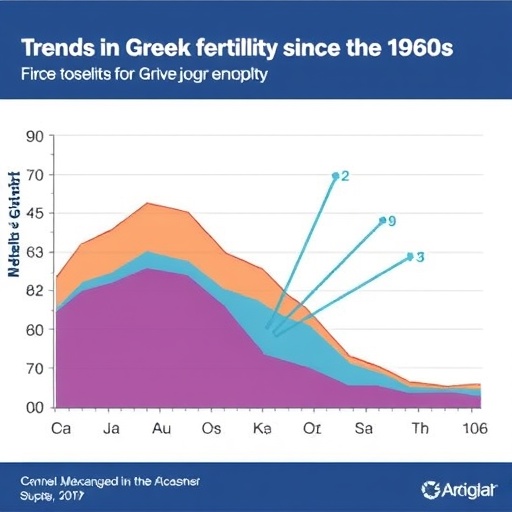
The landscape of fertility in Greece has undergone remarkable transformations since the 1960s, reflecting broader socio-economic and cultural shifts in the nation. This period marked a significant transition from high birth rates to a pattern of decline that challenges conventional paradigms of demographic change. A recent study conducted by Zafeiris, Kontogiannis, and Kotzamanis seeks to unravel this intricate narrative through a comprehensive joinpoint regression analysis that elucidates the trends and patterns of fertility in Greece over the past several decades.
The researchers utilized historical fertility data, employing joinpoint regression to identify the points at which significant changes in birth rates occurred. Doing so allows for a nuanced understanding of the various phases in fertility trends, revealing not only the dynamics at play but also the key factors influencing these changes. By dissecting the data into distinct segments, the analysis highlights critical junctures where socio-economic developments intersect with fertility rates, providing a rich context for understanding the implications of these shifts.
From the onset of the study period in the 1960s, Greece experienced a demographic landscape characterized by relatively high fertility rates. This era was influenced by traditional family structures, strong religious values, and limited access to contraception. The societal norms of the time encouraged larger families, reflecting a common belief in the importance of having multiple children. However, as the global socio-economic context evolved, Greece began to mirror these changes in its fertility patterns.
The research identified a significant decline in fertility rates beginning in the late 1970s, coinciding with numerous societal shifts such as increased urbanization, changes in women’s participation in the workforce, and a growing emphasis on education. The impact of these factors cannot be understated; access to education and employment opportunities dramatically altered the perception of family planning. Women began to prioritize personal and professional development, leading to a desire for smaller family sizes.
Furthermore, the economic crises that punctuated Greek history, particularly in the early 2000s and again during the financial turmoil of the last decade, played a pivotal role in shaping fertility decisions. The study indicates that economic instability often leads couples to postpone childbearing and family expansion. This phenomenon is not restricted to Greece alone but resonates across many European nations facing similar economic hurdles.
The joinpoint regression analysis presented by the researchers underscores these shifts quantitatively, detailing how birth rates began to stabilize in the years following the financial crisis. This stabilization does not imply a return to previous fertility levels but rather suggests a new normal characterized by lower birth rates and changing family dynamics. The findings reveal a complex interplay between economic, cultural, and policy factors that contribute to these evolving trends.
Moreover, public policies aimed at supporting families and incentivizing childbirth have been both reactive and proactive in this changing landscape. Initiatives such as parental leave, child allowances, and early childhood education programs reflect a recognition of the need to address low fertility rates and encourage family growth. The researchers underscore that effective policy measures can have substantial impacts on birth rates when appropriately aligned with societal expectations and economic conditions.
In their analysis, Zafeiris et al. further explore the implications of declining fertility rates on Greek society. Population aging, shifts in the workforce, and the sustainability of social systems present significant challenges. As the proportion of the elderly increases in the population, fewer young people are available to support them, straining economic resources and potential growth. This demographic challenge amplifies the urgency for policymakers to devise innovative solutions that encourage family growth and stability.
In sourcing the data for their joinpoint regression analysis, the researchers employed a plethora of statistical techniques to ensure accuracy and reliability. They meticulously reviewed historical datasets, applying rigorous statistical tools to account for variables that may influence fertility trends. The robustness of their findings offers valuable insights for further research on demographic patterns not only in Greece but also in other European contexts facing similar challenges.
The richness of this study lies in its synthesis of quantitative data with qualitative understanding. By engaging with societal narratives, the research contextualizes the statistical findings within broader societal trends, making the results more relatable and impactful for policymakers, scholars, and the general public alike.
Transitioning from the implications of the findings, the authors argue that understanding the dynamics of fertility in Greece is essential for shaping the future of the nation’s demographic landscape. Educating the public about family planning choices, supporting couples in child-rearing, and addressing economic uncertainties must be priorities moving forward. The study highlights that successful demographic policies should be multifaceted, addressing the range of economic, social, and cultural factors that influence the decision to have children.
The authors conclude that continued research into fertility trends, particularly in light of evolving societal norms and economic conditions, is crucial for anticipating future challenges. By recognizing patterns and potential pitfalls, Greece can cultivate an environment that not only honors family values but fosters the conditions necessary for demographic growth.
The implications of declining fertility in Greece, as explored in this study, resonate beyond the borders of the nation. Understanding these shifts is critical for other countries facing similar trends in fertility decline. As global population dynamics evolve, the lessons learned from Greece’s experience could provide valuable insights for a wide array of nations grappling with demographic transitions.
The joinpoint regression analysis serves as a pivotal tool for unpacking the complexities surrounding fertility trends. Through this robust methodological framework, the researchers present a compelling narrative that connects past data with potential future outcomes. This innovative approach invites further exploration into the causes and consequences of fertility changes, positioning the research as a cornerstone for future studies in demography.
In summary, Zafeiris, Kontogiannis, and Kotzamanis present a vital exploration of Greece’s fertility evolution through a lens of statistical rigor and societal reflection. Their work underscores the importance of recognizing demographic shifts within the context of broader cultural and economic frameworks. As Greece navigates these turbulent waters, the insights gleaned from this research will undoubtedly inform policy and societal discourse for years to come.
Zafeiris, K.N., Kontogiannis, G. & Kotzamanis, B. The evolution of fertility in Greece since the 1960s: a joinpoint regression analysis. J Pop Research 41, 23 (2024). https://doi.org/10.1007/s12546-024-09343-0
Cite Scienmag News
Courtney Benton. (December 10, 2025). Trends in Greek Fertility Since the 1960s. Scienmag. https://scienmag.com/trends-in-greek-fertility-since-the-1960s/
Courtney Benton. "Trends in Greek Fertility Since the 1960s." Scienmag, 10 December 2025, https://scienmag.com/trends-in-greek-fertility-since-the-1960s/. Accessed 3 September 2026.
Courtney Benton. "Trends in Greek Fertility Since the 1960s." Scienmag. December 10, 2025. https://scienmag.com/trends-in-greek-fertility-since-the-1960s/


